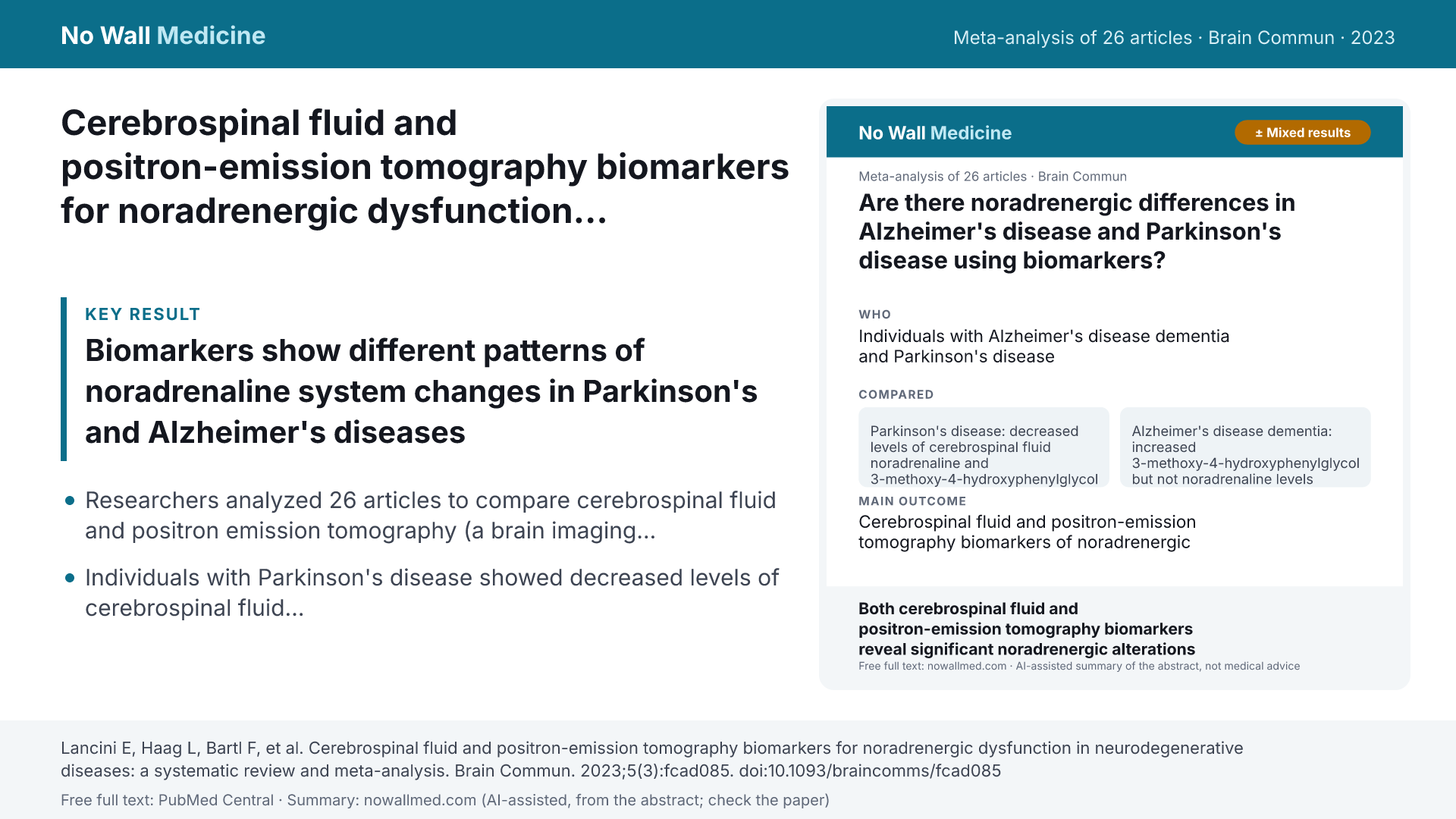
Biomarkers show different patterns of noradrenaline system changes in Parkinson's and Alzheimer's diseases
Cerebrospinal fluid and positron-emission tomography biomarkers for noradrenergic dysfunction in neurodegenerative diseases: a systematic review and meta-analysis
Meta-analysis of 26 articlesMixed results
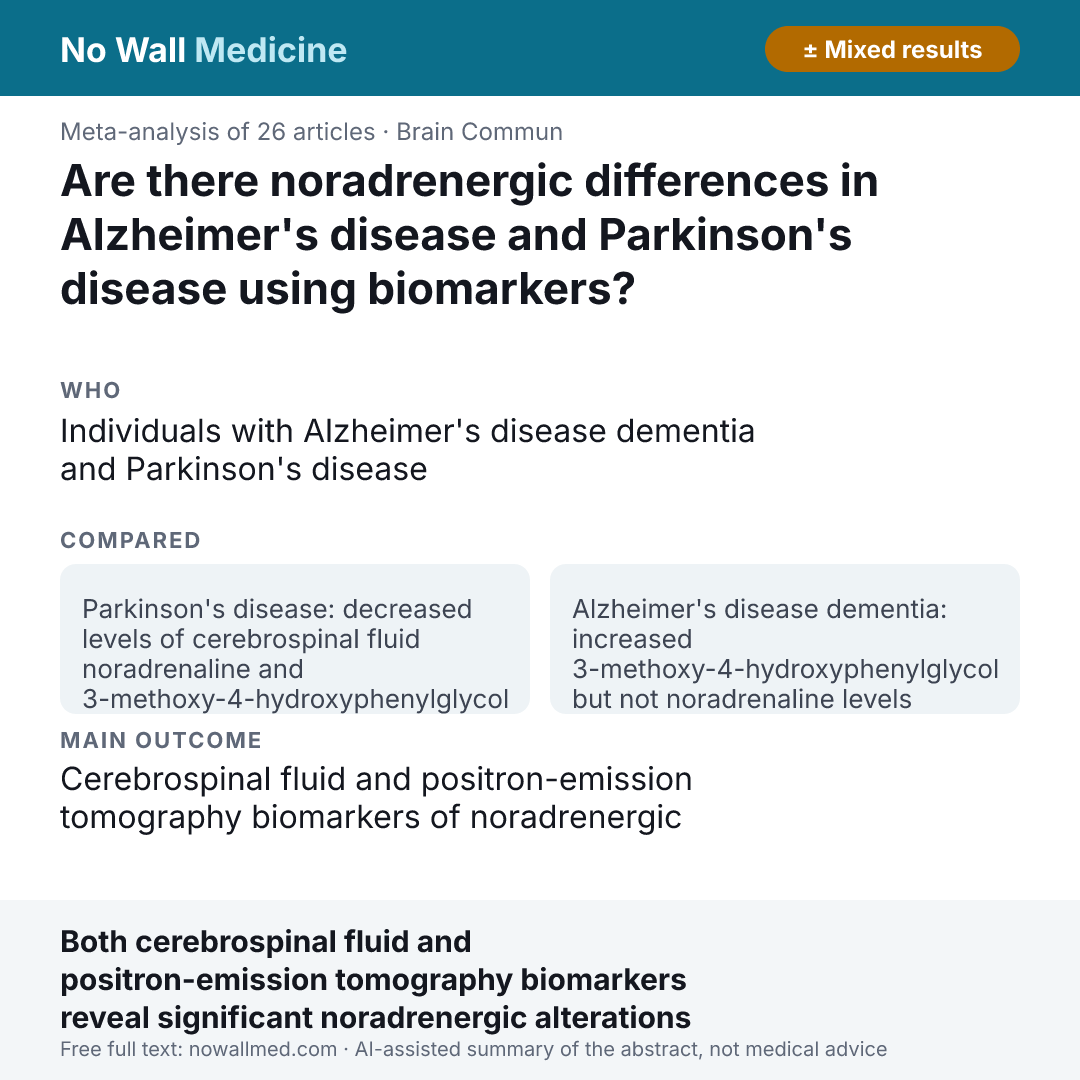
Are there noradrenergic differences in Alzheimer's disease and Parkinson's disease using biomarkers?
Who
Individuals with Alzheimer's disease dementia and Parkinson's disease
Compared
Parkinson's disease: decreased levels of cerebrospinal fluid noradrenaline and 3-methoxy-4-hydroxyphenylglycol and hypothalamus noradrenaline transporters availability
Alzheimer's disease dementia: increased 3-methoxy-4-hydroxyphenylglycol but not noradrenaline levels
Main outcome
Cerebrospinal fluid and positron-emission tomography biomarkers of noradrenergic dysfunction
Bottom line: Both cerebrospinal fluid and positron-emission tomography biomarkers reveal significant noradrenergic alterations in Parkinson's disease and Alzheimer's disease dementia.
Limitation: Further studies are required to understand how these biomarkers are associated to clinical symptoms and pathology.
Brain Commun · 2023-03-29 · Save PNG
Clinical question: Are there noradrenergic differences in Alzheimer's disease and Parkinson's disease using biomarkers?
Key points
- Researchers analyzed 26 articles to compare cerebrospinal fluid and positron emission tomography (a brain imaging technique) biomarkers in Parkinson's disease and Alzheimer's disease dementia.
- Individuals with Parkinson's disease showed decreased levels of cerebrospinal fluid noradrenaline, 3-methoxy-4-hydroxyphenylglycol, and noradrenaline transporter availability in the hypothalamus compared to controls.
- In Alzheimer's disease dementia, 3-methoxy-4-hydroxyphenylglycol levels were increased compared to controls, but noradrenaline levels were not.
Headline and key points written with AI from the paper’s abstract, with every number checked against it. Read the paper before relying on them.
Was this summary helpful?
Headline, design, result, key points, caveat and citation as plain text.
Cite this article
Lancini E, Haag L, Bartl F, et al. Cerebrospinal fluid and positron-emission tomography biomarkers for noradrenergic dysfunction in neurodegenerative diseases: a systematic review and meta-analysis. Brain Commun. 2023;5(3):fcad085. doi:10.1093/braincomms/fcad085
Spotted a mistake? Suggest a correction