Review of clinical trials shows cerebrospinal fluid pressure monitoring is feasible for spinal cord compression
Cerebrospinal fluid pressure dynamics as a biomechanical marker for quantification of spinal cord compression: Conceptual framework and systematic review of clinical trials
Systematic reviewBenefit found
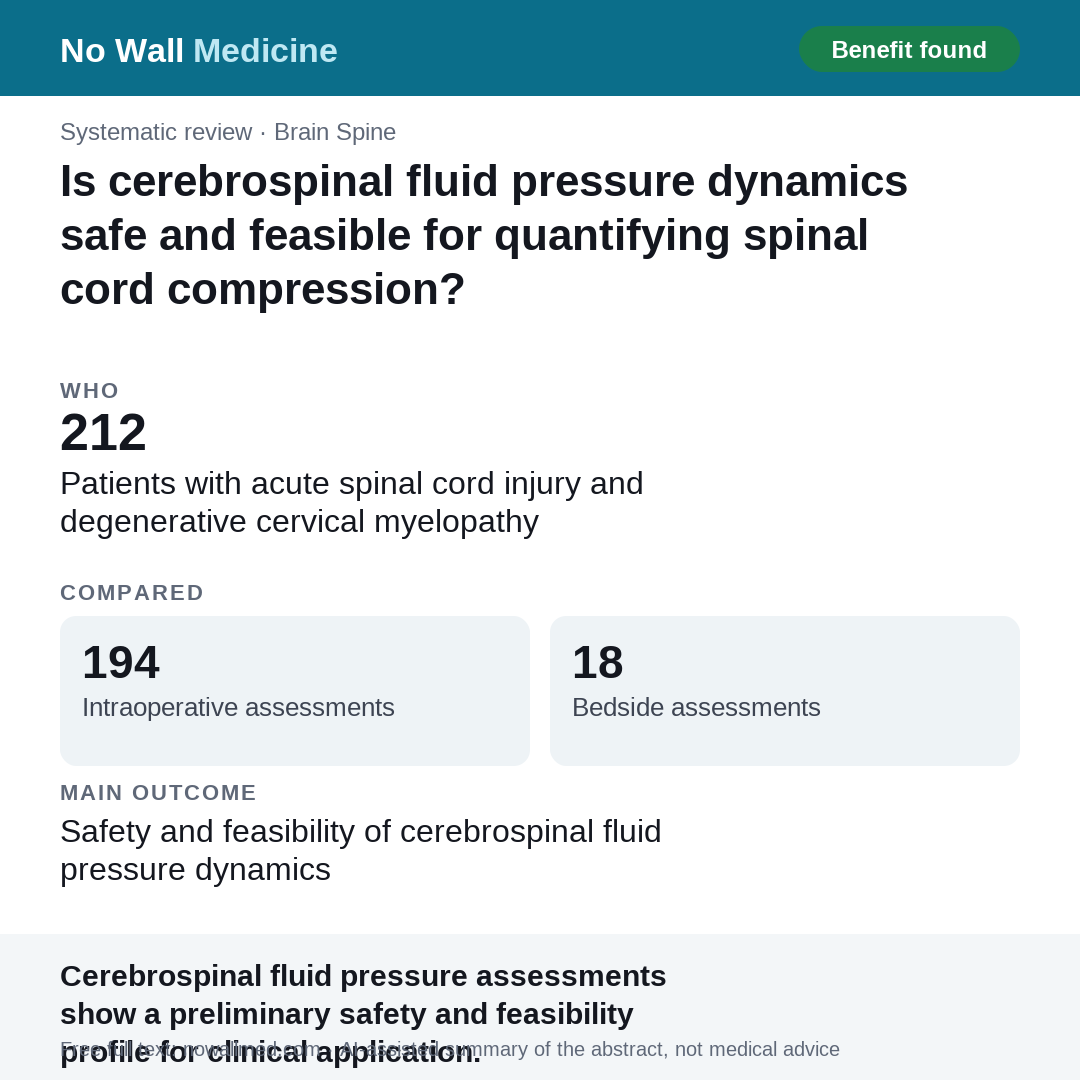
Is cerebrospinal fluid pressure dynamics safe and feasible for quantifying spinal cord compression?
Who
212
Patients with acute spinal cord injury and degenerative cervical myelopathy
Compared
194Intraoperative assessments
18Bedside assessments
Main outcome
Safety and feasibility of cerebrospinal fluid pressure dynamics
Bottom line: Cerebrospinal fluid pressure assessments show a preliminary safety and feasibility profile for clinical application.
Limitation: Clinical value is not yet determined due to challenges defining critical pressure thresholds.
Brain Spine · 2025-02-12Download image
Clinical question: Is cerebrospinal fluid pressure dynamics safe and feasible for quantifying spinal cord compression?
Why it matters: It is unknown if cerebrospinal fluid pressure dynamics can serve as a reliable biomechanical marker for spinal cord compression or if specific pressure thresholds exist for different diseases.
Key points
- Researchers reviewed 11 papers involving 212 patients to examine the safety and feasibility of measuring cerebrospinal fluid pressure dynamics.
- The adverse event rate associated with the intrathecal catheter, a tube placed in the spinal canal, was 8% (n = 15/194).
- Cerebrospinal fluid pressure was used to calculate spinal cord perfusion pressure in 7/11 studies and to evaluate surgical decompression in 5/11 studies.
Limitation the authors note: The clinical value of these measurements is not yet determined because the interrelation between pressure measures and neuroimaging is not yet proven.
Headline and key points written with AI from the paper’s abstract, with every number checked against it. Read the paper before relying on them.
Cite this article
Kheram N, Bessen MA, Jones CF, Davies BM, Kotter M, Farshad M. Cerebrospinal fluid pressure dynamics as a biomechanical marker for quantification of spinal cord compression: Conceptual framework and systematic review of clinical trials. Brain Spine. 2025. doi:10.1016/j.bas.2025.104211
Spotted a mistake? Suggest a correction
Top studies every Monday
The week’s key trials and guidelines in your specialties, by email. Free.
Get the weekly digest