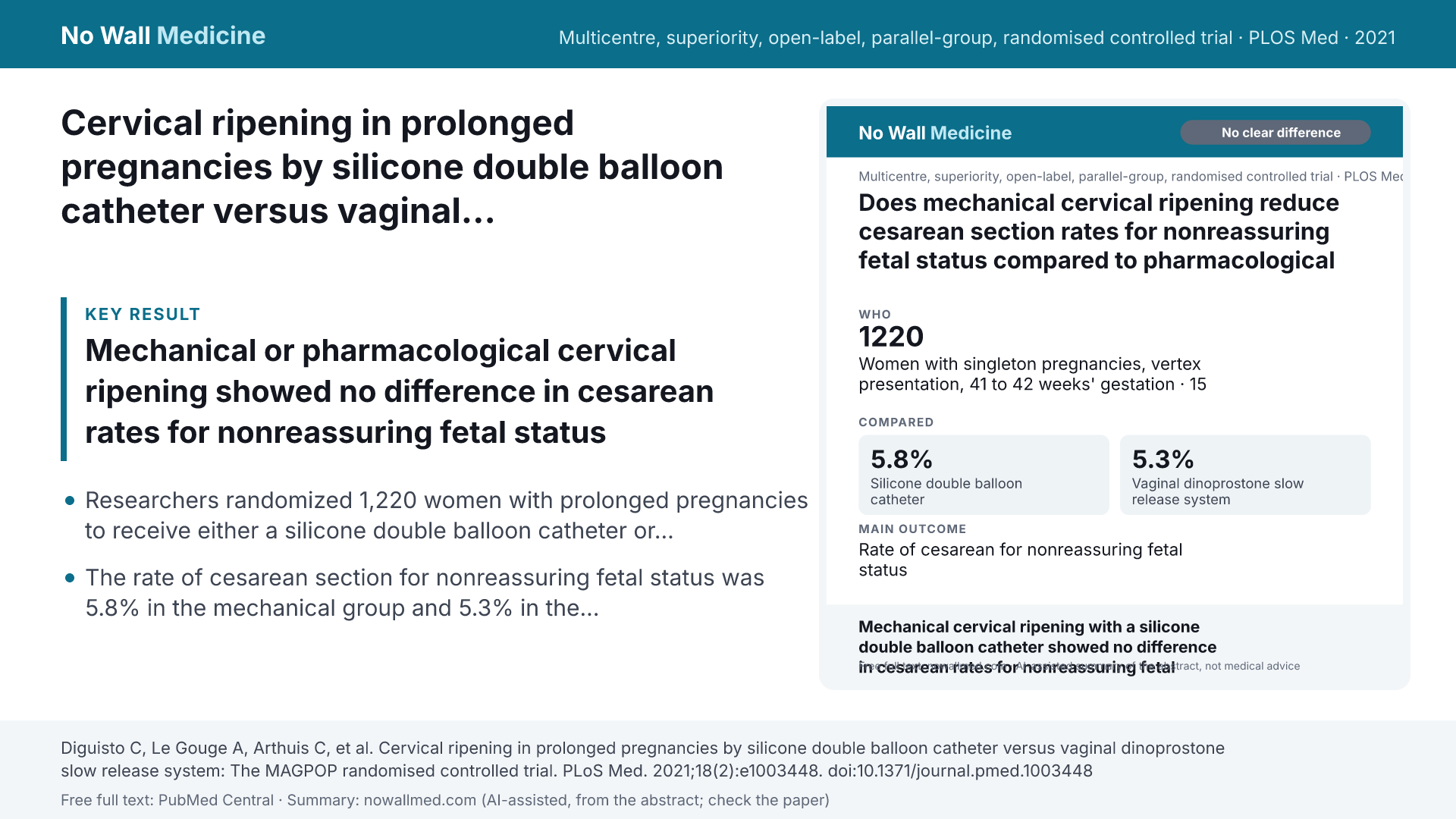
Mechanical or pharmacological cervical ripening showed no difference in cesarean rates for nonreassuring fetal status
Cervical ripening in prolonged pregnancies by silicone double balloon catheter versus vaginal dinoprostone slow release system: The MAGPOP randomised controlled trial
Multicentre, superiority, open-label, parallel-group, randomised controlled trialNo clear difference
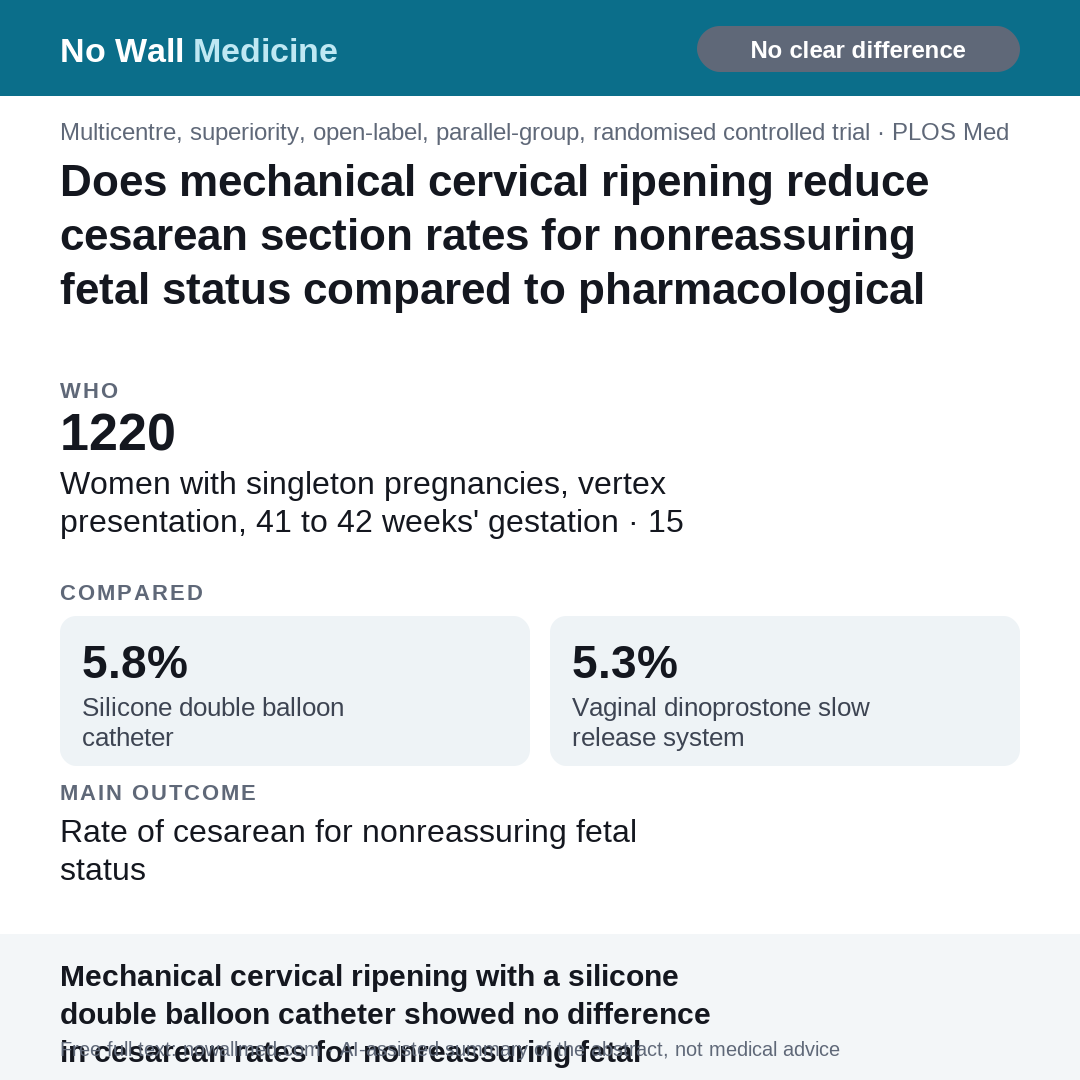
Does mechanical cervical ripening reduce cesarean section rates for nonreassuring fetal status compared to pharmacological ripening?
Who
1220
Women with singleton pregnancies, vertex presentation, 41 to 42 weeks' gestation · 15 French maternity units
Compared
5.8%Silicone double balloon catheter (35/607)
5.3%Vaginal dinoprostone slow release system (32/609)
Main outcome
Rate of cesarean for nonreassuring fetal status
Result: proportion difference: 0.5% (95% CI -2.1% to 3.1%)
Bottom line: Mechanical cervical ripening with a silicone double balloon catheter showed no difference in cesarean rates for nonreassuring fetal status compared to dinoprostone.
Limitation: A low observed rate of cesarean section.
PLOS Med · 2021-02-11Download image
Clinical question: Does mechanical cervical ripening reduce cesarean section rates for nonreassuring fetal status compared to pharmacological ripening?
Why it matters: No specific method is currently recommended for cervical ripening when inducing labor in prolonged pregnancies with an unfavorable cervix.
Key points
- Researchers randomized 1,220 women with prolonged pregnancies to receive either a silicone double balloon catheter or a vaginal pessary for slow release of dinoprostone.
- The rate of cesarean section for nonreassuring fetal status was 5.8% in the mechanical group and 5.3% in the pharmacological group, showing no significant difference.
- The pharmacological group had a shorter median time from cervical ripening to delivery at 23 hours compared to 32 hours in the mechanical group.
Limitation the authors note: The authors noted a low observed rate of cesarean section.
Headline and key points written with AI from the paper’s abstract, with every number checked against it. Read the paper before relying on them.
Was this summary helpful?
Subject terms
Cite this article
Diguisto C, Le Gouge A, Arthuis C, et al. Cervical ripening in prolonged pregnancies by silicone double balloon catheter versus vaginal dinoprostone slow release system: The MAGPOP randomised controlled trial. PLOS Med. 2021. doi:10.1371/journal.pmed.1003448
Spotted a mistake? Suggest a correction