Cervical spinal cord compression in children and adolescents with 22q11.2 deletion syndrome
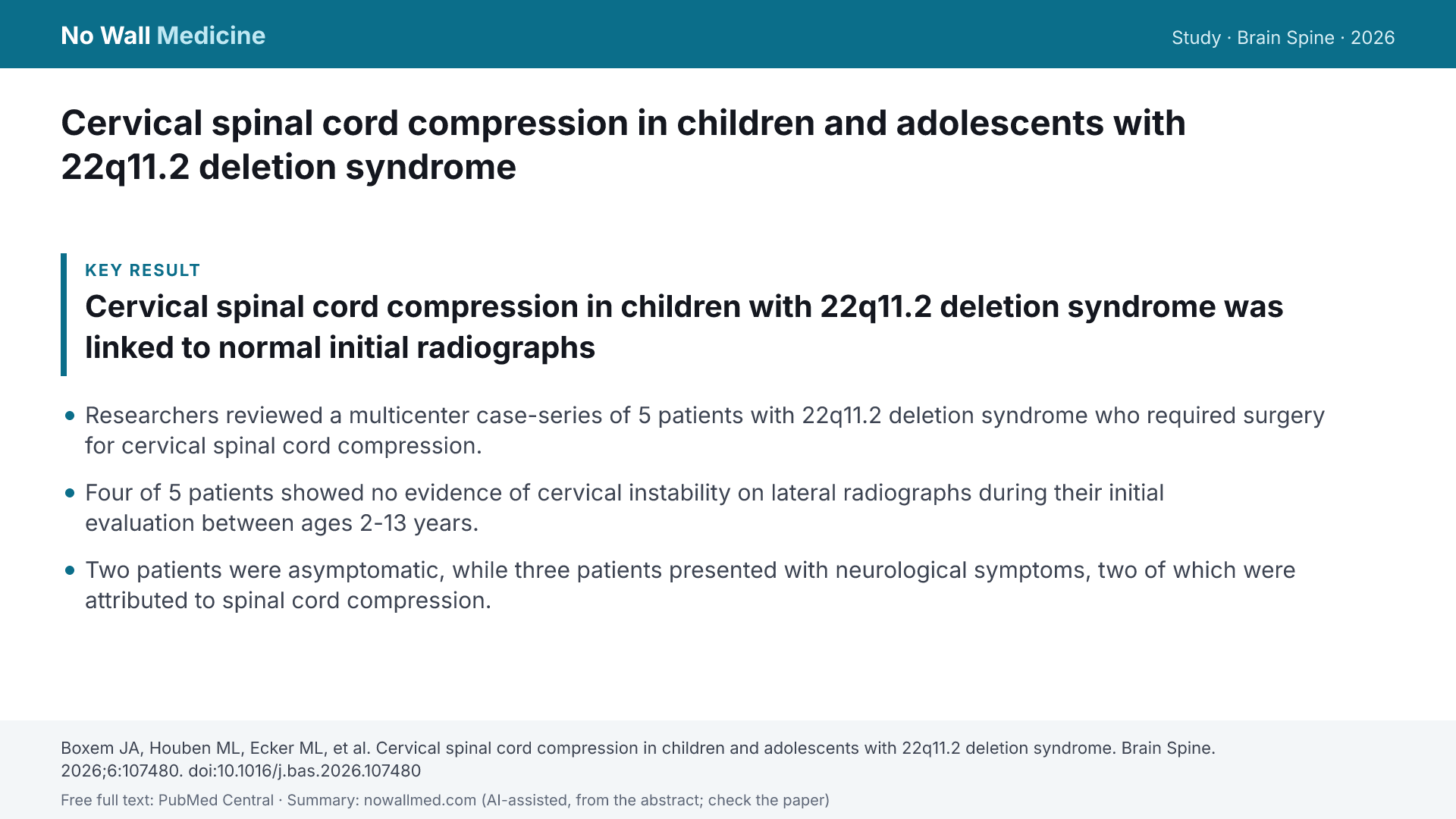
Key result: Cervical spinal cord compression in children with 22q11.2 deletion syndrome was linked to normal initial radiographs
Key points
- Researchers reviewed a multicenter case-series of 5 patients with 22q11.2 deletion syndrome who required surgery for cervical spinal cord compression.
- Four of 5 patients showed no evidence of cervical instability on lateral radiographs during their initial evaluation between ages 2-13 years.
- Two patients were asymptomatic, while three patients presented with neurological symptoms, two of which were attributed to spinal cord compression.
Why it matters: The clinical course and risk of spinal cord compression in patients with 22q11.2 deletion syndrome remain poorly defined.
Limitation the authors note: This study is a retrospective multicenter case-series.
Discussion prompts
- Would these patients look like yours? Who was left out?
- Is the main outcome one that matters to patients?
- Is the difference large enough to change what you do?
Cite: Boxem JA, Houben ML, Ecker ML, et al. Cervical spinal cord compression in children and adolescents with 22q11.2 deletion syndrome. Brain Spine. 2026;6:107480. doi:10.1016/j.bas.2026.107480
Free full text: PubMed Central · Summary and visual abstract: nowallmed.com/a/cervical-spinal-cord-compression-in-children-and-adolescents-with-11ueb6p/ (AI-assisted from the abstract; check the paper before relying on it).