Predicting whether patients stay on antiplatelet medication after heart attack remains difficult
Challenge in Predicting Persistence to P2Y12 Inhibitors: A Perspective From the ARTEMIS Trial
Randomized, controlled trialNo clear difference
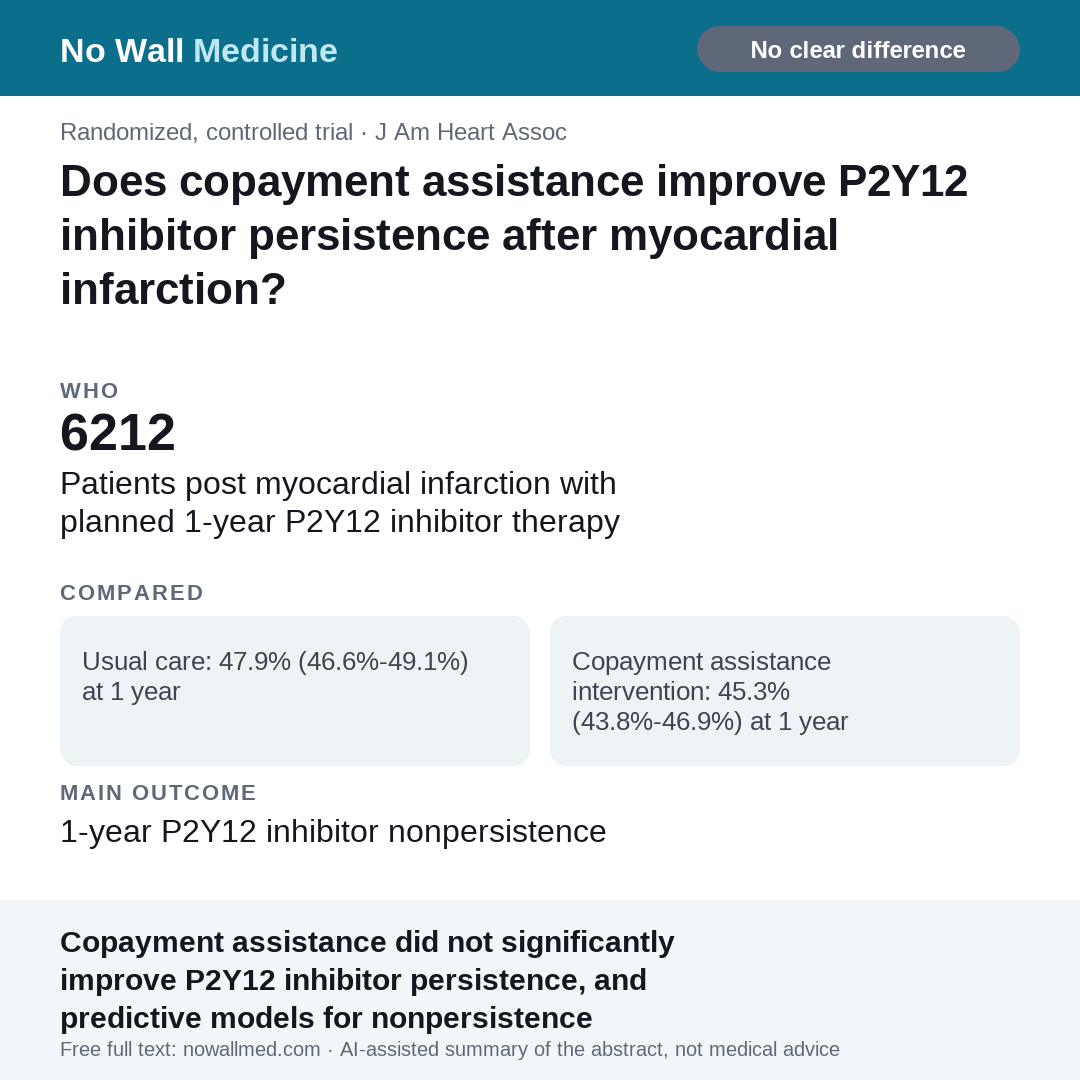
Does copayment assistance improve P2Y12 inhibitor persistence after myocardial infarction?
Who
6212
Patients post myocardial infarction with planned 1-year P2Y12 inhibitor therapy
Compared
Usual care: 47.9% (46.6%-49.1%) at 1 year
Copayment assistance intervention: 45.3% (43.8%-46.9%) at 1 year
Main outcome
1-year P2Y12 inhibitor nonpersistence
Bottom line: Copayment assistance did not significantly improve P2Y12 inhibitor persistence, and predictive models for nonpersistence performed poorly.
Limitation: Models predicting persistence with P2Y12 inhibitor therapy performed poorly.
J Am Heart Assoc · 2023-06-10Download image
Clinical question: Does copayment assistance improve P2Y12 inhibitor persistence after myocardial infarction?
Why it matters: Current risk models have limited ability to predict which patients are at risk of stopping their P2Y12 inhibitor medication prematurely.
Key points
- Researchers studied 6212 patients after a heart attack to measure how many continued taking P2Y12 inhibitor antiplatelet therapy for one year.
- Nonpersistence rates were 23.8% (95% CI, 22.7%-24.8%) at 30 days and 47.9% (46.6%-49.1%) at 1 year in the usual care group.
- A predictive model using 53 variables had a C-index of 0.63, and adding patient-reported beliefs did not improve discrimination to a C-index of 0.62.
Headline and key points written with AI from the paper’s abstract, with every number checked against it. Read the paper before relying on them.
Was this summary helpful?
Subject terms
Cite this article
Rymer JA, Wegermann ZK, Kaltenbach LA, Webb LE, Peterson ED, Wang TY. Challenge in Predicting Persistence to P2Y12 Inhibitors: A Perspective From the ARTEMIS Trial. J Am Heart Assoc. 2023. doi:10.1161/JAHA.122.029063
Spotted a mistake? Suggest a correction
Top studies every Monday
The week’s key trials and guidelines in your specialties, plus any topics you follow. By email, free.
Get the weekly digest