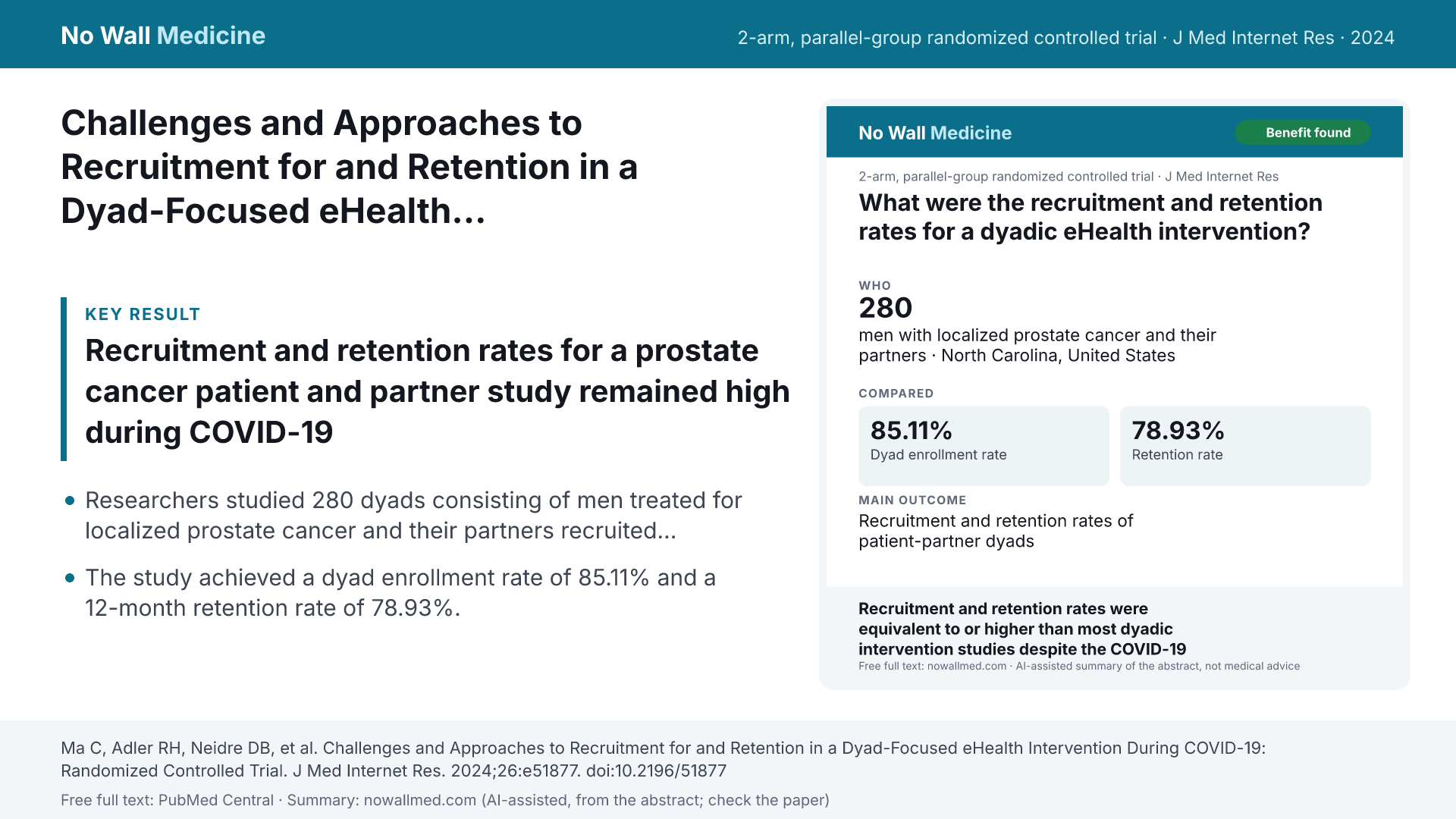
Recruitment and retention rates for a prostate cancer patient and partner study remained high during COVID-19
Challenges and Approaches to Recruitment for and Retention in a Dyad-Focused eHealth Intervention During COVID-19: Randomized Controlled Trial
2-arm, parallel-group randomized controlled trialBenefit found
What were the recruitment and retention rates for a dyadic eHealth intervention?
Who
280
men with localized prostate cancer and their partners · North Carolina, United States
Compared
85.11%Dyad enrollment rate (95% CI 81.3%-88.9%)
78.93%Retention rate (95% CI 74.2%-83.7%)
Main outcome
Recruitment and retention rates of patient-partner dyads
Bottom line: Recruitment and retention rates were equivalent to or higher than most dyadic intervention studies despite the COVID-19 pandemic.
J Med Internet Res · 2024-12-03 · Save PNG
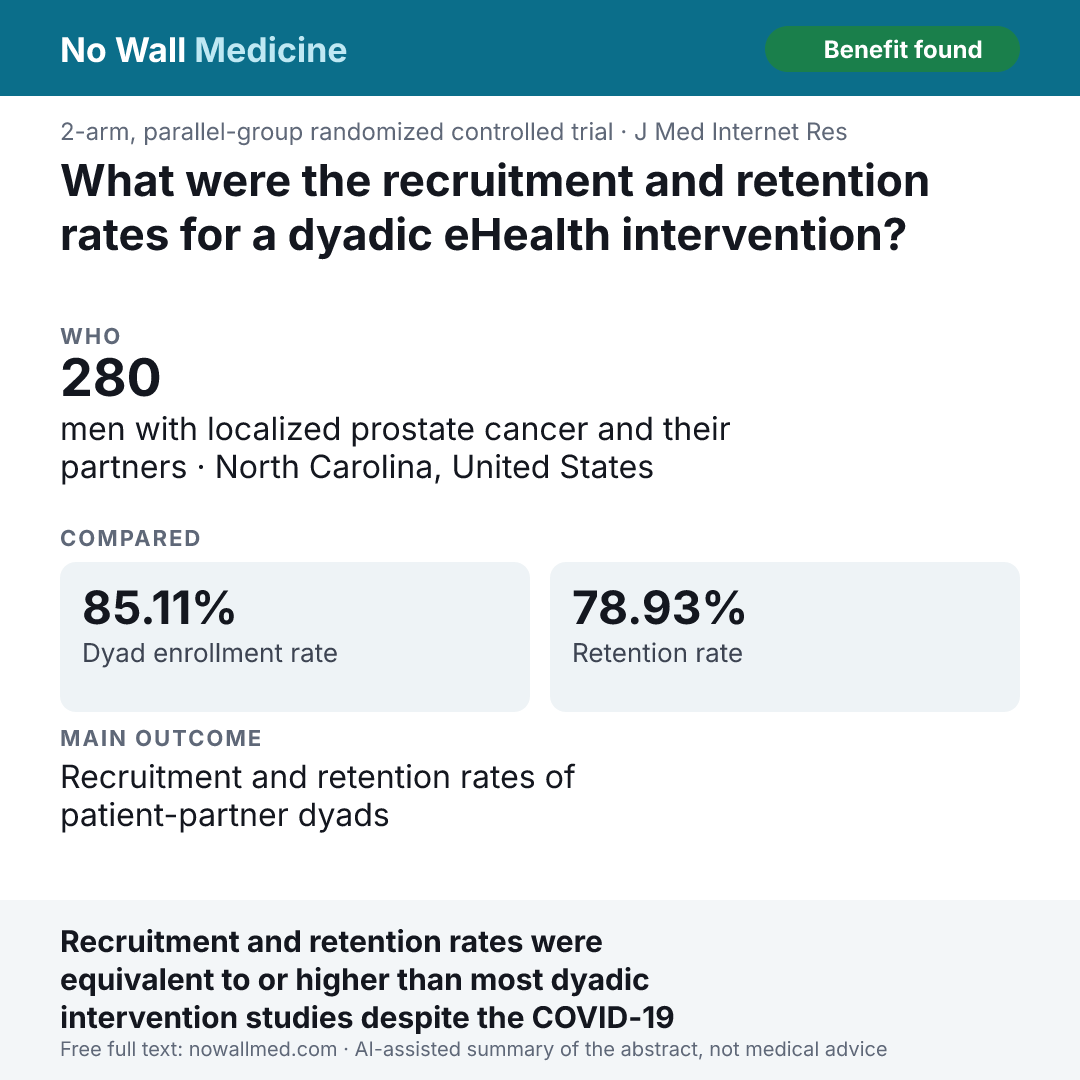
Clinical question: What were the recruitment and retention rates for a dyadic eHealth intervention?
Why it matters: Family-based randomized controlled trials often face difficulties with recruiting and keeping participants involved in the study.
Key points
- Researchers studied 280 dyads consisting of men treated for localized prostate cancer and their partners recruited through a statewide cancer registry.
- The study achieved a dyad enrollment rate of 85.11% and a 12-month retention rate of 78.93%.
- Self-reporting as other races was associated with a higher likelihood of dropping out, while older participants were associated with a lower likelihood of withdrawing.
Headline and key points written with AI from the paper’s abstract, with every number checked against it. Read the paper before relying on them.
Was this summary helpful?
Subject terms
Headline, design, result, key points, caveat and citation as plain text.
Cite this article
Ma C, Adler RH, Neidre DB, et al. Challenges and Approaches to Recruitment for and Retention in a Dyad-Focused eHealth Intervention During COVID-19: Randomized Controlled Trial. J Med Internet Res. 2024;26:e51877. doi:10.2196/51877
Spotted a mistake? Suggest a correction