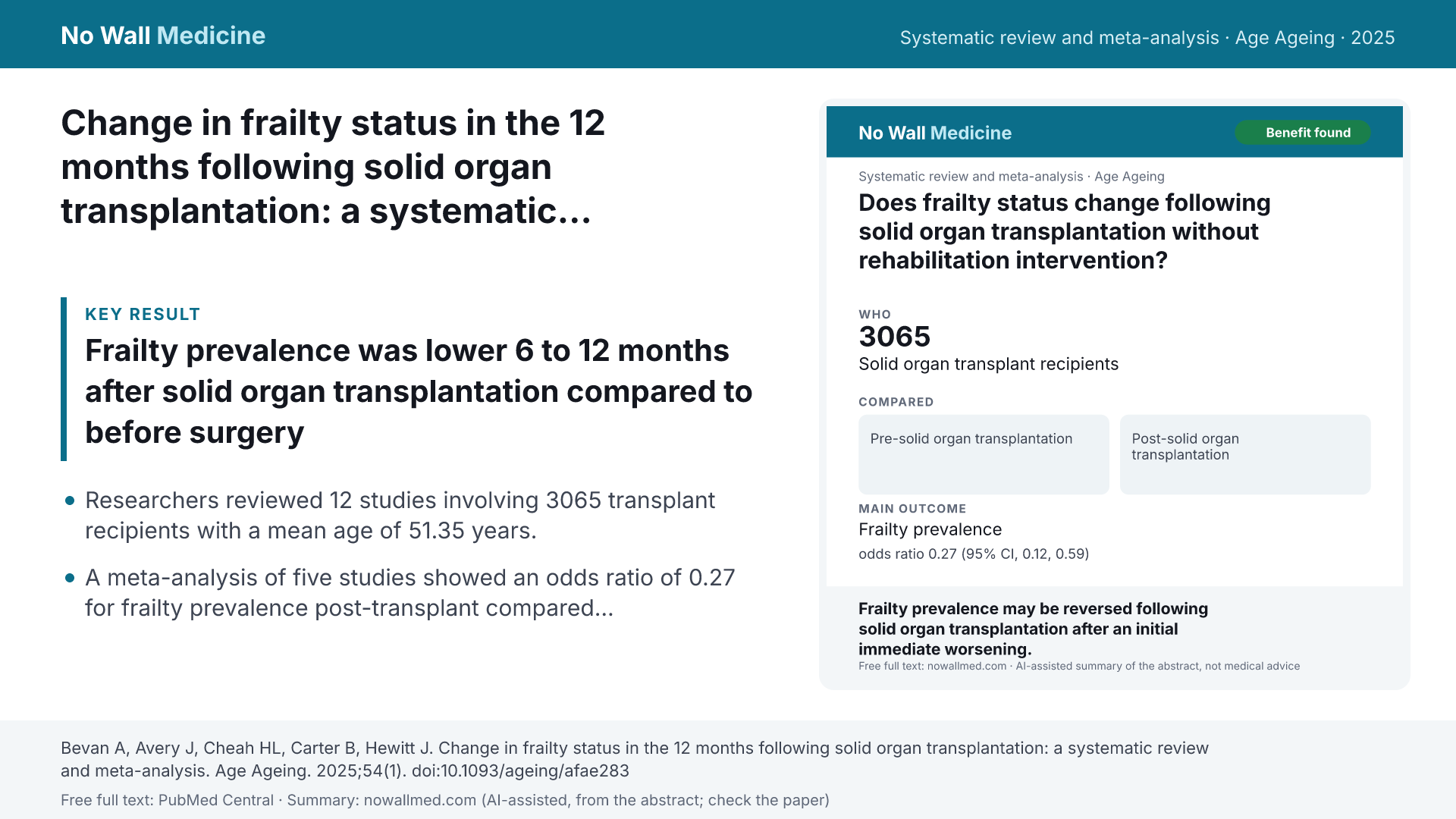
Frailty prevalence was lower 6 to 12 months after solid organ transplantation compared to before surgery
Change in frailty status in the 12 months following solid organ transplantation: a systematic review and meta-analysis
Systematic review and meta-analysisBenefit found
Does frailty status change following solid organ transplantation without rehabilitation intervention?
Who
3065
Solid organ transplant recipients
Compared
Pre-solid organ transplantation
Post-solid organ transplantation
Main outcome
Frailty prevalence
Result: odds ratio 0.27 (95% CI, 0.12, 0.59)
Bottom line: Frailty prevalence may be reversed following solid organ transplantation after an initial immediate worsening.
Age Ageing · 2025-01-08 · Save PNG
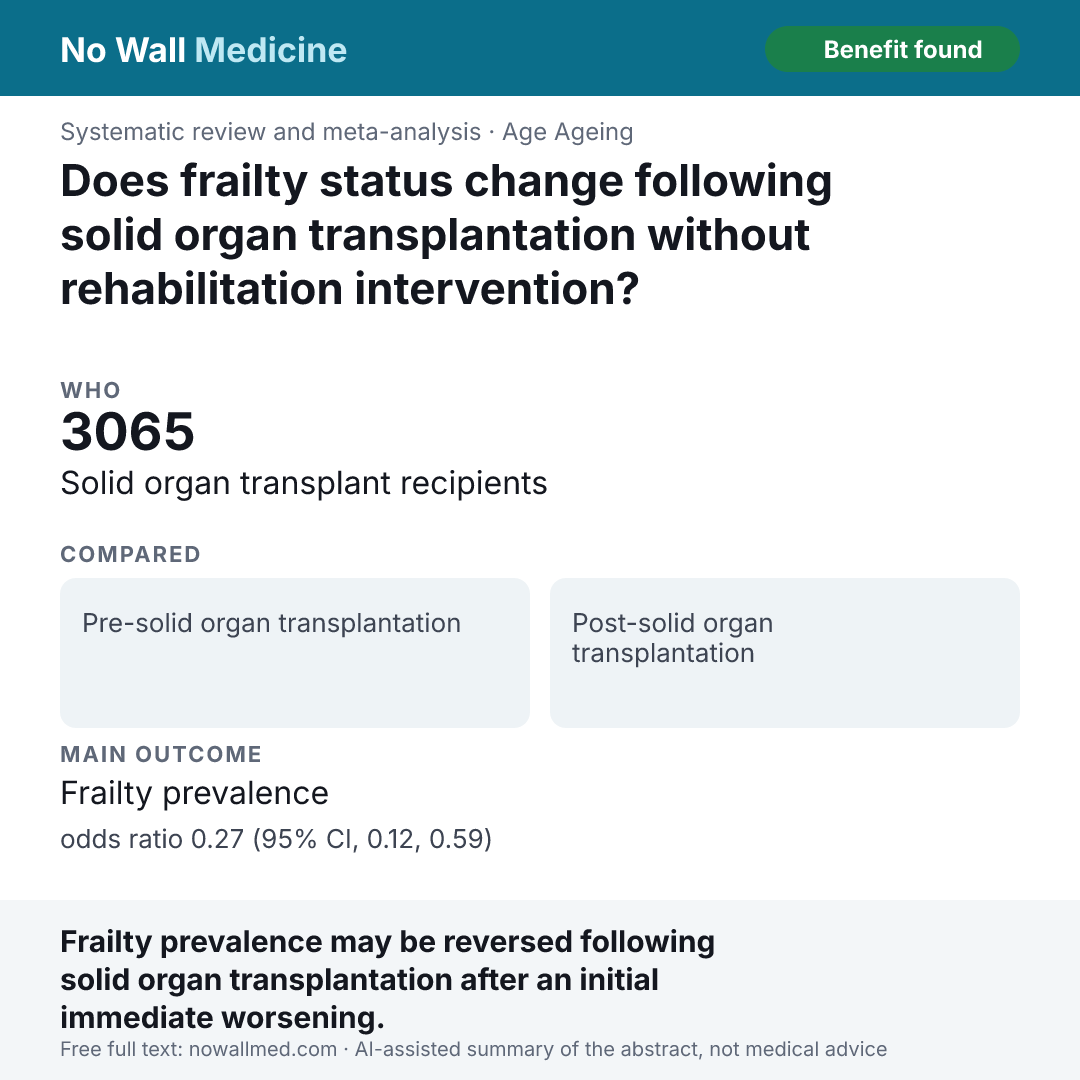
Clinical question: Does frailty status change following solid organ transplantation without rehabilitation intervention?
Key points
- Researchers reviewed 12 studies involving 3065 transplant recipients with a mean age of 51.35 years.
- A meta-analysis of five studies showed an odds ratio of 0.27 for frailty prevalence post-transplant compared to pre-transplant.
- After removing one poor quality study, four studies showed an odds ratio of 0.45 for being frail at 6-12 months post-transplant.
Headline and key points written with AI from the paper’s abstract, with every number checked against it. Read the paper before relying on them.
Was this summary helpful?
Subject terms
Headline, design, result, key points, caveat and citation as plain text.
Cite this article
Bevan A, Avery J, Cheah HL, Carter B, Hewitt J. Change in frailty status in the 12 months following solid organ transplantation: a systematic review and meta-analysis. Age Ageing. 2025;54(1). doi:10.1093/ageing/afae283
Spotted a mistake? Suggest a correction