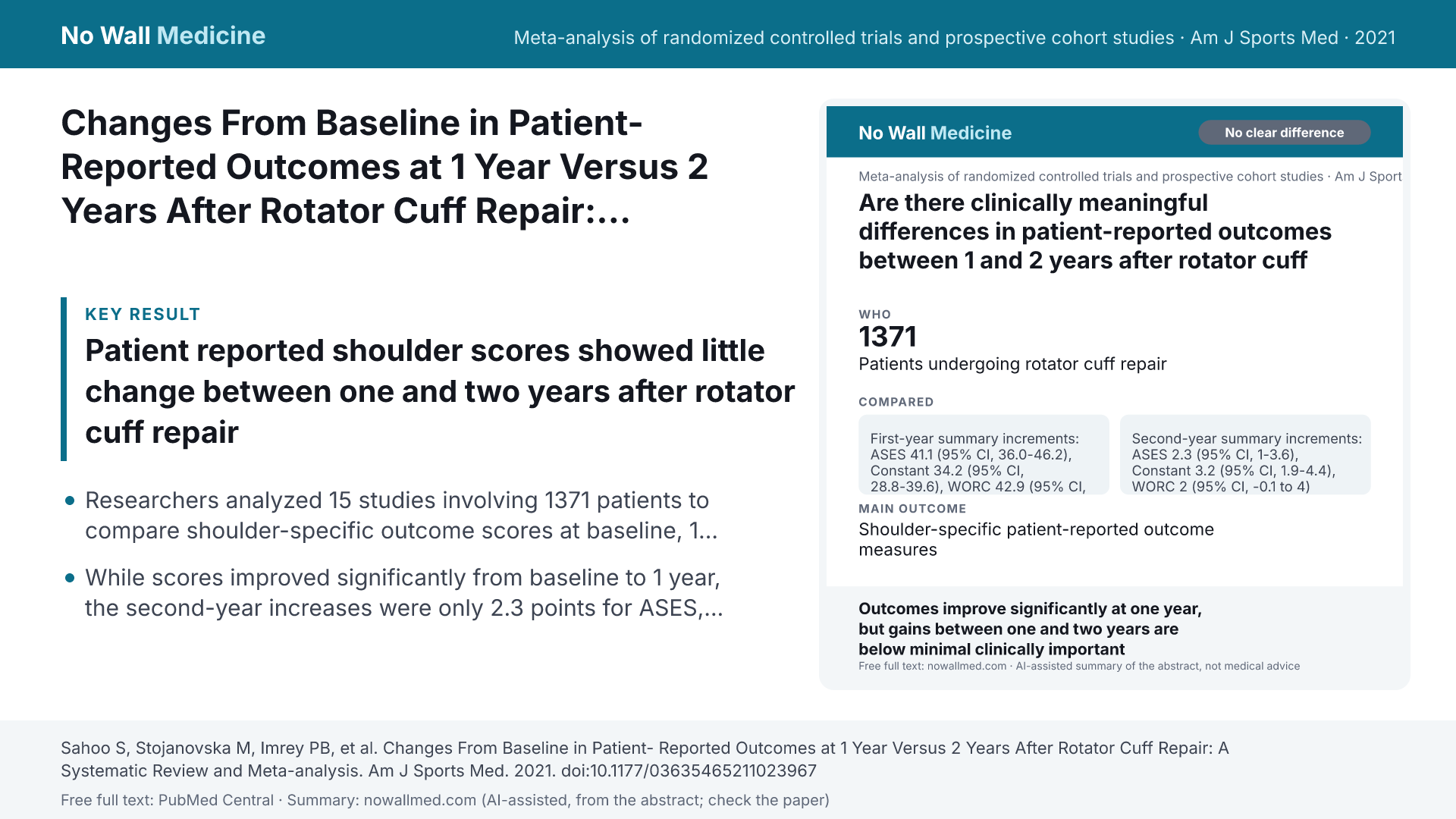
Changes From Baseline in Patient- Reported Outcomes at 1 Year Versus 2 Years After Rotator Cuff Repair: A Systematic Review and Meta-analysis
Key result: Patient reported shoulder scores showed little change between one and two years after rotator cuff repair
Key points
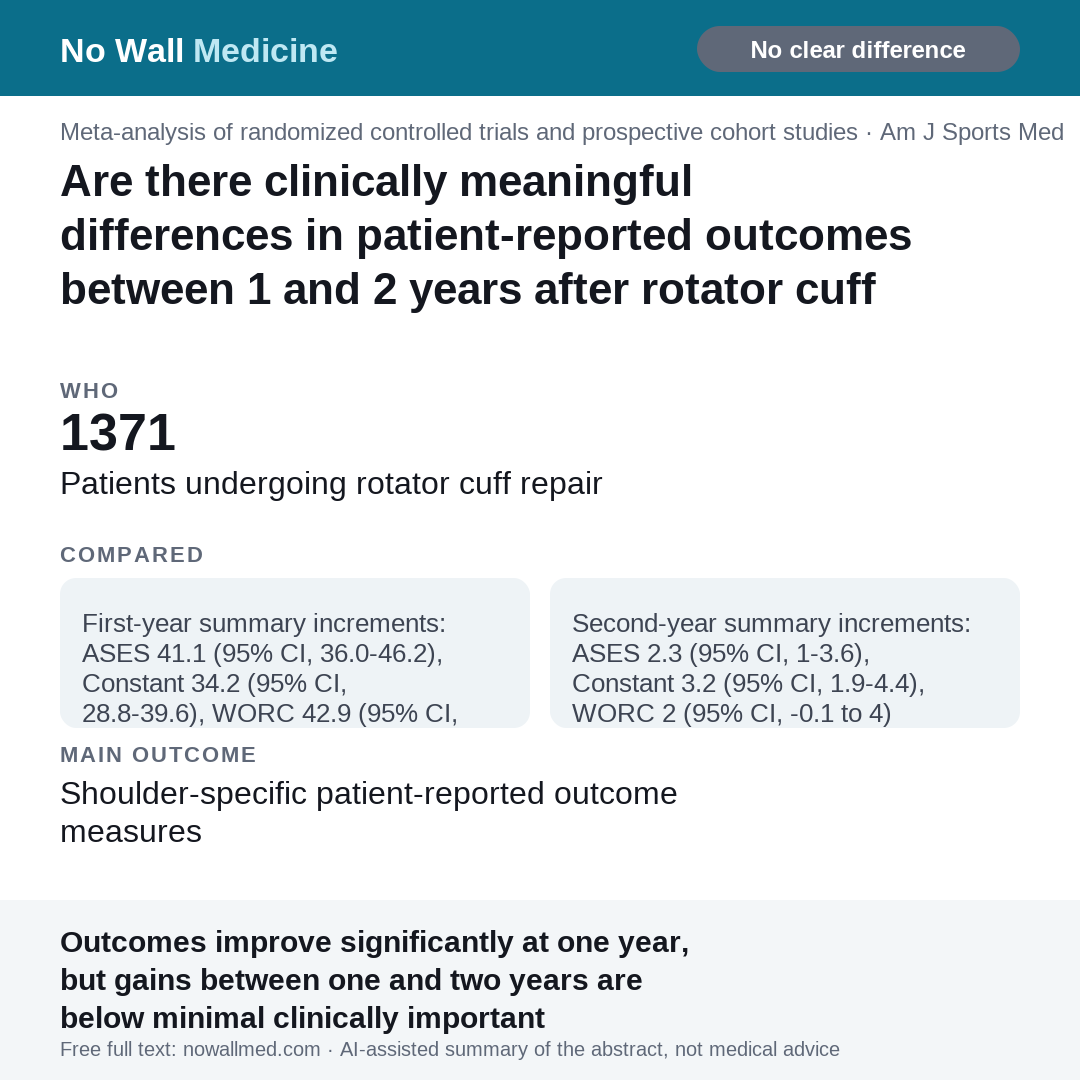
- Researchers analyzed 15 studies involving 1371 patients to compare shoulder-specific outcome scores at baseline, 1 year, and 2 years after rotator cuff repair.
- While scores improved significantly from baseline to 1 year, the second-year increases were only 2.3 points for ASES, 3.2 points for Constant, and 2 points for WORC Index.
- The gains observed between 1 year and 2 years were below the minimal clinically important differences for these patient-reported outcome measures.
Why it matters: It is unknown if requiring 2 years of follow-up for surgical outcome reporting provides more clinically meaningful information than 1 year of follow-up.
Limitation the authors note: Studies were highly heterogeneous.
Discussion prompts
- Would these patients look like yours? Who was left out?
- Is the main outcome one that matters to patients?
- Is the difference large enough to change what you do?
Cite: Sahoo S, Stojanovska M, Imrey PB, Jin Y, Bowles RJ, Ho JC. Changes From Baseline in Patient- Reported Outcomes at 1 Year Versus 2 Years After Rotator Cuff Repair: A Systematic Review and Meta-analysis. Am J Sports Med. 2021. doi:10.1177/03635465211023967
Free full text: PubMed Central · Summary and visual abstract: nowallmed.com/a/changes-from-baseline-in-patient-reported-outcomes-at-1-year-versus-2-xy41je/ (AI-assisted from the abstract; check the paper before relying on it).