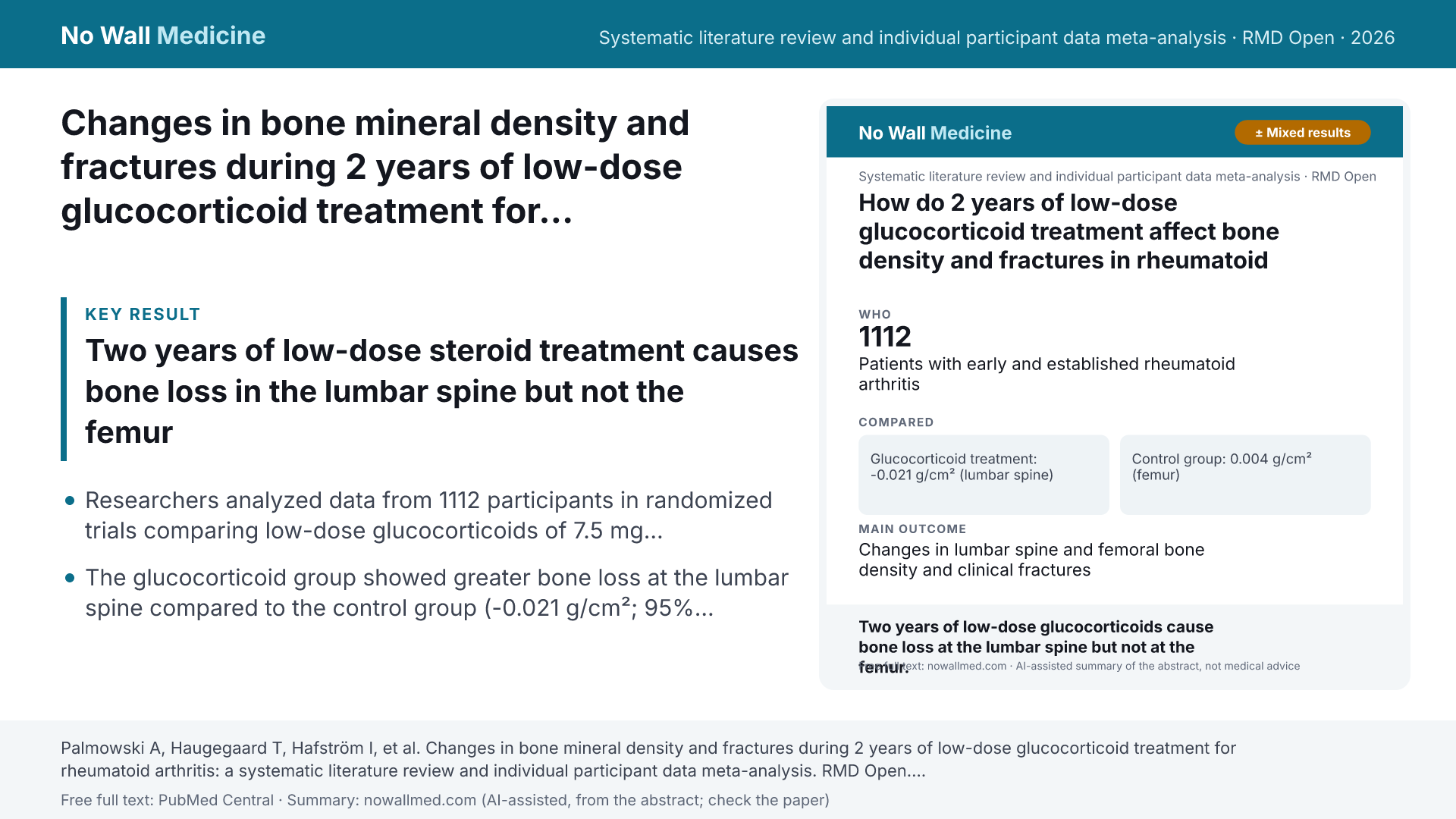
Two years of low-dose steroid treatment causes bone loss in the lumbar spine but not the femur
Changes in bone mineral density and fractures during 2 years of low-dose glucocorticoid treatment for rheumatoid arthritis: a systematic literature review and individual participant data meta-analysis
Systematic literature review and individual participant data meta-analysisMixed results
How do 2 years of low-dose glucocorticoid treatment affect bone density and fractures in rheumatoid arthritis?
Who
1112
Patients with early and established rheumatoid arthritis
Compared
Glucocorticoid treatment: -0.021 g/cm² (lumbar spine)
Control group: 0.004 g/cm² (femur)
Main outcome
Changes in lumbar spine and femoral bone density and clinical fractures
Result: -0.021 g/cm² (95% CI -0.037 to -0.005) for lumbar spine
Bottom line: Two years of low-dose glucocorticoids cause bone loss at the lumbar spine but not at the femur.
RMD Open · 2026-05-07 · Save PNG
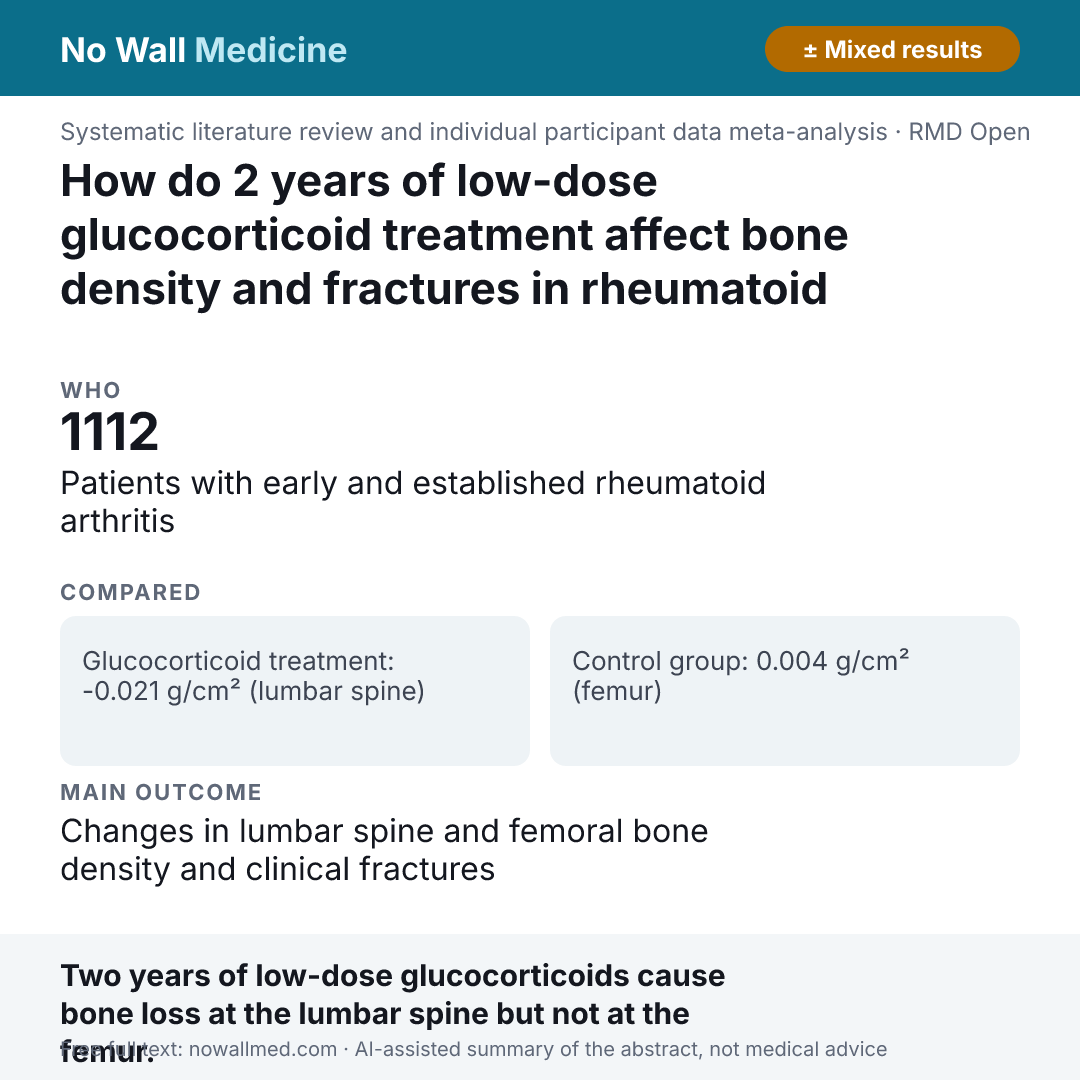
Clinical question: How do 2 years of low-dose glucocorticoid treatment affect bone density and fractures in rheumatoid arthritis?
Key points
- Researchers analyzed data from 1112 participants in randomized trials comparing low-dose glucocorticoids of 7.5 mg prednisone equivalent or less per day to placebo or standard care.
- The glucocorticoid group showed greater bone loss at the lumbar spine compared to the control group (-0.021 g/cm²; 95% CI -0.037 to -0.005; p=0.034) but not at the femur.
- Among the participants, 35 individuals experienced one or more clinical fractures, and the fracture risk was comparable between the two study groups.
Headline and key points written with AI from the paper’s abstract, with every number checked against it. Read the paper before relying on them.
Was this summary helpful?
Abstract
Objective
To evaluate the effects of 2 years of low-dose glucocorticoid (GC) treatment on bone mineral density and fracture risk in patients with rheumatoid arthritis (RA). Methods
We performed a protocolised (dx.doi.org/10.17504/protocols.io.6qpvr3ombvmk/v1) systematic literature review and individual participant data meta-analysis of randomised trials in early and established RA, which compared GCs at ≤7.5 mg prednisone equivalent/day with placebo or standard of care. All patients could receive background treatment with disease-modifying antirheumatic drugs. Changes in lumbar spine and femoral bone density and participants with ≥1 clinical fracture over 2 years in intention-to-treat analyses were coprimary endpoints. Main analyses were based on one-stage models; I² was estimated from two-stage models. Missing data were handled using multiple imputation. Several sensitivity analyses assessed the robustness of our results. Results
Out of 2336 articles, five out of six identified trials provided individual participant data (1112 participants). Greater bone loss was observed at the lumbar spine in the GC compared with the control group (-0.021 g/cm²; 95% CI -0.037 to -0.005; p=0.034; I²=31%) but not at the femur (0.004 g/cm²; 95% CI -0.008 to 0.016; p=0.47; I²=0%). Subgroup analyses did not reveal groups particularly susceptible to GC-induced bone loss at the lumbar spine. 35 participants experienced ≥1 fracture; fracture risk was comparable in both groups. Sensitivity analyses yielded consistent results. Conclusion
Low-dose GCs, used for 2 years to treat RA, lead to bone loss at the lumbar spine but not at the femur.
Abstract reproduced under the article’s CC BY licence.
Subject terms
Headline, design, result, key points, caveat and citation as plain text.
Cite this article
Palmowski A, Haugegaard T, Hafström I, et al. Changes in bone mineral density and fractures during 2 years of low-dose glucocorticoid treatment for rheumatoid arthritis: a systematic literature review and individual participant data meta-analysis. RMD Open. 2026;12(2). doi:10.1136/rmdopen-2025-006615
Spotted a mistake? Suggest a correction