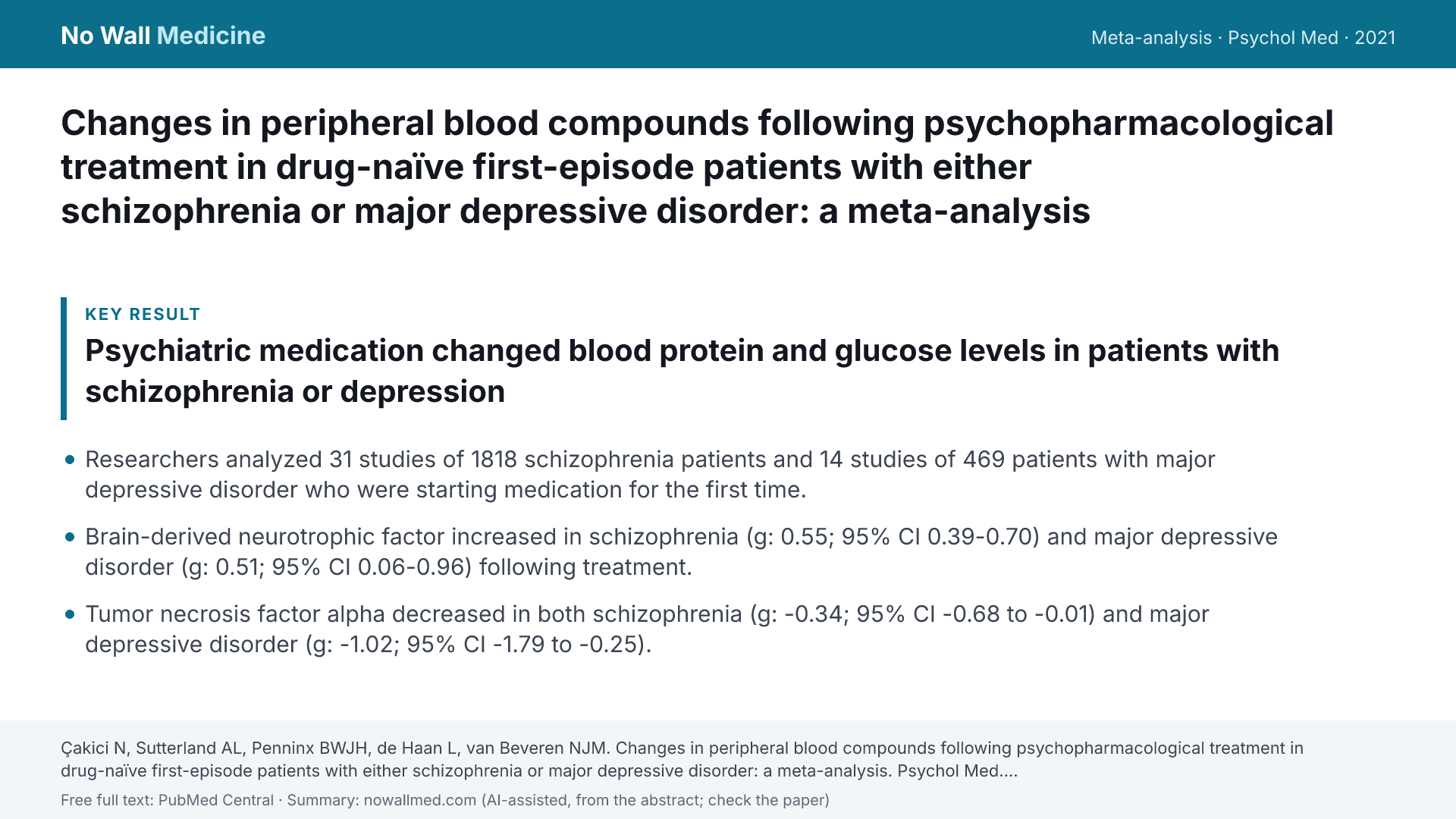
Psychiatric medication changed blood protein and glucose levels in patients with schizophrenia or depression
Changes in peripheral blood compounds following psychopharmacological treatment in drug-naïve first-episode patients with either schizophrenia or major depressive disorder: a meta-analysis
Why it matters: It was unknown which specific compounds in the peripheral blood change after psychopharmacological treatment in patients experiencing their first episode of schizophrenia or major depressive disorder.
Key points
- Researchers analyzed 31 studies of 1818 schizophrenia patients and 14 studies of 469 patients with major depressive disorder who were starting medication for the first time.
- Brain-derived neurotrophic factor increased in schizophrenia (g: 0.55; 95% CI 0.39-0.70) and major depressive disorder (g: 0.51; 95% CI 0.06-0.96) following treatment.
- Tumor necrosis factor alpha decreased in both schizophrenia (g: -0.34; 95% CI -0.68 to -0.01) and major depressive disorder (g: -1.02; 95% CI -1.79 to -0.25).
Headline and key points written with AI from the paper’s abstract, with every number checked against it. Read the paper before relying on them.
Was this summary helpful?
Subject terms
Cite this article
Çakici N, Sutterland AL, Penninx BWJH, de Haan L, van Beveren NJM. Changes in peripheral blood compounds following psychopharmacological treatment in drug-naïve first-episode patients with either schizophrenia or major depressive disorder: a meta-analysis. Psychol Med. 2021. doi:10.1017/S0033291721000155
Spotted a mistake? Suggest a correction
Top studies every Monday
The week’s key trials and guidelines in your specialties, plus any topics you follow. By email, free.
Get the weekly digest