Changes in pulse pressure variation after passive leg raising predict fluid responsiveness in ventilated patients
Changes in pulse pressure variation induced by passive leg raising test to predict preload responsiveness in mechanically ventilated patients with low tidal volume in ICU: a systematic review and meta-analysis
Systematic review and meta-analysisBenefit found
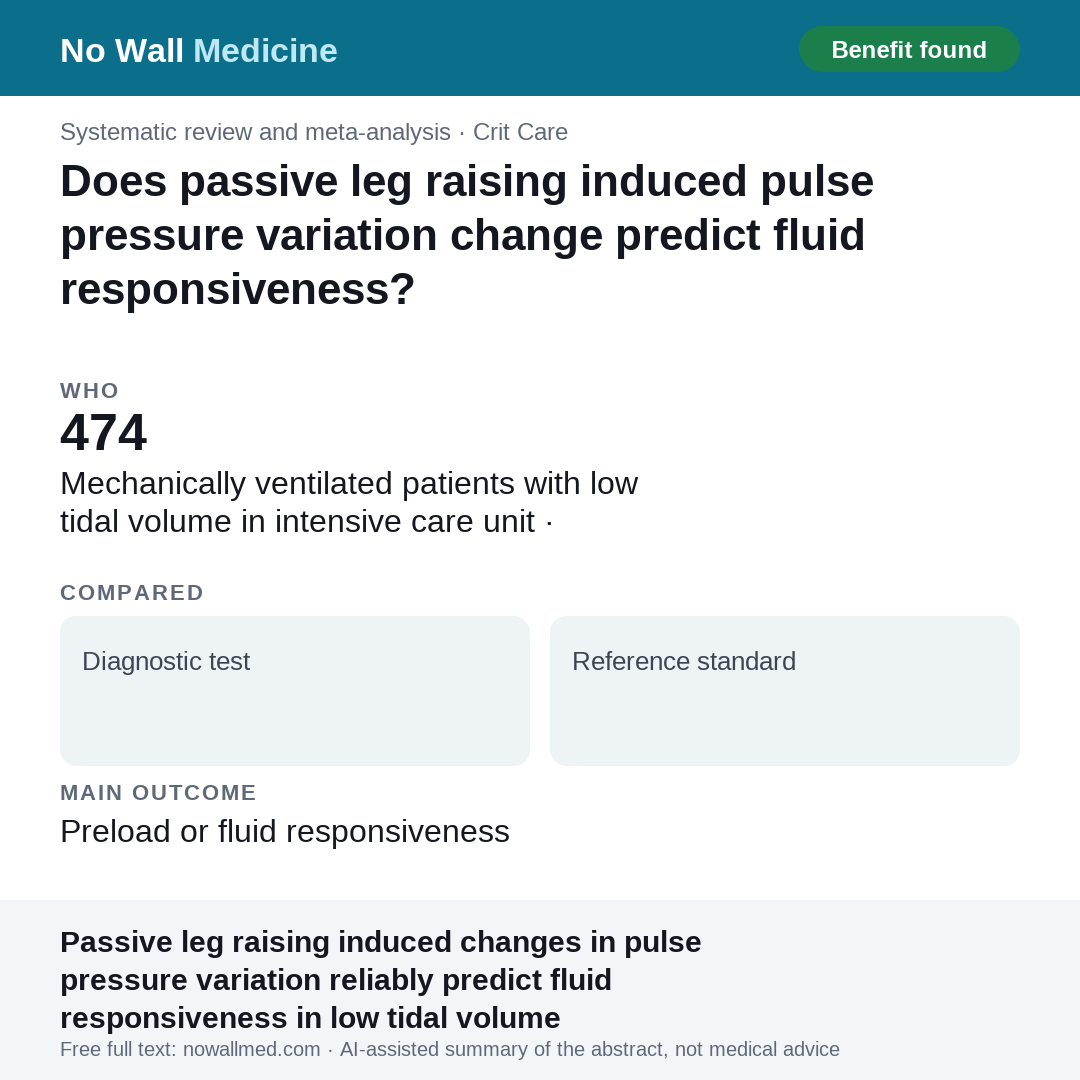
Does passive leg raising induced pulse pressure variation change predict fluid responsiveness?
Who
474
Mechanically ventilated patients with low tidal volume in intensive care unit · Intensive care unit
Compared
Diagnostic test
Reference standard
Main outcome
Preload or fluid responsiveness
Result: area under the curve 0.91 (95% CI 0.88-0.93)
Bottom line: Passive leg raising induced changes in pulse pressure variation reliably predict fluid responsiveness in low tidal volume ventilated patients.
Crit Care · 2025-01-09Download image
Clinical question: Does passive leg raising induced pulse pressure variation change predict fluid responsiveness?
Why it matters: Pulse pressure variation is limited in patients receiving low tidal volume mechanical ventilation, making it unclear if changes after a passive leg raising test can predict fluid responsiveness.
Key points
- Researchers analyzed five studies involving 474 patients to see if changes in pulse pressure variation, a measure of blood pressure fluctuations, could predict fluid responsiveness.
- The pooled sensitivity was 0.88 and the specificity was 0.83 for predicting whether patients would respond to fluid administration.
- The absolute change in pulse pressure variation had an area under the curve of 0.91 with a diagnostic odds ratio of 35.
Headline and key points written with AI from the paper’s abstract, with every number checked against it. Read the paper before relying on them.
Topics
Cite this article
Mallat J, Siuba MT, Abou-Arab O, Kovacevic P, Ismail K, Duggal A. Changes in pulse pressure variation induced by passive leg raising test to predict preload responsiveness in mechanically ventilated patients with low tidal volume in ICU: a systematic review and meta-analysis. Crit Care. 2025. doi:10.1186/s13054-024-05238-x
Spotted a mistake? Suggest a correction
Top studies every Monday
The week’s key trials and guidelines in your specialties, by email. Free.
Get the weekly digest