Changes in walking speed following resistance training in people with multiple sclerosis: A systematic review and meta-analysis
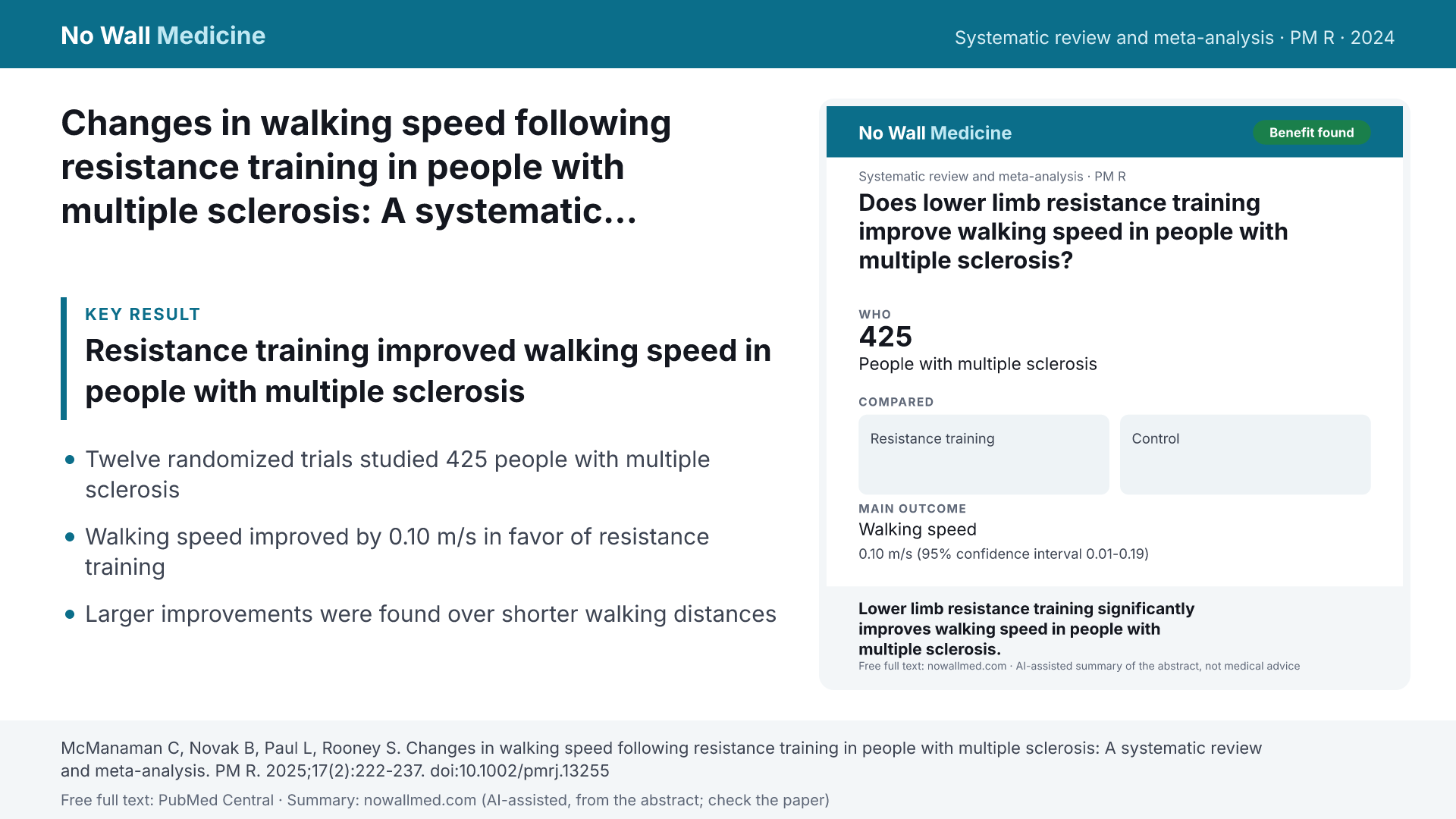
Key result: Resistance training improved walking speed in people with multiple sclerosis
Systematic review and meta-analysisBenefit found
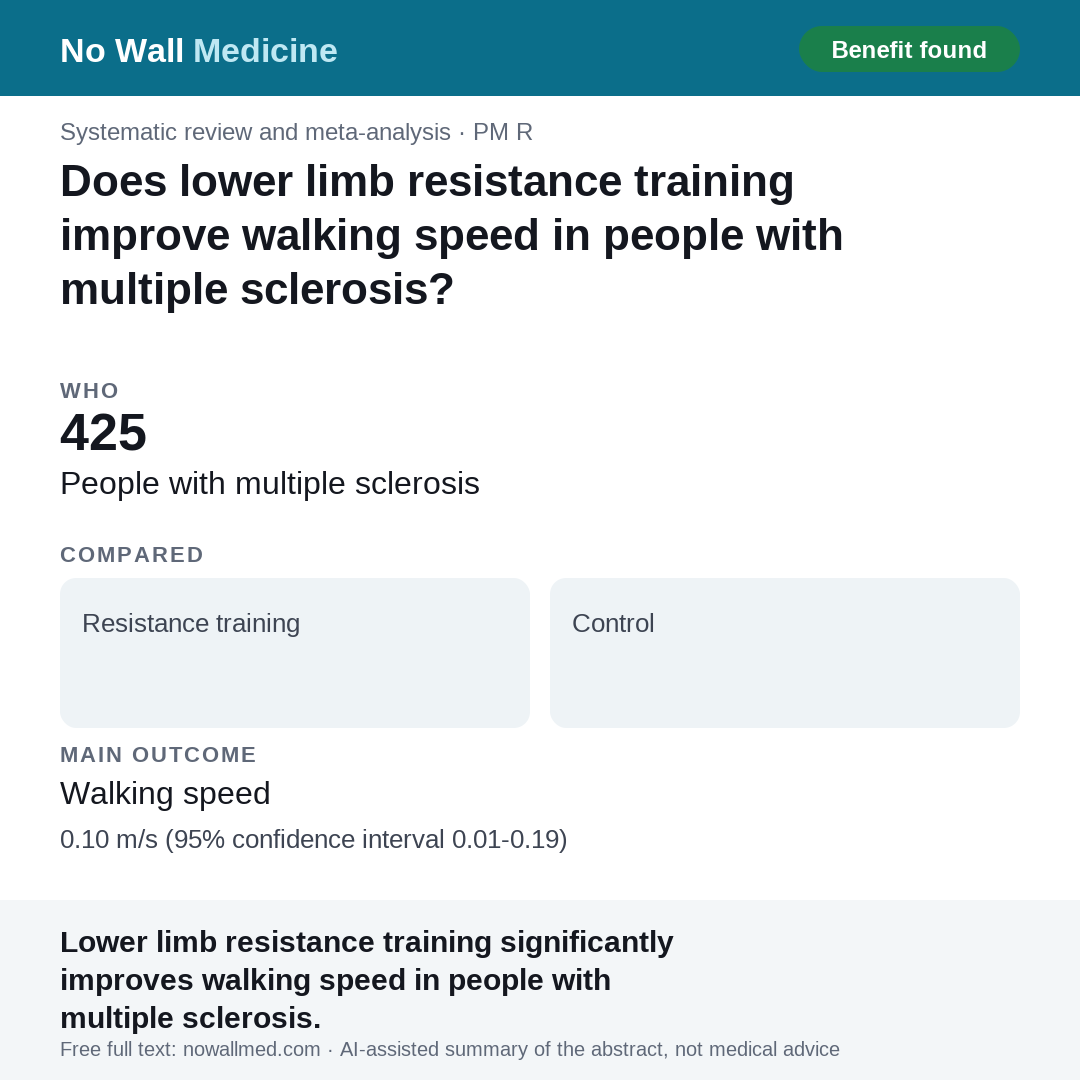
Does lower limb resistance training improve walking speed in people with multiple sclerosis?
Who
425
People with multiple sclerosis
Compared
Resistance training
Control
Main outcome
Walking speed
Result: 0.10 m/s (95% confidence interval 0.01-0.19)
Bottom line: Lower limb resistance training significantly improves walking speed in people with multiple sclerosis.
Limitation: Results were variable across studies and sensitivity analysis showed distance-dependent improvements.
PM R · 2024-09-23Download image
Key points
- Twelve randomized trials studied 425 people with multiple sclerosis.
- Walking speed improved by 0.10 m/s in favor of resistance training.
- Larger improvements were found over shorter walking distances.
Limitation the authors note: Variability in results was noted across studies
Discussion prompts
- Would these patients look like yours? Who was left out?
- Is the main outcome one that matters to patients?
- Is the difference large enough to change what you do?
Cite: McManaman C, Novak B, Paul L, Rooney S. Changes in walking speed following resistance training in people with multiple sclerosis: A systematic review and meta-analysis. PM R. 2024. doi:10.1002/pmrj.13255
Free full text: PubMed Central · Summary and visual abstract: nowallmed.com/a/changes-in-walking-speed-following-resistance-training-in-people-with-2qz3tf/ (AI-assisted from the abstract; check the paper before relying on it).