Pulse wave transit time changes were associated with immediate preload shifts in healthy adults
Changes of pulse wave transit time after haemodynamic manoeuvres in healthy adults: a prospective randomised observational trial (PWTT volunteer study)
Prospective randomised observational trialBenefit found
How does pulse wave transit time mirror haemodynamic variables after different manoeuvres?
Who
24
24 healthy adult volunteers
Compared
Stand-up: mean change +55.9 ms
Passive leg raise: mean change -15.4 ms
Step-test: no significant change at 1 min
Valsalva manoeuvre: heterogeneous results
Main outcome
Correlation between pulse wave transit time and stroke volume
Bottom line: Pulse wave transit time shows promise to register immediate preload changes in healthy adults.
Limitation: Clinical usefulness may be hampered by late changes due to reasons different from fluid shifts.
BJA Open · 2024-06-24Download image
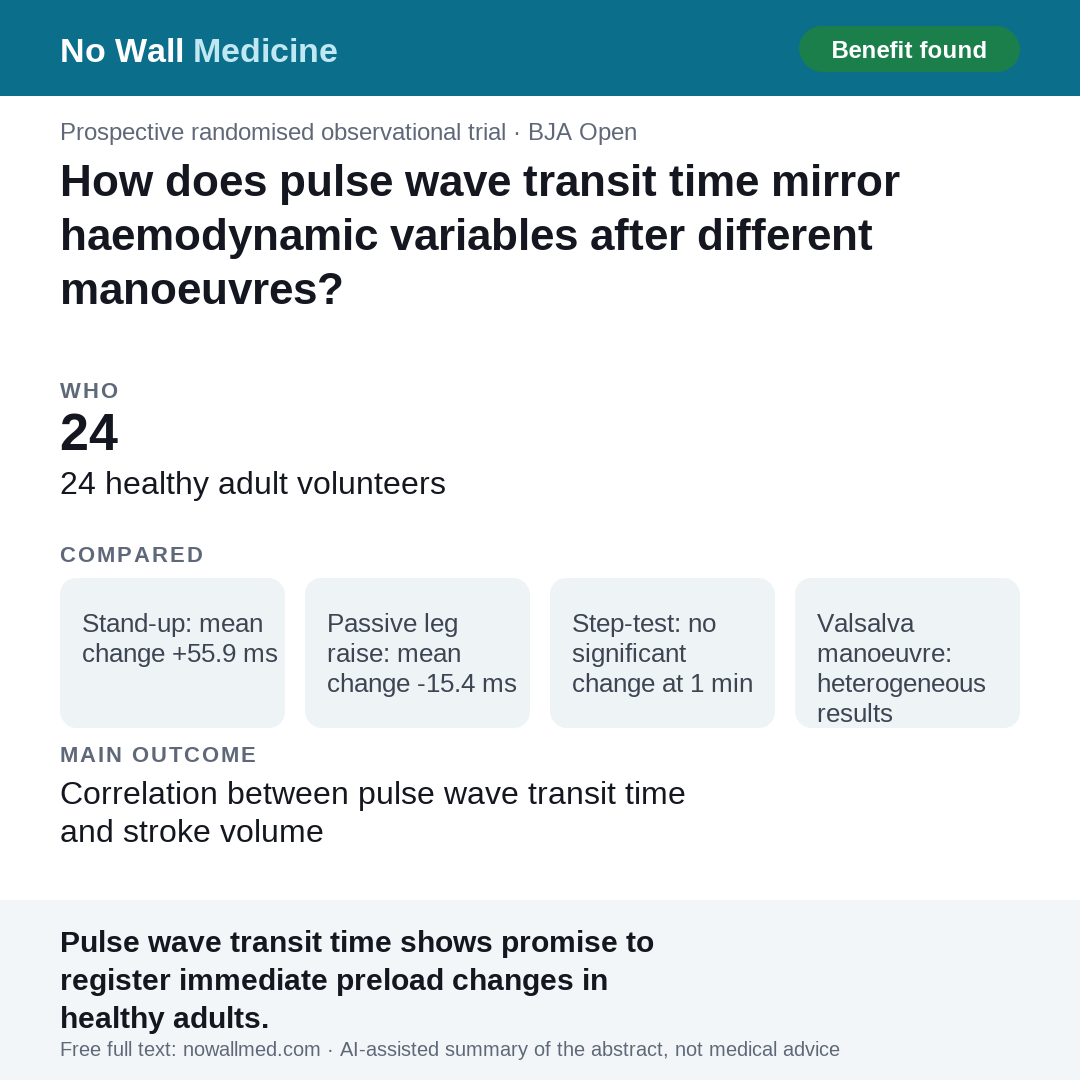
Clinical question: How does pulse wave transit time mirror haemodynamic variables after different manoeuvres?
Why it matters: It is unknown how pulse wave transit time mirrors hemodynamic variables representing preload, inotropy, or afterload.
Key points
- Researchers studied 24 healthy adult volunteers using four different physical maneuvers to measure pulse wave transit time, which is the time it takes a pulse wave to travel through the arteries.
- Standing up caused an immediate increase in pulse wave transit time by a mean of +55.9 ms, while a passive leg raise caused an immediate decrease of -15.4 ms.
- The step-test caused no significant change in pulse wave transit time after 1 min, though it did increase mean arterial pressure and heart rate.
Headline and key points written with AI from the paper’s abstract, with every number checked against it. Read the paper before relying on them.
Was this summary helpful?
Cite this article
Wirkus JM, Goss F, David M, Hartmann EK, Fukui K, Schmidtmann I. Changes of pulse wave transit time after haemodynamic manoeuvres in healthy adults: a prospective randomised observational trial (PWTT volunteer study). BJA Open. 2024. doi:10.1016/j.bjao.2024.100291
Spotted a mistake? Suggest a correction
Top studies every Monday
The week’s key trials and guidelines in your specialties, plus any topics you follow. By email, free.
Get the weekly digest