Virtual reality shows potential for skill development and knowledge acquisition in plastic and reconstructive surgery
Characterizing the untapped potential of virtual reality in plastic and reconstructive surgical training: A systematic review on skill transferability
Systematic reviewBenefit found
What is the potential of virtual reality in plastic and reconstructive surgical training?
Who
31
Studies on virtual reality in surgical education
Compared
Virtual reality
Traditional modes
Main outcome
Skill transferability, knowledge acquisition, and skill development
Bottom line: Virtual reality shows significant potential for knowledge acquisition and skill development in plastic and reconstructive surgery.
JPRAS Open · 2024-07-06Download image
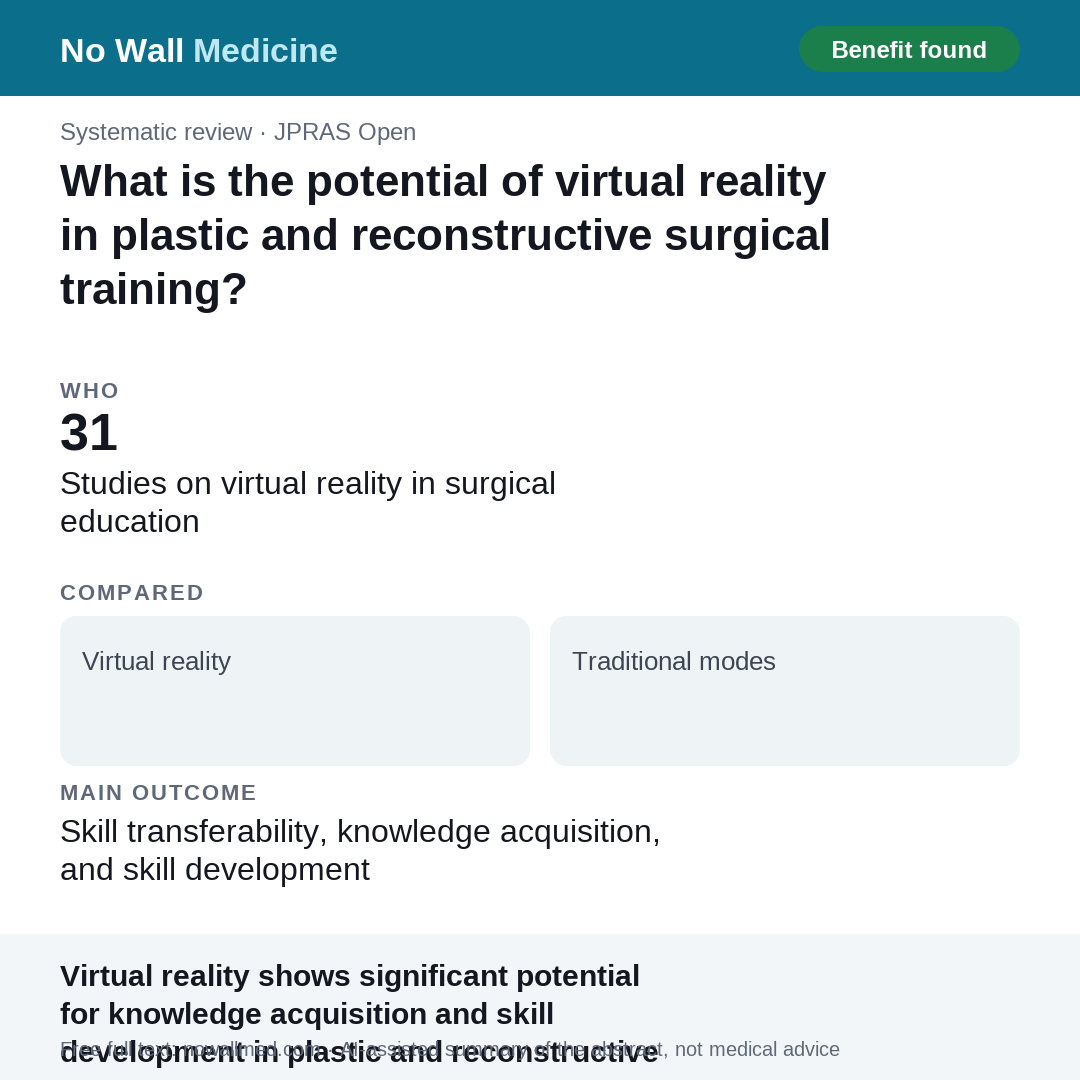
Clinical question: What is the potential of virtual reality in plastic and reconstructive surgical training?
Why it matters: It is unknown how virtual reality tools specifically transfer skills and impact training within the field of plastic and reconstructive surgery.
Key points
- Researchers reviewed 31 studies from 1926 screened papers to assess how virtual reality tools transfer skills in surgical education.
- Novice surgeons using virtual reality simulators showed improved confidence, accuracy in complex tasks, decision-making efficiency, and dexterity compared to traditional training.
- Virtual reality applications frequently included anatomy visualization at 83.9% and procedure planning at 67.7%, but none addressed patient communication or team-based training.
Headline and key points written with AI from the paper’s abstract, with every number checked against it. Read the paper before relying on them.
Was this summary helpful?
Cite this article
Landau M, Comeaux M, Mortell T, Boyle R, Imbrescia K, Chaffin AE. Characterizing the untapped potential of virtual reality in plastic and reconstructive surgical training: A systematic review on skill transferability. JPRAS Open. 2024. doi:10.1016/j.jpra.2024.06.015
Spotted a mistake? Suggest a correction
Top studies every Monday
The week’s key trials and guidelines in your specialties, plus any topics you follow. By email, free.
Get the weekly digest