Large language model mental health chatbots increased in 2024 but lack clinical efficacy testing
Charting the evolution of artificial intelligence mental health chatbots from rule-based systems to large language models: a systematic review
Systematic review of 160 studiesUnclear result
How have artificial intelligence mental health chatbots evolved and how are they evaluated?
Who
160
Artificial intelligence mental health chatbots
Compared
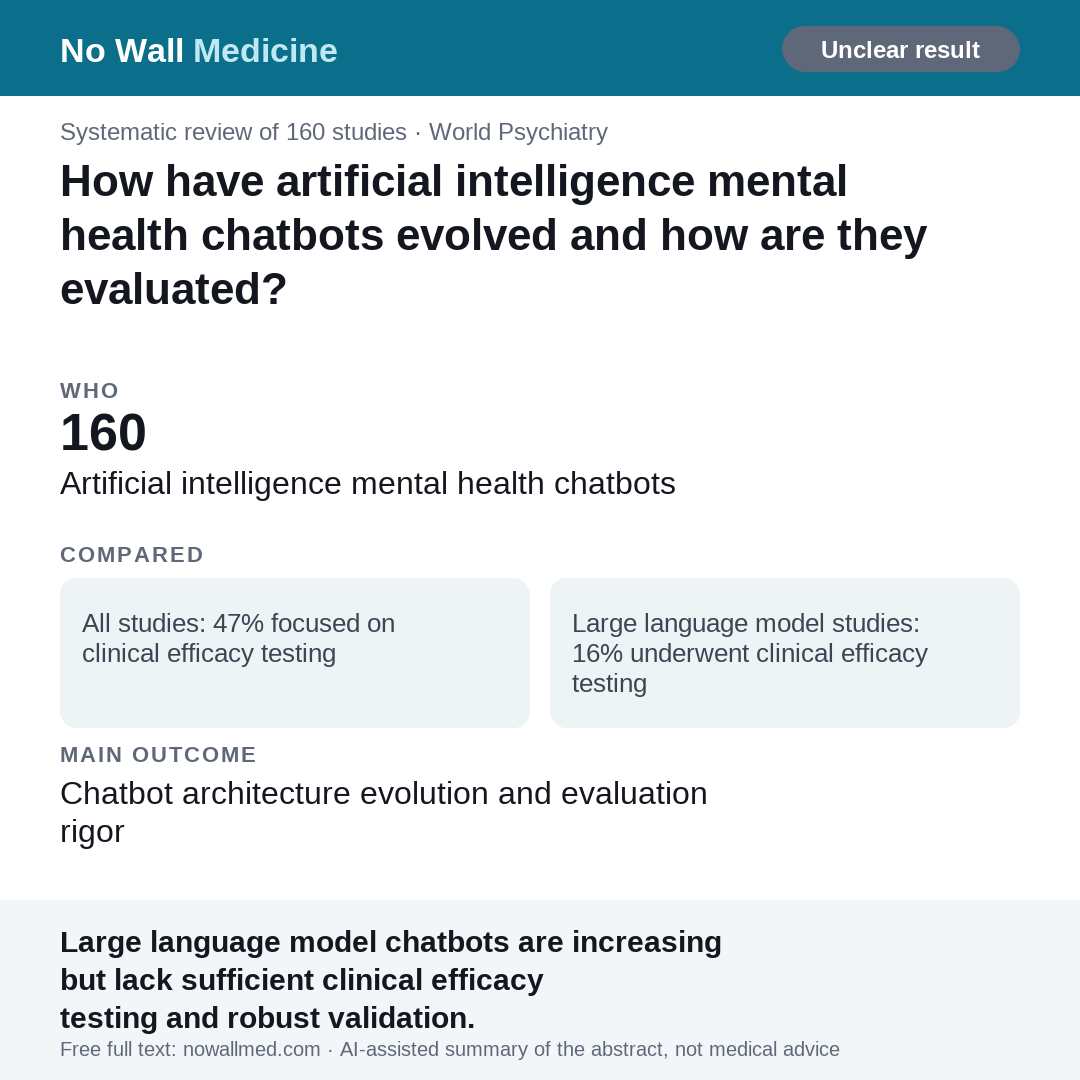
All studies: 47% focused on clinical efficacy testing
Large language model studies: 16% underwent clinical efficacy testing
Main outcome
Chatbot architecture evolution and evaluation rigor
Bottom line: Large language model chatbots are increasing but lack sufficient clinical efficacy testing and robust validation.
Limitation: Discrepancies exist between marketed claims and actual artificial intelligence architectures used.
World Psychiatry · 2025-09-15Download image
Clinical question: How have artificial intelligence mental health chatbots evolved and how are they evaluated?
Why it matters: The rapid evolution of artificial intelligence chatbots has created a fragmented landscape with variable clinical evidence and evaluation rigor.
Key points
- Researchers reviewed 160 studies from 2020 to 2024 to classify chatbot architectures and evaluate their testing rigor.
- Large language model-based chatbots reached 45% of new studies in 2024, but only 16% of these underwent clinical efficacy testing.
- Overall, only 47% of all studied chatbots focused on clinical efficacy testing, leaving a gap in validating therapeutic benefits.
Headline and key points written with AI from the paper’s abstract, with every number checked against it. Read the paper before relying on them.
Was this summary helpful?
Cite this article
Hua Y, Siddals S, Ma Z, Galatzer-Levy I, Xia W, Hau C. Charting the evolution of artificial intelligence mental health chatbots from rule-based systems to large language models: a systematic review. World Psychiatry. 2025. doi:10.1002/wps.21352
Spotted a mistake? Suggest a correction
Top studies every Monday
The week’s key trials and guidelines in your specialties, plus any topics you follow. By email, free.
Get the weekly digest