Chest Wall Perforator Flaps in Partial Breast Reconstruction: A Systematic Review and Meta-analysis
Systematic review and meta-analysisBenefit found
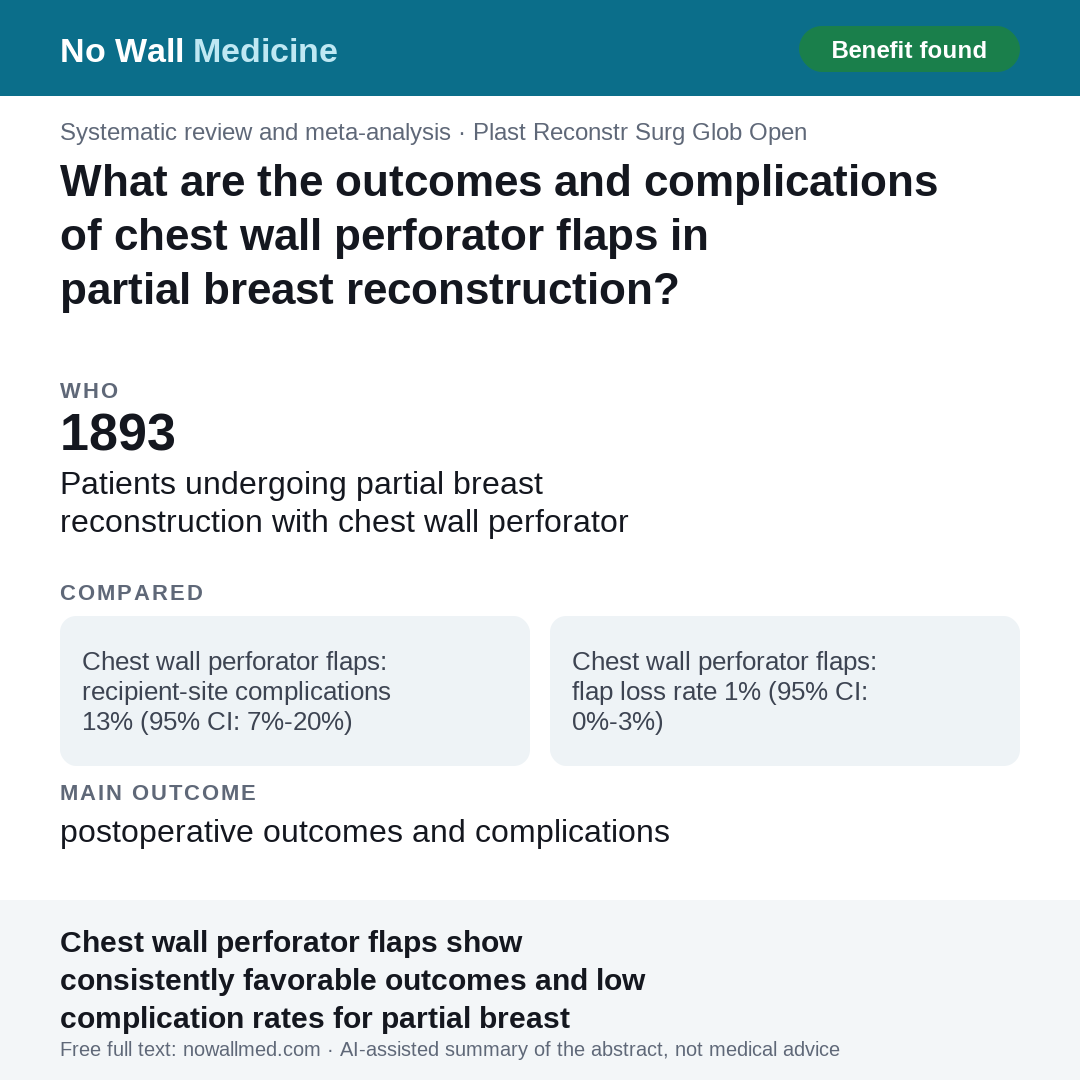
What are the outcomes and complications of chest wall perforator flaps in partial breast reconstruction?
Who
1893
Patients undergoing partial breast reconstruction with chest wall perforator flaps
Compared
Chest wall perforator flaps: recipient-site complications 13% (95% CI: 7%-20%)
Chest wall perforator flaps: flap loss rate 1% (95% CI: 0%-3%)
Main outcome
postoperative outcomes and complications
Bottom line: Chest wall perforator flaps show consistently favorable outcomes and low complication rates for partial breast reconstruction.
Plast Reconstr Surg Glob Open · 2025-08-04Download image
Clinical question: What are the outcomes and complications of chest wall perforator flaps in partial breast reconstruction?
Abstract
Background
Breast-conserving surgery with radiotherapy is the standard treatment for early-stage management of breast cancer but may cause volume loss. In such cases, muscle-sparing chest wall perforator flaps (CWPFs) offer a reliable, function-preserving reconstruction option with low donor-site morbidity, making them particularly useful for volume replacement. This systematic review and meta-analysis evaluated the outcomes and complications of CWPFs in breast-conserving surgery. Methods
A systematic literature review was conducted according to Preferred Reporting Items for Systematic Reviews and Meta-Analyses guidelines. Articles reporting postoperative outcomes and complications following partial breast reconstruction using CWPFs were included. A proportional meta-analysis was then performed to calculate pooled complication rates and 95% confidence intervals (95% CIs). Results
Seventeen studies, involving 1893 unilateral CWPFs, were included. The rate of recipient-site complications was 13% (95% CI: 7%-20%), and the flap loss rate was 1% (95% CI: 0%-3%). Reexcision and completion mastectomy rates were 12.9% and 1.46%, respectively. Patient satisfaction was consistently high, assessed using a 4-point Likert scale (n = 3), BREAST-Q (n = 2), or author-designed questionnaires (n = 2). Surgeon and independent reviewer assessments also indicated favorable aesthetic results but lacked standardization across studies. Conclusions
This meta-analysis synthesized all existing evidence on CWPFs for partial breast reconstruction across all breast quadrants. The 1893 flaps reviewed showed consistently favorable outcomes, broad applicability based on tumor location, and low complication rates. CWPFs seem to be an ideal option for partial breast reconstruction in patients with small breasts and large defects.
Cite this article
Nava CM, Zinner G, Martineau J, Oranges CM. Chest Wall Perforator Flaps in Partial Breast Reconstruction: A Systematic Review and Meta-analysis. Plast Reconstr Surg Glob Open. 2025. doi:10.1097/GOX.0000000000006996
Spotted a mistake? Suggest a correction
Top studies every Monday
The week’s key trials and guidelines in your specialties, by email. Free.
Get the weekly digest