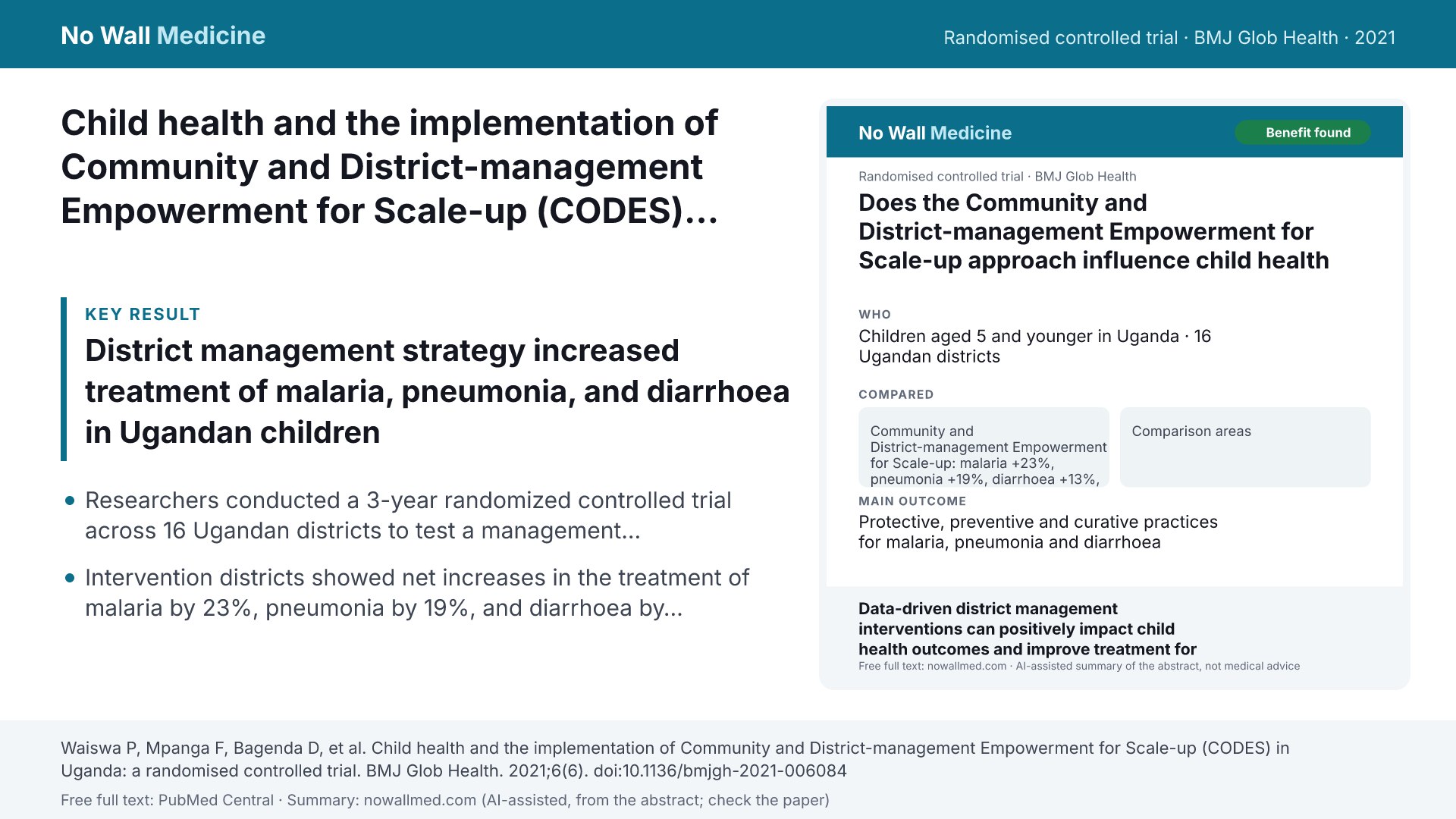
District management strategy increased treatment of malaria, pneumonia, and diarrhoea in Ugandan children
Child health and the implementation of Community and District-management Empowerment for Scale-up (CODES) in Uganda: a randomised controlled trial
Randomised controlled trialBenefit found
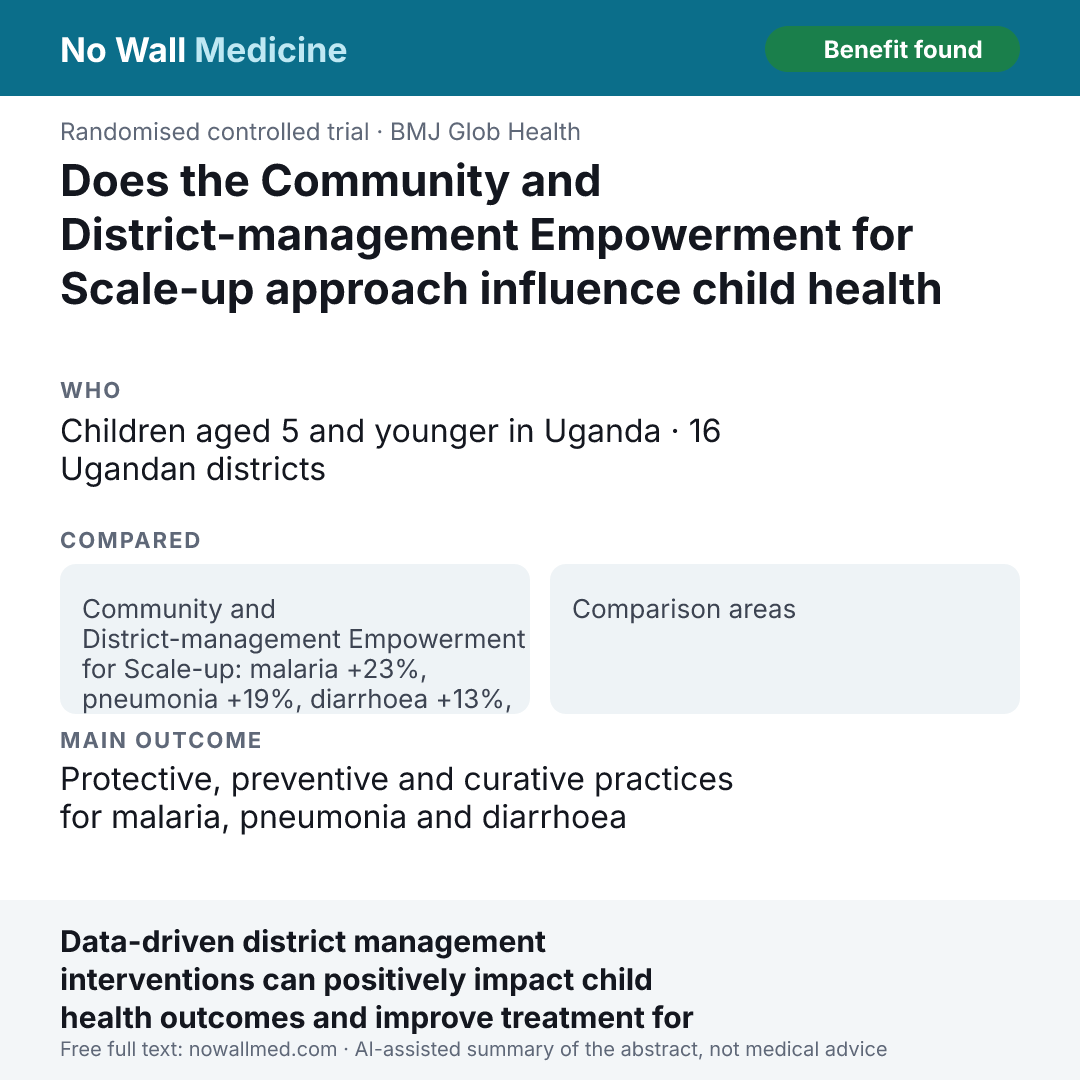
Does the Community and District-management Empowerment for Scale-up approach influence child health services?
Who
Children aged 5 and younger in Uganda · 16 Ugandan districts
Compared
Community and District-management Empowerment for Scale-up: malaria +23%, pneumonia +19%, diarrhoea +13%, stool disposal +10%
Comparison areas
Main outcome
Protective, preventive and curative practices for malaria, pneumonia and diarrhoea
Bottom line: Data-driven district management interventions can positively impact child health outcomes and improve treatment for malaria, pneumonia, and diarrhoea.
Limitation: Limited fiscal space constrained district managers' ability to implement solutions identified through the approach.
BMJ Glob Health · 2021-06-09 · ISRCTN15705788
Headline and visual abstract written with AI from the paper’s abstract, with every number checked against it. Read the paper before relying on them.
Was this summary helpful?
Abstract
Introduction
Uganda's district-level administrative units buttress the public healthcare system. In many districts, however, local capacity is incommensurate with that required to plan and implement quality health interventions. This study investigates how a district management strategy informed by local data and community dialogue influences health services. Methods
A 3-year randomised controlled trial (RCT) comprised of 16 Ugandan districts tested a management approach, Community and District-management Empowerment for Scale-up (CODES). Eight districts were randomly selected for each of the intervention and comparison areas. The approach relies on a customised set of data-driven diagnostic tools to identify and resolve health system bottlenecks. Using a difference-in-differences approach, the authors performed an intention-to-treat analysis of protective, preventive and curative practices for malaria, pneumonia and diarrhoea among children aged 5 and younger. Results
Intervention districts reported significant net increases in the treatment of malaria (+23%), pneumonia (+19%) and diarrhoea (+13%) and improved stool disposal (+10%). Coverage rates for immunisation and vitamin A consumption saw similar improvements. By engaging communities and district managers in a common quest to solve local bottlenecks, CODES fostered demand for health services. However, limited fiscal space-constrained district managers' ability to implement solutions identified through CODES. Conclusion
Data-driven district management interventions can positively impact child health outcomes, with clinically significant improvements in the treatment of malaria, pneumonia and diarrhoea as well as stool disposal. The findings recommend the model's suitability for health systems strengthening in Uganda and other decentralised contexts. Trial registration number
ISRCTN15705788.
Abstract reproduced under the article’s CC BY licence.
Subject terms
Cite this article
Waiswa P, Mpanga F, Bagenda D, et al. Child health and the implementation of Community and District-management Empowerment for Scale-up (CODES) in Uganda: a randomised controlled trial. BMJ Glob Health. 2021;6(6). doi:10.1136/bmjgh-2021-006084
Spotted a mistake? Suggest a correction