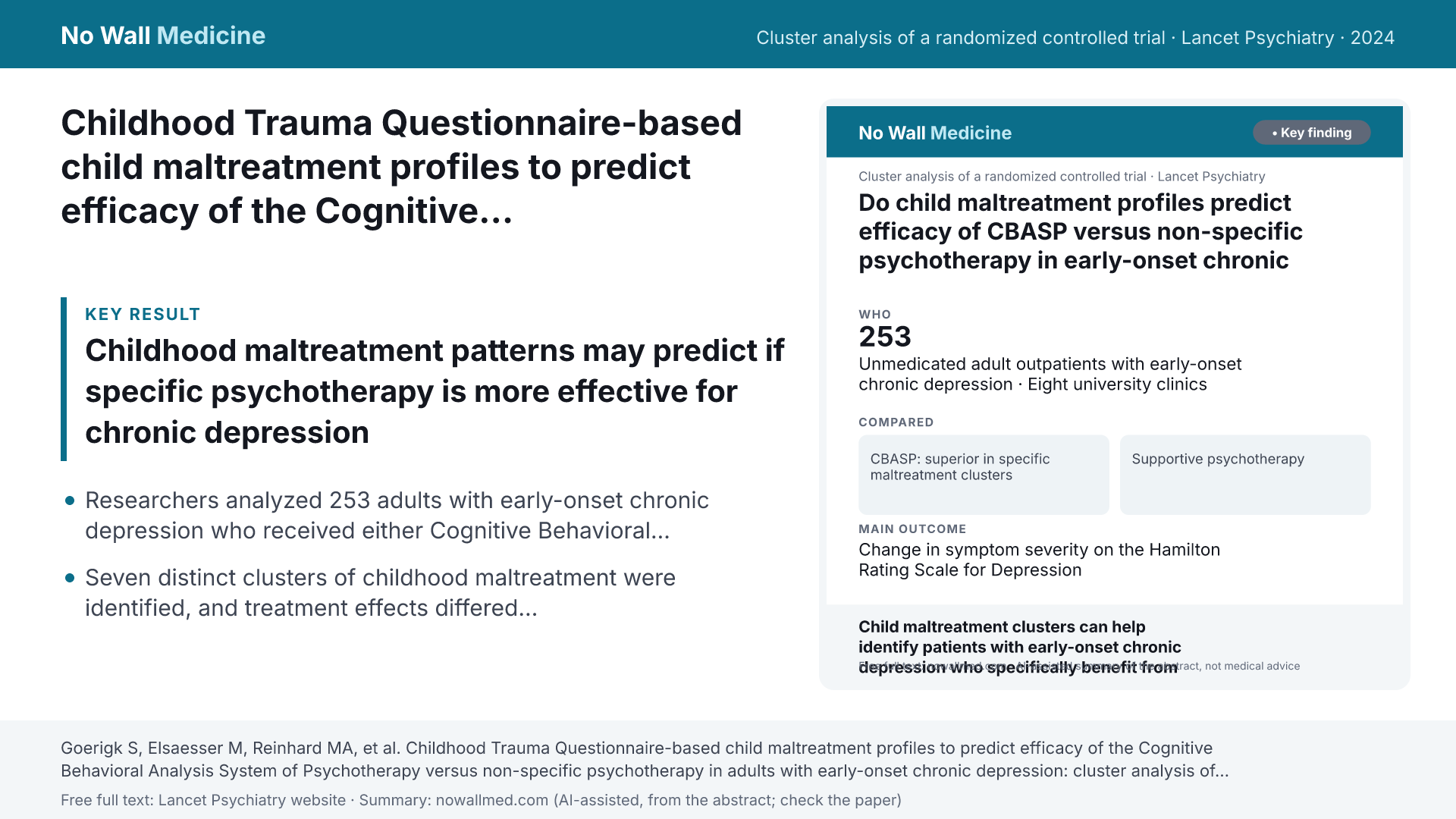
Childhood maltreatment patterns may predict if specific psychotherapy is more effective for chronic depression
Childhood Trauma Questionnaire-based child maltreatment profiles to predict efficacy of the Cognitive Behavioral Analysis System of Psychotherapy versus non-specific psychotherapy in adults with early-onset chronic depression: cluster analysis of data from a randomised controlled trial
Cluster analysis of a randomized controlled trialKey finding
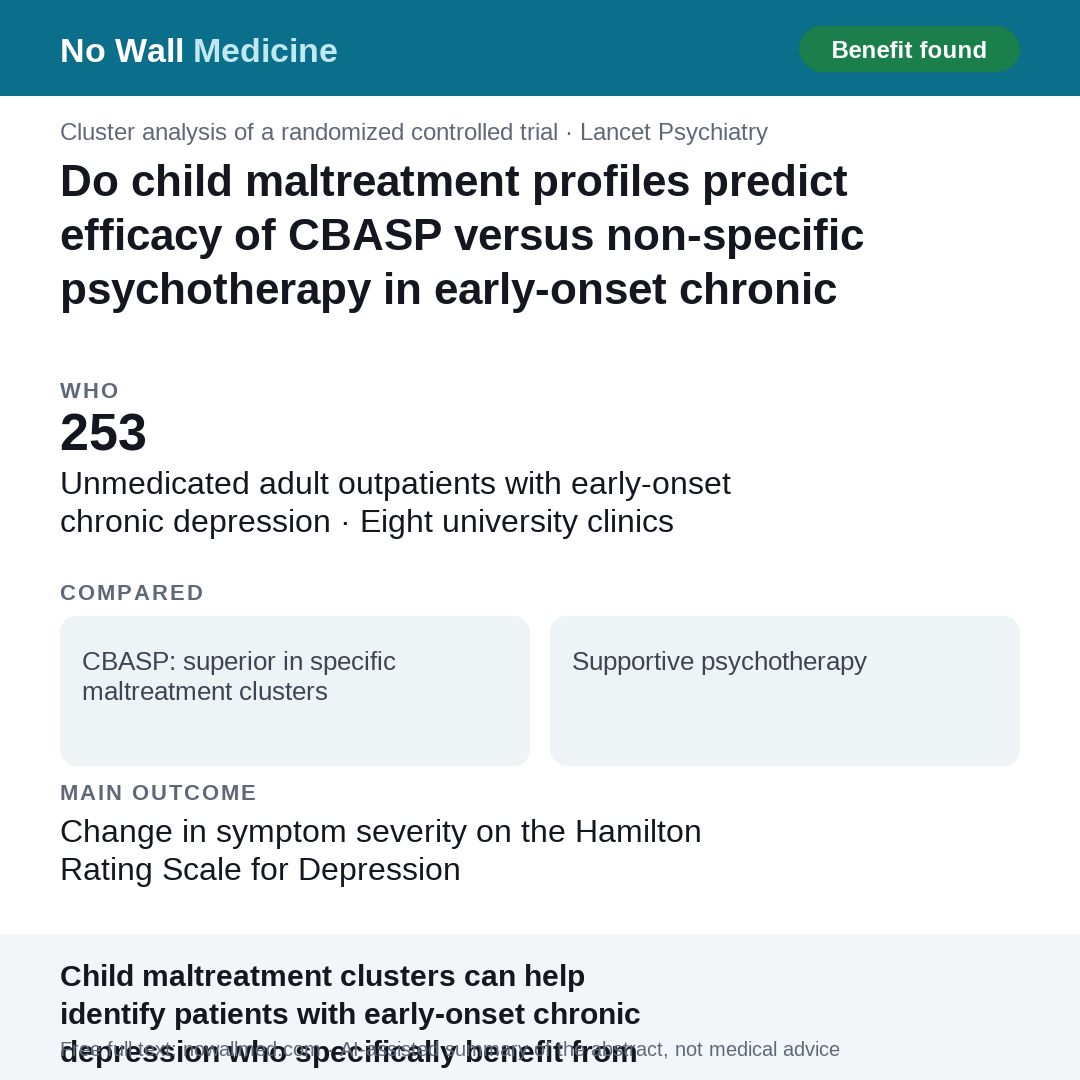
Do child maltreatment profiles predict efficacy of CBASP versus non-specific psychotherapy in early-onset chronic depression?
Who
253
Unmedicated adult outpatients with early-onset chronic depression · Eight university clinics and psychological institutes in Germany
Compared
CBASP: superior in specific maltreatment clusters
Supportive psychotherapy
Main outcome
Change in symptom severity on the Hamilton Rating Scale for Depression
Result: F(6,948·76)=2·47; p=0·023
Bottom line: Child maltreatment clusters can help identify patients with early-onset chronic depression who specifically benefit from CBASP.
Funded by: German Research Foundation and German Federal Ministry of Education and Research
Lancet Psychiatry · 2024-08-16Download image
Clinical question: Do child maltreatment profiles predict efficacy of CBASP versus non-specific psychotherapy in early-onset chronic depression?
Key points
- Researchers analyzed 253 adults with early-onset chronic depression who received either Cognitive Behavioral Analysis System of Psychotherapy or non-specific supportive psychotherapy.
- Seven distinct clusters of childhood maltreatment were identified, and treatment effects differed significantly between these groups (p=0.023) over a 2-year period.
- Cognitive Behavioral Analysis System of Psychotherapy showed greater symptom reduction in clusters involving predominant emotional neglect, emotional neglect and abuse, or emotional neglect combined with emotional and physical abuse.
Headline and key points written with AI from the paper’s abstract, with every number checked against it. Read the paper before relying on them.
Was this summary helpful?
Abstract
Background
Child maltreatment is a broadly confirmed risk factor for mental and physical illness. Some psychological treatments specifically target mental health conditions associated with child maltreatment. For example, the Cognitive Behavioral Analysis System of Psychotherapy (CBASP) focuses on maladaptive interpersonal behaviours in chronic depression. However, how the assessment of child maltreatment could inform personalised treatment is unclear. We used data from a previously published clinical trial to investigate whether a pre-established child maltreatment clustering approach predicts differential outcomes after CBASP versus non-specific supportive psychotherapy in patients with early-onset chronic depression. Methods
We did a cluster analysis of data from a previous randomised controlled trial of unmedicated adult outpatients with early-onset chronic depression who were treated at eight university clinics and psychological institutes in Germany with 32 sessions of CBASP or non-specific supportive psychotherapy. Participants were eligible for the original trial if they were aged 18-65 years; had major depressive disorder (MDD) with an early onset and duration of at least 2 years, current MDD superimposed on a pre-existing dysthymic disorder, or recurrent MDD with incomplete remission between episodes as defined by DSM-IV; and had a score of at least 20 points on the 24-item Hamilton Rating Scale for Depression (HRSD-24). Participants were included in the current study if they had completed the short form of the Childhood Trauma Questionnaire (CTQ) at trial baseline. We used an agglomerative hierarchical clustering approach to derive child maltreatment clusters from individual patterns across the five domains of the CTQ. We used linear mixed models to investigate whether clustering could predict differential clinical outcomes (change in symptom severity on the HRSD-24) up to 2 years after treatment onset. People with lived experience were involved in the current study. Findings
253 patients (129 [51%] treated with CBASP and 124 [49%] with supportive psychotherapy) had complete CTQ records and were included in the analysis. 169 (67%) participants were women, 84 (33%) were men, and the mean age was 45·9 years (SD 11·7). We identified seven child maltreatment clusters and found significant differences in treatment effects of CBASP and supportive psychotherapy between the clusters (F(6,948·76)=2·47; p=0·023); differences were maintained over the 2-year follow-up. CBASP was superior in distinct clusters of co-occurring child maltreatment: predominant emotional neglect (change in β -6·02 [95% CI -11·9 to -0·13]; Cohen's d=-0·98 [95% CI -1·94 to -0·02]; p=0·045), predominant emotional neglect and abuse (-6·39 [-10·22 to -2·56]; -1·04 [-1·67 to -0·42]; p=0·0011), and emotional neglect and emotional and physical abuse (-9·41 [-15·91 to -2·91]; -1·54 [-2·6 to -0·47]; p=0·0046). Interpretation
CTQ-based cluster analysis can facilitate identification of patients with early-onset chronic depression who would specifically benefit from CBASP. Child maltreatment clusters could be implemented in clinical assessments and serve to develop and personalise trauma-informed care in mental health. Funding
The German Research Foundation and the German Federal Ministry of Education and Research.
Abstract reproduced under the article’s CC BY NC ND licence.
Subject terms
Cite this article
Goerigk S, Elsaesser M, Reinhard MA, et al. Childhood Trauma Questionnaire-based child maltreatment profiles to predict efficacy of the Cognitive Behavioral Analysis System of Psychotherapy versus non-specific psychotherapy in adults with early-onset chronic depression: cluster analysis of data from a randomised controlled trial. Lancet Psychiatry. 2024. doi:10.1016/S2215-0366(24)00209-8
Spotted a mistake? Suggest a correction