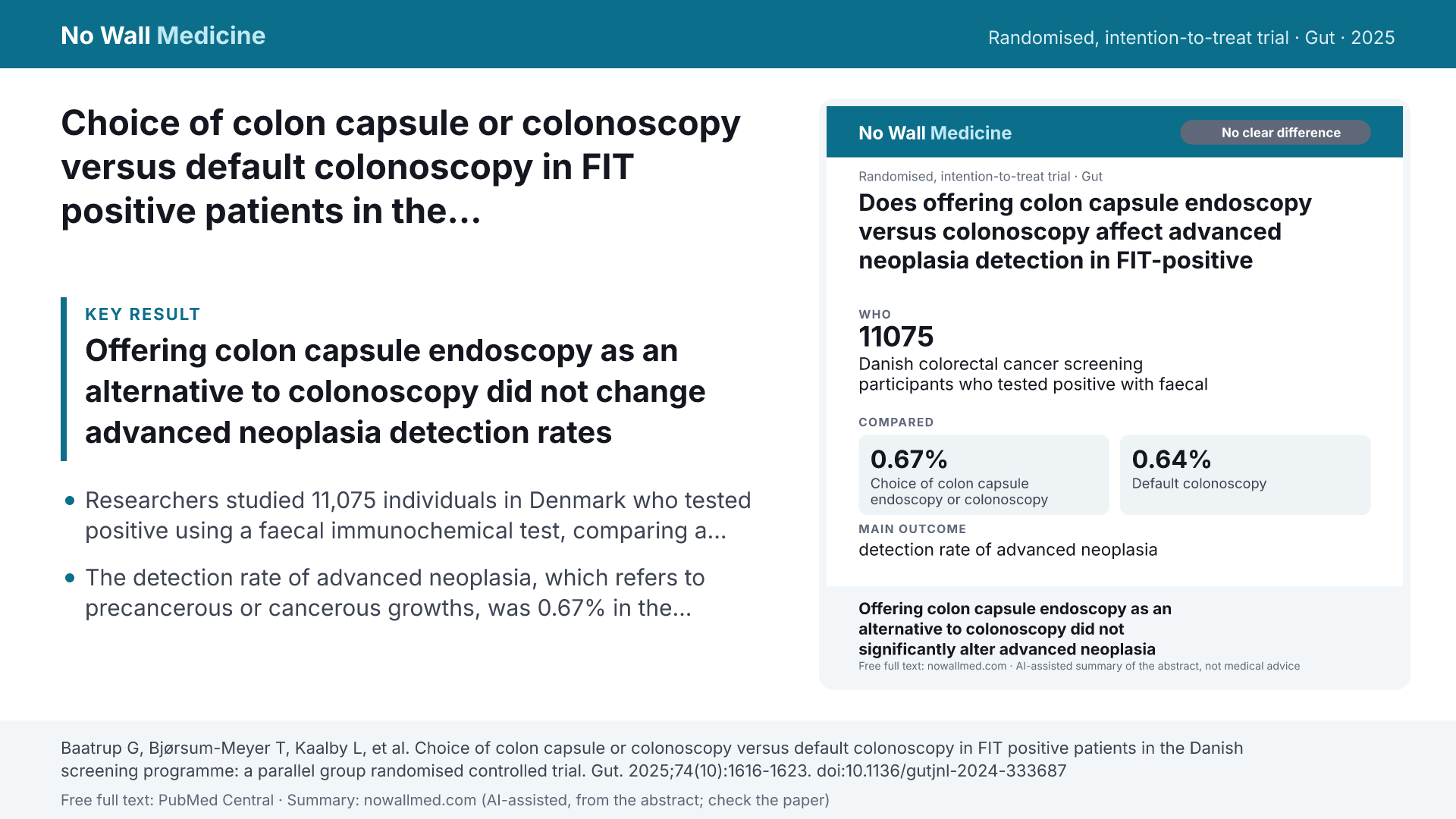
Offering colon capsule endoscopy as an alternative to colonoscopy did not change advanced neoplasia detection rates
Choice of colon capsule or colonoscopy versus default colonoscopy in FIT positive patients in the Danish screening programme: a parallel group randomised controlled trial
Randomised, intention-to-treat trialNo clear difference
Does offering colon capsule endoscopy versus colonoscopy affect advanced neoplasia detection in FIT-positive patients?
Who
11075
Danish colorectal cancer screening participants who tested positive with faecal immunochemical test · Denmark
Compared
0.67%Choice of colon capsule endoscopy or colonoscopy
0.64%Default colonoscopy
Main outcome
detection rate of advanced neoplasia
Bottom line: Offering colon capsule endoscopy as an alternative to colonoscopy did not significantly alter advanced neoplasia detection rates.
Gut · 2025-09-08 · Save PNG
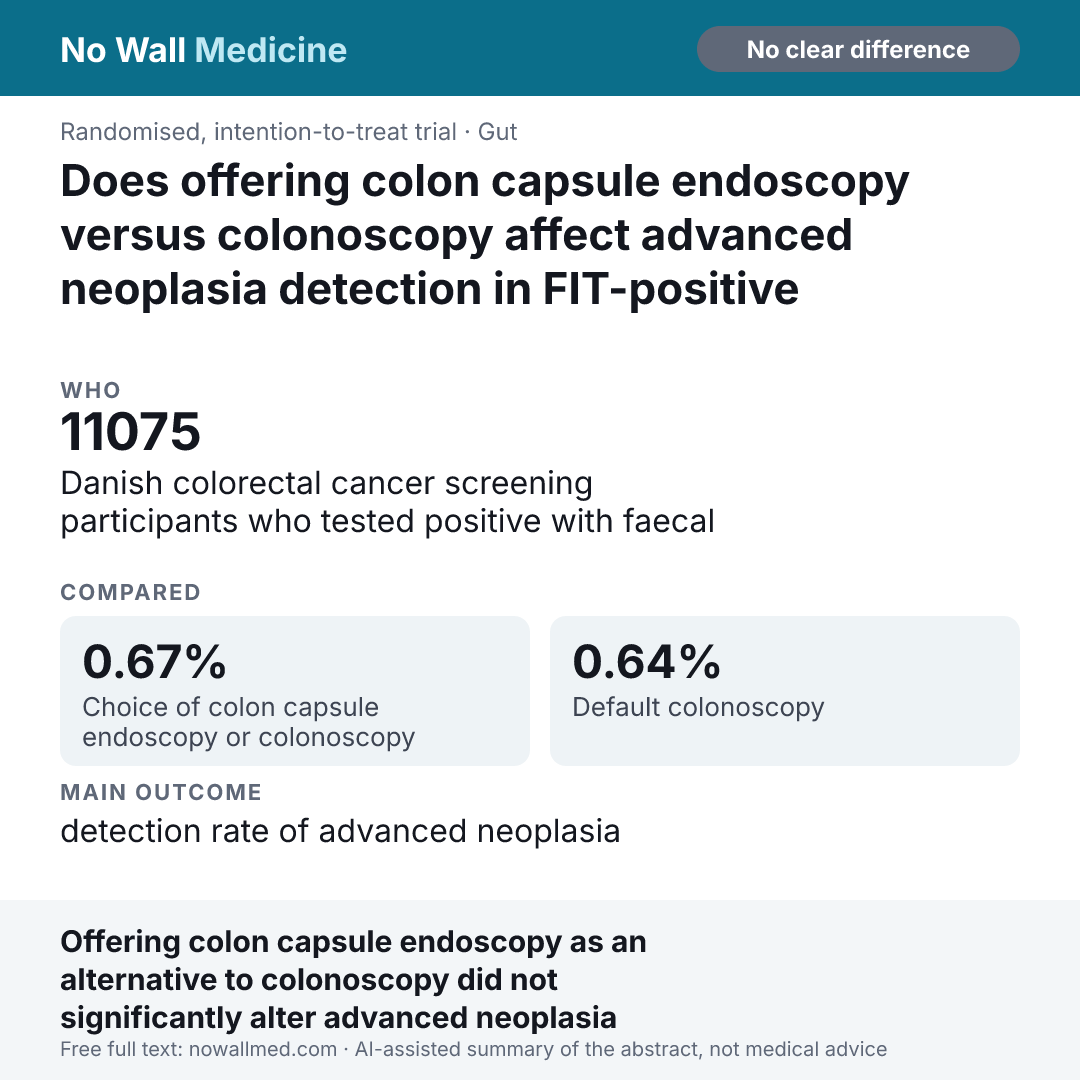
Clinical question: Does offering colon capsule endoscopy versus colonoscopy affect advanced neoplasia detection in FIT-positive patients?
Key points
- Researchers studied 11,075 individuals in Denmark who tested positive using a faecal immunochemical test, comparing a choice between colon capsule endoscopy and colonoscopy against a colonoscopy-only group.
- The detection rate of advanced neoplasia, which refers to precancerous or cancerous growths, was 0.67% in the group offered a choice and 0.64% in the control group.
- In the group offered a choice, 45.8% preferred colon capsule endoscopy, but 69.9% of those patients were eventually referred for a follow-up colonoscopy.
Headline and key points written with AI from the paper’s abstract, with every number checked against it. Read the paper before relying on them.
Was this summary helpful?
Abstract
Background
Colonoscopy is among the standard tests for colorectal cancer (CRC) screening. However, uptake varies, and alternatives such as colon capsule endoscopy (CCE) are available. The uptake and detection rate of clinically significant neoplasia with CCE, compared with colonoscopy, remain unclear in this setting. Objective
The primary objective of this study was to compare the detection rates of advanced neoplasia between CCE and colonoscopy, using a pathway in which the study group could choose between the two procedures, while the control group was offered only colonoscopy. Design
A randomised, intention-to-treat trial was conducted among Danish CRC screening participants who tested positive with a faecal immunochemical test (FIT). The trial compared the detection rate of advanced neoplasia (primary outcome) and the uptake rate of both approaches between the two arms. Results
A total of 473 684 invitations were sent to 396 676 individuals, with 62.6% returning the test. Among them, 11 075 tests were positive (4.5%), with no significant differences between the two study groups. Among FIT-positive cases, the uptake for colonoscopy was 91.1% in the control arm and 91.7% in the study arm, where participants had a choice of methods. In the study arm, 45.8% preferred CCE, 11.4% preferred colonoscopy and 42.8% had no preference and underwent colonoscopy. Ultimately, 69.9% of patients who initially opted for CCE were later referred for colonoscopy. The rate of advanced neoplasia detection was similar between the groups: 0.67% in the study arm versus 0.64% in the control arm. Conclusion
Offering CCE as an alternative to colonoscopy did not significantly alter the detection rate of advanced neoplasia, nor did it increase uptake in a screening programme with high adherence to colonoscopy following a positive FIT test. Instead, it led to a very high rate of secondary colonoscopies. Therefore, CCE cannot be recommended in this setting. Trial registration number
NCT04049357 (ClinicalTrials.gov).
Abstract reproduced under the article’s CC BY NC licence.
Subject terms
Headline, design, result, key points, caveat and citation as plain text.
Cite this article
Baatrup G, Bjørsum-Meyer T, Kaalby L, et al. Choice of colon capsule or colonoscopy versus default colonoscopy in FIT positive patients in the Danish screening programme: a parallel group randomised controlled trial. Gut. 2025;74(10):1616-1623. doi:10.1136/gutjnl-2024-333687
Spotted a mistake? Suggest a correction