Chronic obstructive pulmonary disease was associated with an increased risk of cognitive impairment
Chronic obstructive pulmonary disease as a risk factor for cognitive impairment: a systematic review and meta-analysis
Systematic review and meta-analysisHarm found
Is chronic obstructive pulmonary disease an independent risk factor for cognitive impairment?
Who
625644
People with and without chronic obstructive pulmonary disease
Compared
Patients with chronic obstructive pulmonary disease
Those without chronic obstructive pulmonary disease
Main outcome
Risk of cognitive impairment
Bottom line: Patients with chronic obstructive pulmonary disease have a higher risk of developing cognitive impairment.
BMJ Open Respir Res · 2024-11-28Download image
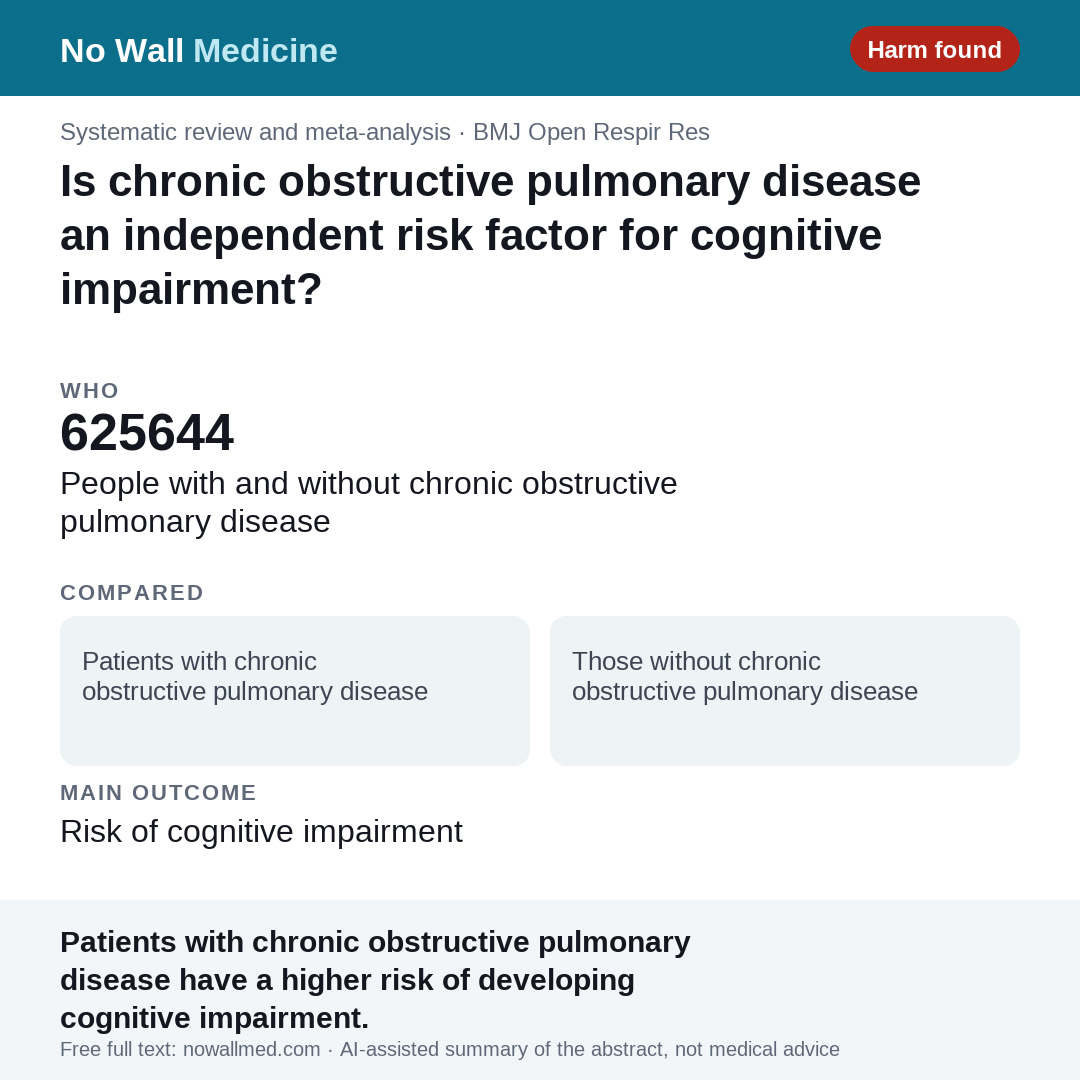
Clinical question: Is chronic obstructive pulmonary disease an independent risk factor for cognitive impairment?
Why it matters: Discrepancies in prevalence rates exist due to diverse study designs, participant ages, and assessment methodologies, leaving the role of chronic obstructive pulmonary disease as an independent risk factor controversial.
Key points
- Researchers analyzed 12 studies involving 625,644 people to determine if chronic obstructive pulmonary disease was a risk factor for cognitive impairment.
- Patients with chronic obstructive pulmonary disease were associated with an increased risk of cognitive impairment compared to those without the condition.
- The association was not significantly different based on sex or age, and the condition was associated with a higher risk of non-amnestic mild cognitive impairment.
Headline and key points written with AI from the paper’s abstract, with every number checked against it. Read the paper before relying on them.
Abstract
Background
Cognitive impairment is affecting plenty of patients with chronic obstructive pulmonary disease (COPD), and it is the main leading cause of quality of life to varying degrees. However, there are still wide discrepancies in these prevalence rates can be attributed to the diversity in study designs, participant age ranges, inclusion criteria and the methodologies used for assessment. Previous studies revealed the association between COPD and cognitive impairment, but the conclusions remain controversial. Objectives
The current systematic review aimed to investigate whether COPD is an independent risk factor for cognitive impairment. Study design
A systematic review and meta-analysis. Data sources
PubMed, Cochrane Library, MEDLINE, Embase, Web of Science, China Knowledge Resource Integrated Database, Wanfang Database, Chinese Biomedical Database and Weipu Database were searched from inception to 1 December 2022. Eligibility criteria
The inclusion criteria involved studies that reported cognitive impairment in COPD. We just included cohort designs, published in English or Chinese language. Data extraction and synthesis
Two reviewers independently extracted and assessed the quality of data using Newcastle-Ottawa Quality Assessment Scale. The outcomes were assessed with random-effects model and reported as the HR with 95% CI using the Review Manager software. Results
12 studies from 10 articles reporting on 625 644 people were included. The findings indicated that compared with those without COPD at baseline, patients with COPD were associated with an increased risk of cognitive impairment. Subgroup analysis showed the association was not significantly different in sex and age, and the subgroup supports that COPD has a higher risk of non-amnestic mild cognitive impairment (na-MCI) than amnestic MCI. Conclusions
Patients with COPD have a higher risk of developing cognitive impairment and are more likely to cause na-MCI compared with those without COPD, and this risk is not affected by gender or age. Therefore, continuous monitoring of cognitive function in COPD is critical. Prospero registration number
CRD42021285913.
Abstract reproduced under the article’s CC BY NC licence.
Topics
Cite this article
Chen X, Yu Z, Liu Y, Zhao Y, Li S, Wang L. Chronic obstructive pulmonary disease as a risk factor for cognitive impairment: a systematic review and meta-analysis. BMJ Open Respir Res. 2024. doi:10.1136/bmjresp-2023-001709
Spotted a mistake? Suggest a correction
Top studies every Monday
The week’s key trials and guidelines in your specialties, by email. Free.
Get the weekly digest