Chronic Stroke Sensorimotor Impairment Is Related to Smaller Hippocampal Volumes: An ENIGMA Analysis
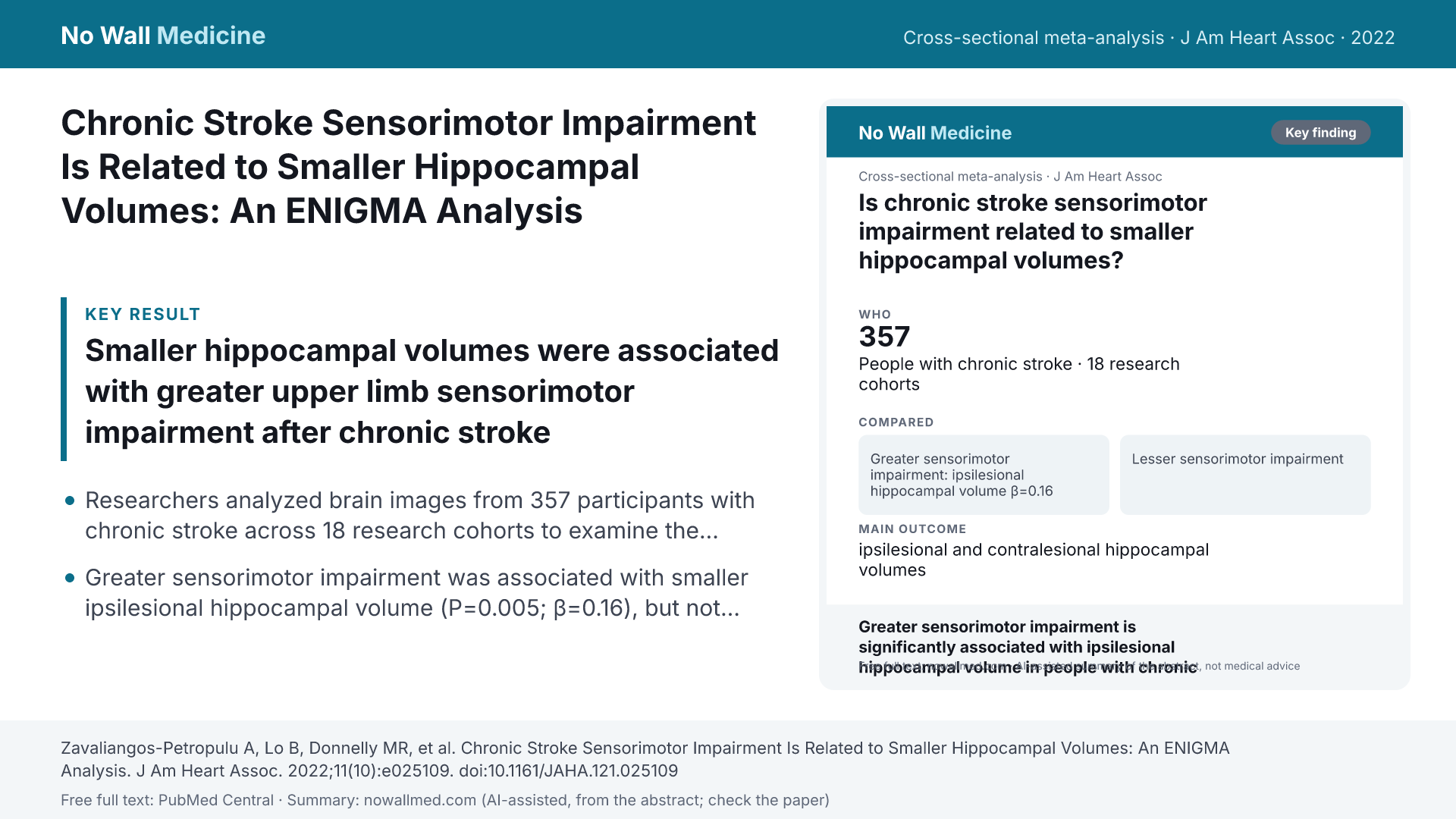
Key result: Smaller hippocampal volumes were associated with greater upper limb sensorimotor impairment after chronic stroke
Cross-sectional meta-analysisBenefit found
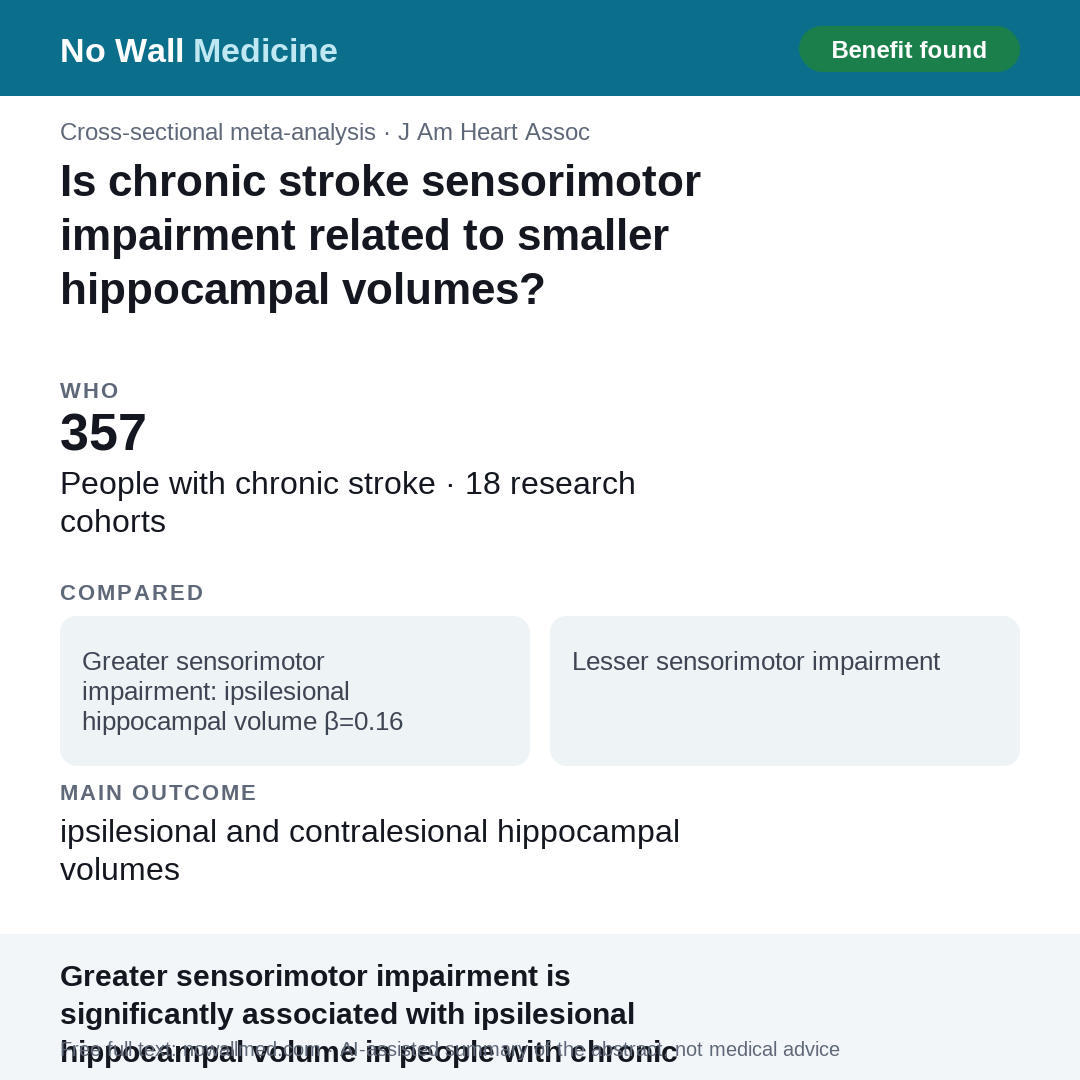
Is chronic stroke sensorimotor impairment related to smaller hippocampal volumes?
Who
357
People with chronic stroke · 18 research cohorts
Compared
Greater sensorimotor impairment: ipsilesional hippocampal volume β=0.16
Lesser sensorimotor impairment
Main outcome
ipsilesional and contralesional hippocampal volumes
Bottom line: Greater sensorimotor impairment is significantly associated with ipsilesional hippocampal volume in people with chronic stroke.
J Am Heart Assoc · 2022-05-16Download image
Key points
- Researchers analyzed brain images from 357 participants with chronic stroke across 18 research cohorts to examine the link between hippocampal volume and motor impairment.
- Greater sensorimotor impairment was associated with smaller ipsilesional hippocampal volume (P=0.005; β=0.16), but not with contralesional hippocampal volume (P=0.96; β=0.003).
- In women, worsening sensorimotor impairment was associated with smaller volumes in both the ipsilesional (P=0.008; β=-0.26) and contralesional (P=0.006; β=-0.27) hippocampus.
Why it matters: It was unknown if the volume of the hippocampus, a brain region involved in sensorimotor behavior, is associated with upper limb impairment in chronic stroke survivors.
Discussion prompts
- Would these patients look like yours? Who was left out?
- Is the main outcome one that matters to patients?
- Is the difference large enough to change what you do?
Cite: Zavaliangos-Petropulu A, Lo B, Donnelly MR, et al. Chronic Stroke Sensorimotor Impairment Is Related to Smaller Hippocampal Volumes: An ENIGMA Analysis. J Am Heart Assoc. 2022. doi:10.1161/JAHA.121.025109
Free full text: PubMed Central · Summary and visual abstract: nowallmed.com/a/chronic-stroke-sensorimotor-impairment-is-related-to-smaller-rvgpal/ (AI-assisted from the abstract; check the paper before relying on it).