Earlier second-line medication administration was associated with better outcomes in patients with status epilepticus
Chronological Sequence of Convulsive Status Epilepticus Treatment Steps in a Real-Life Scenario for Patients Enrolled in a Large Multicenter Trial
Secondary analysis of a randomized trialBenefit found
How does the timing of treatment steps affect success in convulsive status epilepticus?
Who
487
Patients aged 2 years or older with generalized convulsive status epilepticus · Multicenter trial
Compared
46%Achieved treatment success
Did not achieve treatment success
Main outcome
Treatment success defined as seizure cessation and improved mental status
Bottom line: Earlier administration of second-line therapy was significantly associated with treatment success in patients with status epilepticus.
Limitation: In-hospital treatment timing was inconsistent and prehospital benzodiazepine use was often absent.
Acad Emerg Med · 2026-03-19Download image
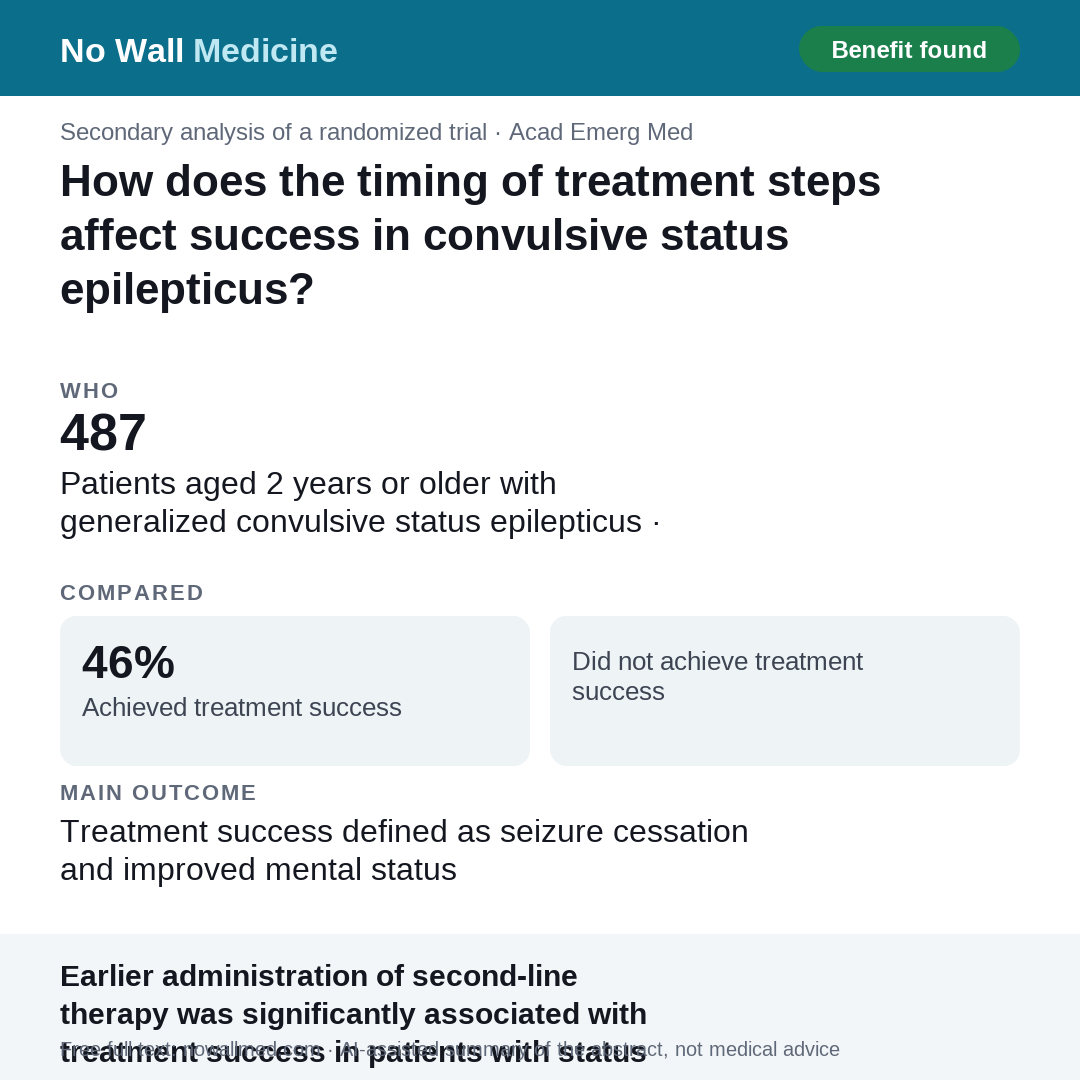
Clinical question: How does the timing of treatment steps affect success in convulsive status epilepticus?
Why it matters: Delays in managing status epilepticus in real-world settings may worsen patient outcomes despite existing treatment guidelines.
Key points
- Researchers analyzed 487 patients aged 2 years or older who experienced generalized convulsive status epilepticus, a medical emergency involving continuous seizures.
- The median time from emergency department arrival to first benzodiazepine was 11 minutes (IQR 5-41) and to second-line antiseizure medications was 26 minutes (IQR 18-43).
- Earlier administration of second-line therapy was significantly associated with treatment success, which was defined as seizure cessation and improved mental status at 60 minutes.
Headline and key points written with AI from the paper’s abstract, with every number checked against it. Read the paper before relying on them.
Topics
Cite this article
Zehtabchi S, Beall J, Silbergleit R, Durkalski-Mauldin V, Rosenthal ES, Chamberlain JM. Chronological Sequence of Convulsive Status Epilepticus Treatment Steps in a Real-Life Scenario for Patients Enrolled in a Large Multicenter Trial. Acad Emerg Med. 2026. doi:10.1111/acem.70265
Spotted a mistake? Suggest a correction