Copanlisib plus rituximab-based chemotherapy showed no difference in progression-free survival for relapsed indolent B-cell lymphoma
CHRONOS-4: phase 3 study of copanlisib plus rituximab-based immunochemotherapy in relapsed indolent B-cell lymphoma
Phase 3, randomized, double-blind, placebo-controlled studyNo clear difference
Does copanlisib plus rituximab-based immunochemotherapy improve efficacy in relapsed indolent B-cell lymphoma?
Who
524
Patients with relapsed indolent non-Hodgkin lymphoma
Compared
32.9 monthsCopanlisib plus rituximab and bendamustine (95% CI, 24.4-38.6)
33.3 monthsPlacebo plus rituximab and bendamustine (95% CI, 27.8-42.8)
Main outcome
progression-free survival
Result: hazard ratio 1.13 (95% CI 0.88-1.44)
Bottom line: Copanlisib plus rituximab-based immunochemotherapy did not provide clinical benefit and was associated with worse tolerability.
Blood Adv · 2024-07-26Download image
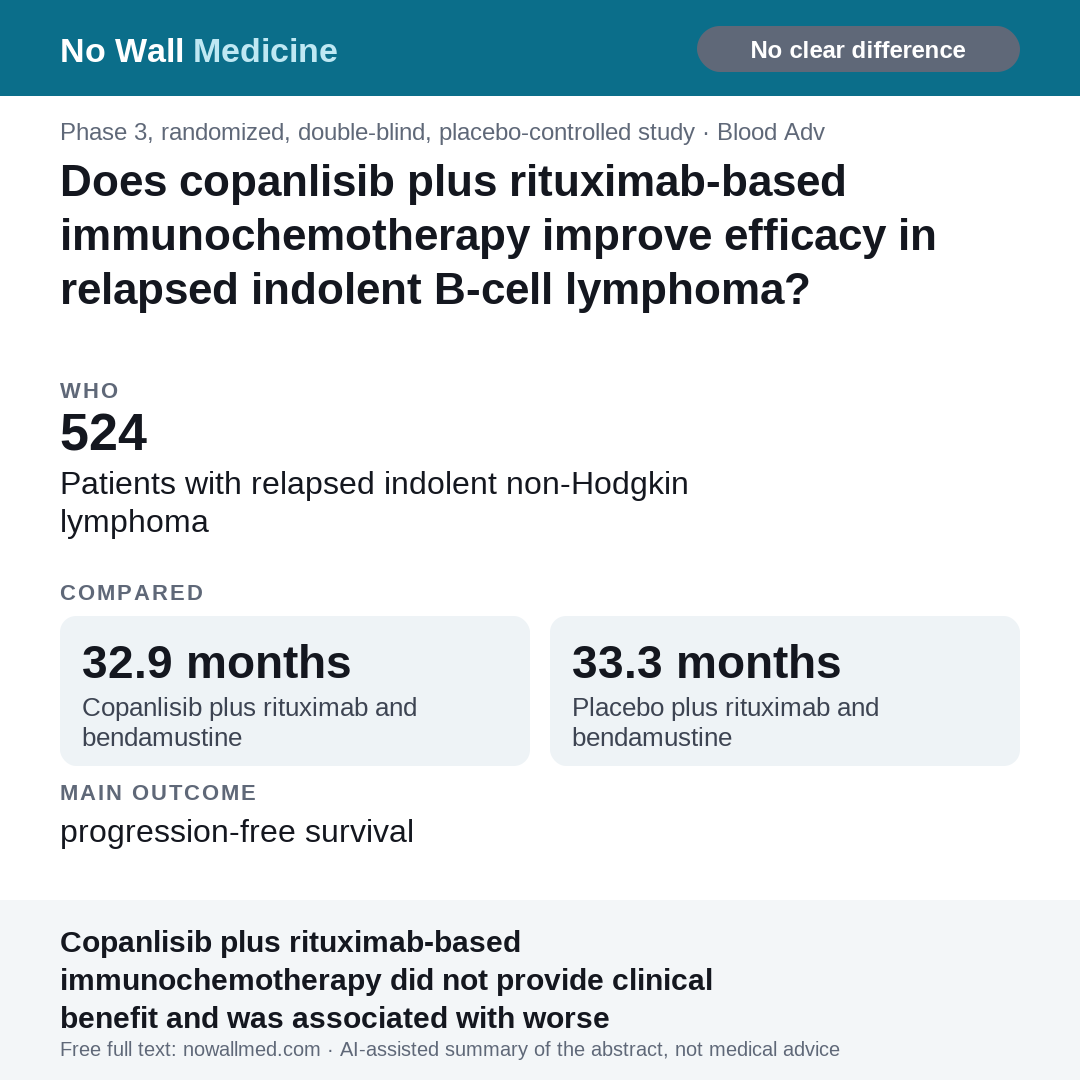
Clinical question: Does copanlisib plus rituximab-based immunochemotherapy improve efficacy in relapsed indolent B-cell lymphoma?
Why it matters: It was unknown if adding copanlisib to standard immunochemotherapy would improve progression-free survival in patients with relapsed indolent non-Hodgkin lymphoma.
Key points
- Researchers studied 524 patients with relapsed indolent non-Hodgkin lymphoma, comparing copanlisib plus rituximab and bendamustine to placebo plus rituximab and bendamustine.
- The median progression-free survival was 32.9 months for the copanlisib group and 33.3 months for the placebo group, showing no significant difference.
- Copanlisib plus rituximab and bendamustine was associated with higher rates of serious treatment-emergent adverse events, grade 4 and 5 adverse events, and treatment discontinuation.
Headline and key points written with AI from the paper’s abstract, with every number checked against it. Read the paper before relying on them.
Abstract
Copanlisib, a pan-class I phosphatidylinositol 3-kinase inhibitor with predominant activity against the α and δ isoforms, previously demonstrated durable responses as monotherapy and improved progression-free survival (PFS) in combination with rituximab in patients with relapsed indolent non-Hodgkin lymphoma (iNHL). CHRONOS-4 was a phase 3, randomized, double-blind, placebo-controlled study to investigate the efficacy and safety of copanlisib in combination with standard immunochemotherapy in patients with relapsed iNHL. Patients (n = 524) were randomized (1:1) to copanlisib (60 mg IV) plus immunochemotherapy (rituximab and bendamustine [R-B] or placebo plus R-B). Copanlisib/placebo were administered with R-B (days 1, 8, and 15 of each 28-day cycle) for ≤6 cycles and as monotherapy from cycle 7 up to 12 months. The primary study end point was PFS. Median exposure was 8.5 months (0.2-12.9) for copanlisib plus R-B and 11.4 months (0.1-12.6) for placebo plus R-B. Median PFS was 32.9 months (95% confidence interval [CI], 24.4-38.6) for copanlisib plus R-B and 33.3 months (95% CI, 27.8-42.8) for placebo plus R-B (hazard ratio, 1.13; 95% CI, 0.88-1.44; P = .83). No differences between treatment arms were observed in overall survival (data not yet mature), objective response rate, and duration of response for the overall population or individual histology types. Overall, copanlisib plus R-B was associated with higher rates of serious treatment-emergent adverse events (TEAEs), grade 4 and 5 TEAEs, and treatment discontinuation. A number of serious TEAEs were infections. Overall, copanlisib plus R-B did not provide clinical benefit vs placebo plus R-B and was associated with worse tolerability in patients with relapsed iNHL. This trial was registered at www.ClinicalTrials.gov as #NCT02626455.
Abstract reproduced under the article’s CC BY NC ND licence.
Topics
Cite this article
Zinzani PL, Wang H, Feng J, Kim TM, Tao R, Zhang H. CHRONOS-4: phase 3 study of copanlisib plus rituximab-based immunochemotherapy in relapsed indolent B-cell lymphoma. Blood Adv. 2024. doi:10.1182/bloodadvances.2024013236
Spotted a mistake? Suggest a correction
Top studies every Monday
The week’s key trials and guidelines in your specialties, plus any topics you follow. By email, free.
Get the weekly digest