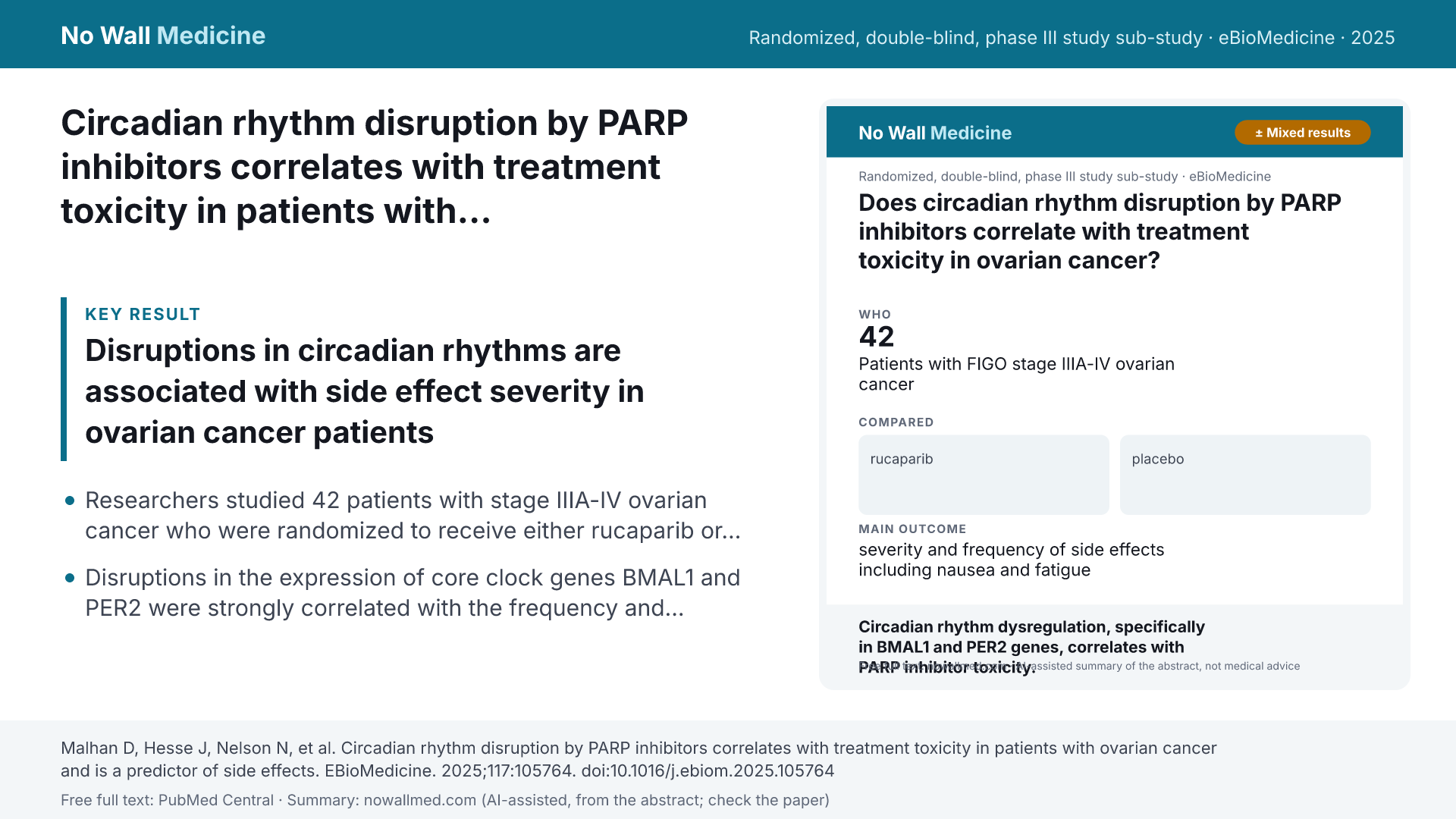
Disruptions in circadian rhythms are associated with side effect severity in ovarian cancer patients
Circadian rhythm disruption by PARP inhibitors correlates with treatment toxicity in patients with ovarian cancer and is a predictor of side effects
Randomized, double-blind, phase III study sub-studyMixed results
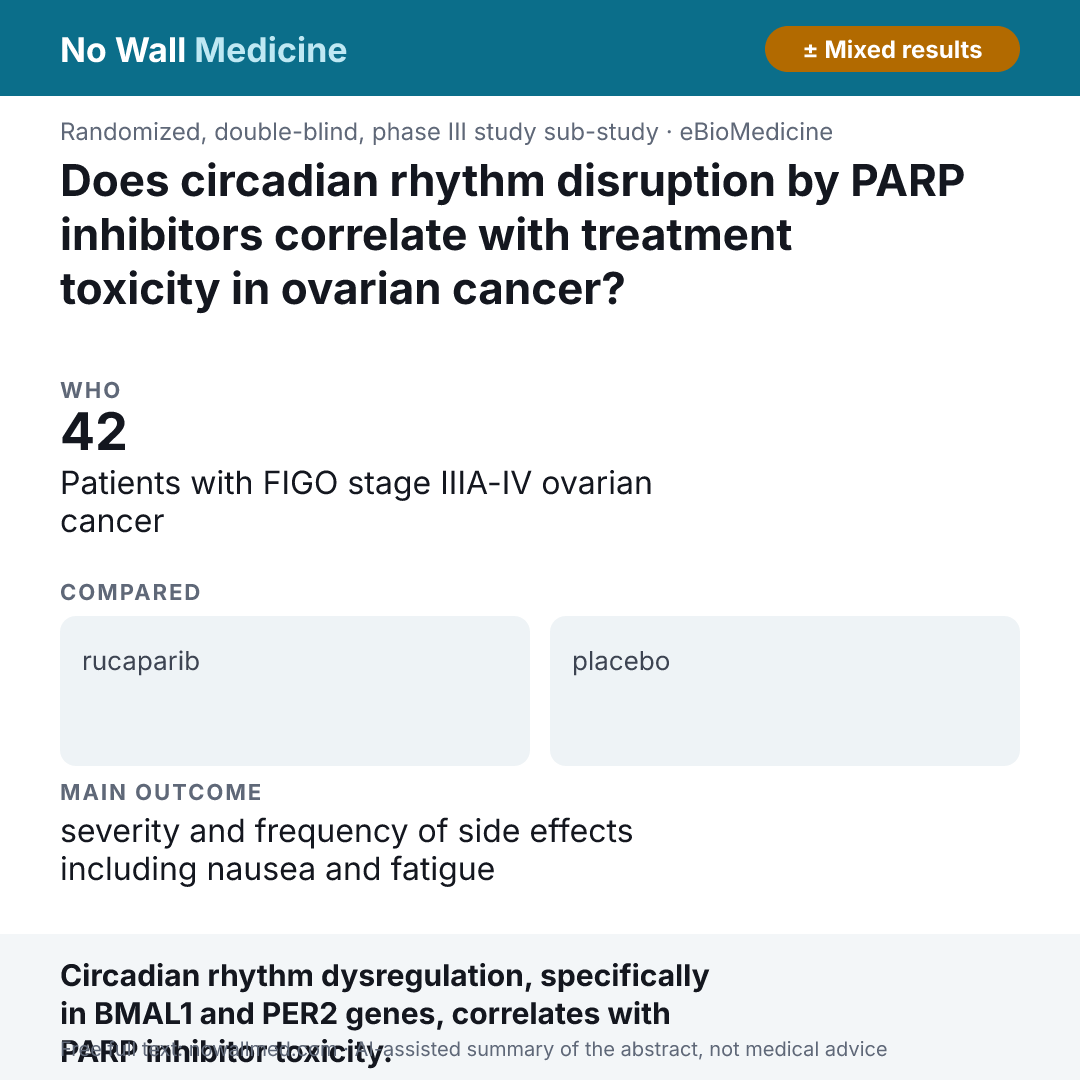
Does circadian rhythm disruption by PARP inhibitors correlate with treatment toxicity in ovarian cancer?
Who
42
Patients with FIGO stage IIIA-IV ovarian cancer
Compared
rucaparib
placebo
Main outcome
severity and frequency of side effects including nausea and fatigue
Bottom line: Circadian rhythm dysregulation, specifically in BMAL1 and PER2 genes, correlates with PARP inhibitor toxicity.
Funded by: Dr. Rolf Schwiete Stiftung, MSH Medical School Hamburg, and Clovis Oncology
eBioMedicine · 2025-05-16 · Save PNG
Clinical question: Does circadian rhythm disruption by PARP inhibitors correlate with treatment toxicity in ovarian cancer?
Why it matters: Treatment-related toxicity from PARP inhibitors remains a challenge that impacts patient quality of life and adherence to treatment.
Key points
- Researchers studied 42 patients with stage IIIA-IV ovarian cancer who were randomized to receive either rucaparib or a placebo.
- Disruptions in the expression of core clock genes BMAL1 and PER2 were strongly correlated with the frequency and severity of nausea and fatigue.
- Rucaparib therapy was associated with altered expression of clock-controlled genes including SIRT1, BRCA1, BRCA2, and TP53.
Headline and key points written with AI from the paper’s abstract, with every number checked against it. Read the paper before relying on them.
Was this summary helpful?
Subject terms
Headline, design, result, key points, caveat and citation as plain text.
Cite this article
Malhan D, Hesse J, Nelson N, et al. Circadian rhythm disruption by PARP inhibitors correlates with treatment toxicity in patients with ovarian cancer and is a predictor of side effects. EBioMedicine. 2025;117:105764. doi:10.1016/j.ebiom.2025.105764
Spotted a mistake? Suggest a correction