Circadian rhythm disruption in animal models is linked to increased heart muscle mass and size
Circadian rhythm disruption in cardiovascular disease: a systematic review and meta-analysis of mechanistic evidence from animal models
Systematic review and meta-analysisHarm found
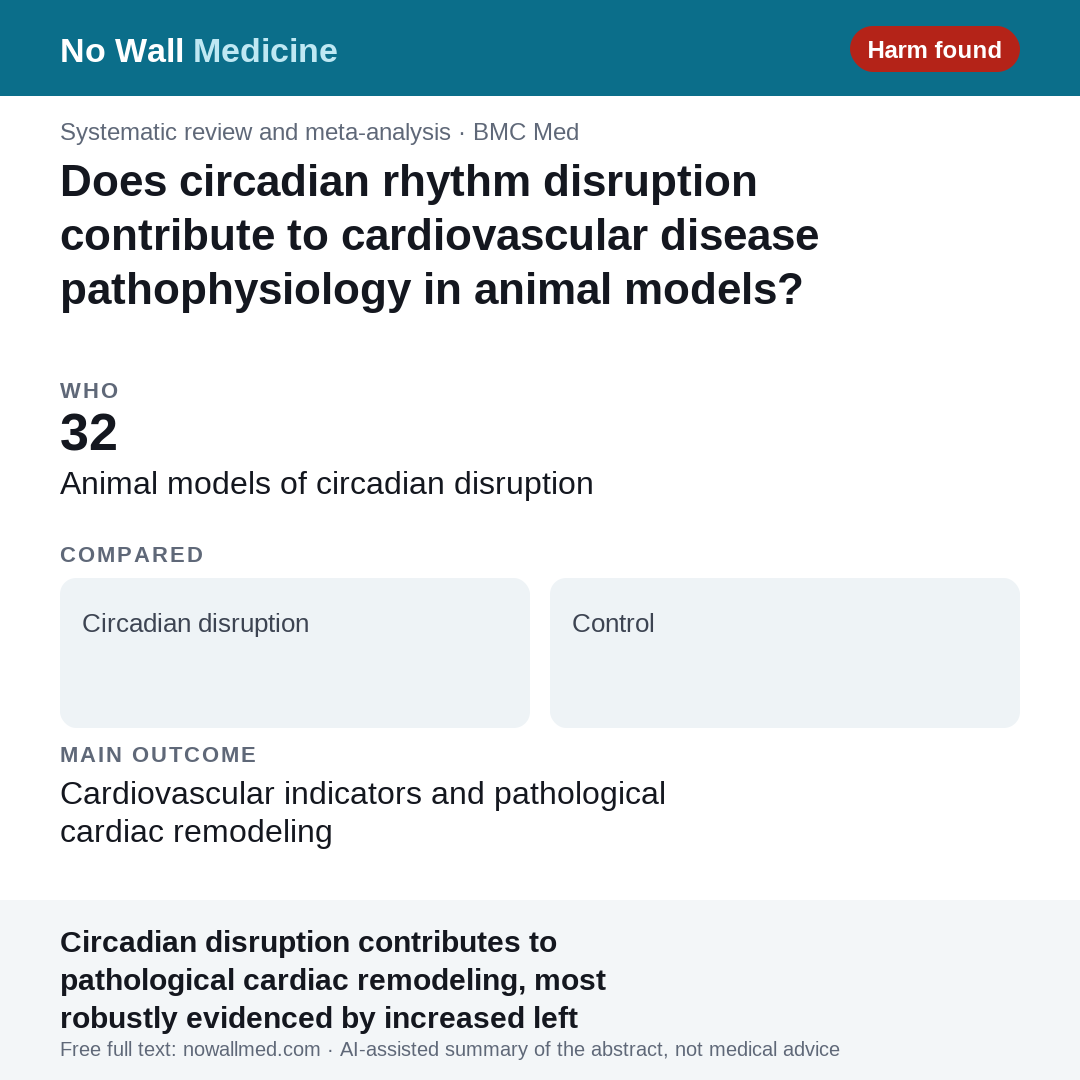
Does circadian rhythm disruption contribute to cardiovascular disease pathophysiology in animal models?
Who
32
Animal models of circadian disruption
Compared
Circadian disruption
Control
Main outcome
Cardiovascular indicators and pathological cardiac remodeling
Result: left ventricular mass-to-body weight ratio SMD: 0.89 (95% CI: 0.38 to 1.39)
Bottom line: Circadian disruption contributes to pathological cardiac remodeling, most robustly evidenced by increased left ventricular mass-to-body weight ratio.
Limitation: Substantial epidemiological gaps remain and future research needs standardized protocols and sex-balanced designs.
BMC Med · 2026-01-09Download image
Clinical question: Does circadian rhythm disruption contribute to cardiovascular disease pathophysiology in animal models?
Why it matters: It is unclear through what molecular mechanisms circadian rhythm disruption, such as that caused by shift work, contributes to cardiovascular disease.
Key points
- Researchers analyzed 32 studies using animal models with genetic or environmental disruptions to the internal biological clock.
- The analysis found high-certainty evidence for increased left ventricular mass-to-body weight ratio (SMD: 0.89, 95% CI: 0.38 to 1.39) and moderate-certainty evidence for larger heart muscle cells.
- Low-certainty evidence also showed reduced ejection fraction (SMD: -1.70, 95% CI: -3.22 to -0.17) and increased triglyceride levels (SMD: 1.64, 95% CI: 0.07 to 3.21).
Limitation the authors note: The authors note that future research should prioritize standardized protocols, sex-balanced designs, and environmental models that replicate human shiftwork patterns.
Headline and key points written with AI from the paper’s abstract, with every number checked against it. Read the paper before relying on them.
Topics
Cite this article
Das MK, De Ryck E, Jorgensen IL, Zienolddiny-Narui S, Erdem JS. Circadian rhythm disruption in cardiovascular disease: a systematic review and meta-analysis of mechanistic evidence from animal models. BMC Med. 2026. doi:10.1186/s12916-025-04572-3
Spotted a mistake? Suggest a correction