Circuit-based paired associative stimulation improved delayed memory recall in adults with amnestic mild cognitive impairment
Circuit-based neuromodulation enhances delayed recall in amnestic mild cognitive impairment
Parallel-group, randomised, controlled clinical trialBenefit found
Does circuit-based paired associative stimulation enhance delayed recall in amnestic mild cognitive impairment?
Who
42
Adults diagnosed with amnestic mild cognitive impairment
Compared
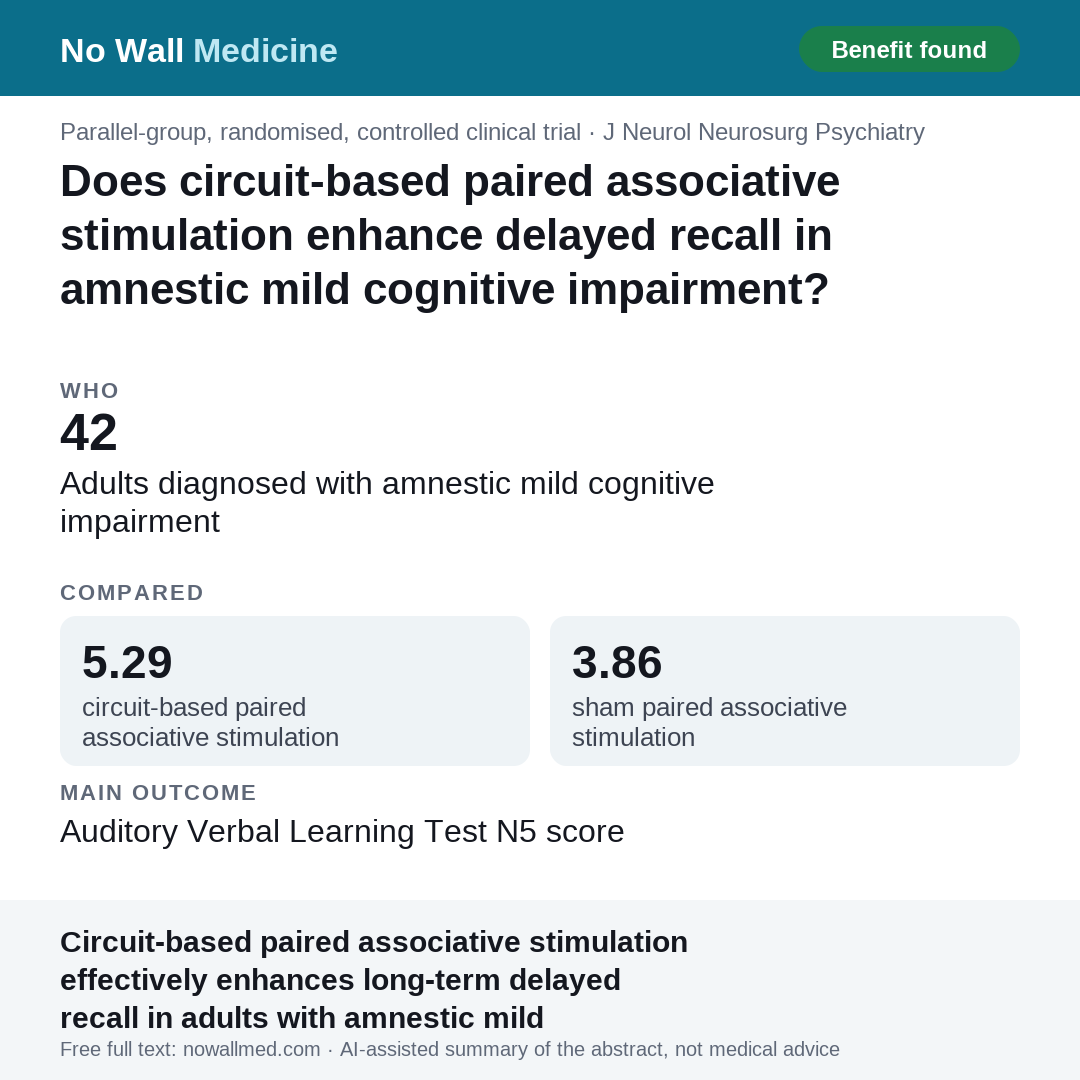
5.29circuit-based paired associative stimulation (1.98)
3.86sham paired associative stimulation (2.39)
Main outcome
Auditory Verbal Learning Test N5 score
Result: Cohen's d=0.97
Bottom line: Circuit-based paired associative stimulation effectively enhances long-term delayed recall in adults with amnestic mild cognitive impairment.
J Neurol Neurosurg Psychiatry · 2024-09-17Download image
Clinical question: Does circuit-based paired associative stimulation enhance delayed recall in amnestic mild cognitive impairment?
Why it matters: It was unknown if circuit-based paired associative stimulation, a form of brain stimulation, could effectively enhance long-term delayed memory recall in adults with amnestic mild cognitive impairment.
Key points
- Researchers conducted a randomized controlled trial with 42 patients diagnosed with amnestic mild cognitive impairment, comparing circuit-based paired associative stimulation to a sham treatment.
- The circuit-based paired associative stimulation group showed an increase in Auditory Verbal Learning Test scores from 2.43 (1.43) to 5.29 (1.98), while the sham group increased from 2.52 (1.44) to 3.86 (2.39).
- Memory improvements in the treatment group were associated with a significant decrease in functional connectivity, or the strength of communication between brain regions, between the left hippocampus and left precuneus.
Headline and key points written with AI from the paper’s abstract, with every number checked against it. Read the paper before relying on them.
Abstract
Background
This study aimed to investigate the efficacy of circuits-based paired associative stimulation (PAS) in adults with amnestic mild cognitive impairment (aMCI). Methods
We conducted a parallel-group, randomised, controlled clinical trial. Initially, a cohort of healthy subjects was recruited to establish the cortical-hippocampal circuits by tracking white matter fibre connections using diffusion tensor imaging. Subsequently, patients diagnosed with aMCI, matched for age and education, were randomly allocated in a 1:1 ratio to undergo a 2-week intervention, either circuit-based PAS or sham PAS. Additionally, we explored the relationship between changes in cognitive performance and the functional connectivity (FC) of cortical-hippocampal circuits. Results
FCs between hippocampus and precuneus and between hippocampus and superior frontal gyrus (orbital part) were most closely associated with the Auditory Verbal Learning Test (AVLT)_N5 score in 42 aMCI patients, thus designated as target circuits. The AVLT_N5 score improved from 2.43 (1.43) to 5.29 (1.98) in the circuit-based PAS group, compared with 2.52 (1.44) to 3.86 (2.39) in the sham PAS group (p=0.003; Cohen's d=0.97). A significant decrease was noted in FC between the left hippocampus and left precuneus in the circuit-based PAS group from baseline to postintervention (p=0.013). Using a generalised linear model, significant group×FC interaction effects for the improvements in AVLT_N5 scores were found within the circuit-based PAS group (B=3.4, p=0.017). Conclusions
Circuit-based PAS effectively enhances long-term delayed recall in adults diagnosed with aMCI, which includes individuals aged 50-80 years. This enhancement is potentially linked to the decreased functional connectivity between the left hippocampus and left precuneus. Trial registration number
ChiCTR2100053315; Chinese Clinical Trial Registry.
Abstract reproduced under the article’s CC BY NC licence.
Topics
Cite this article
Ma J, Wu JJ, Xing XX, Xue X, Xiang YT, Zhen XM. Circuit-based neuromodulation enhances delayed recall in amnestic mild cognitive impairment. J Neurol Neurosurg Psychiatry. 2024. doi:10.1136/jnnp-2023-333152
Spotted a mistake? Suggest a correction
Top studies every Monday
The week’s key trials and guidelines in your specialties, by email. Free.
Get the weekly digest