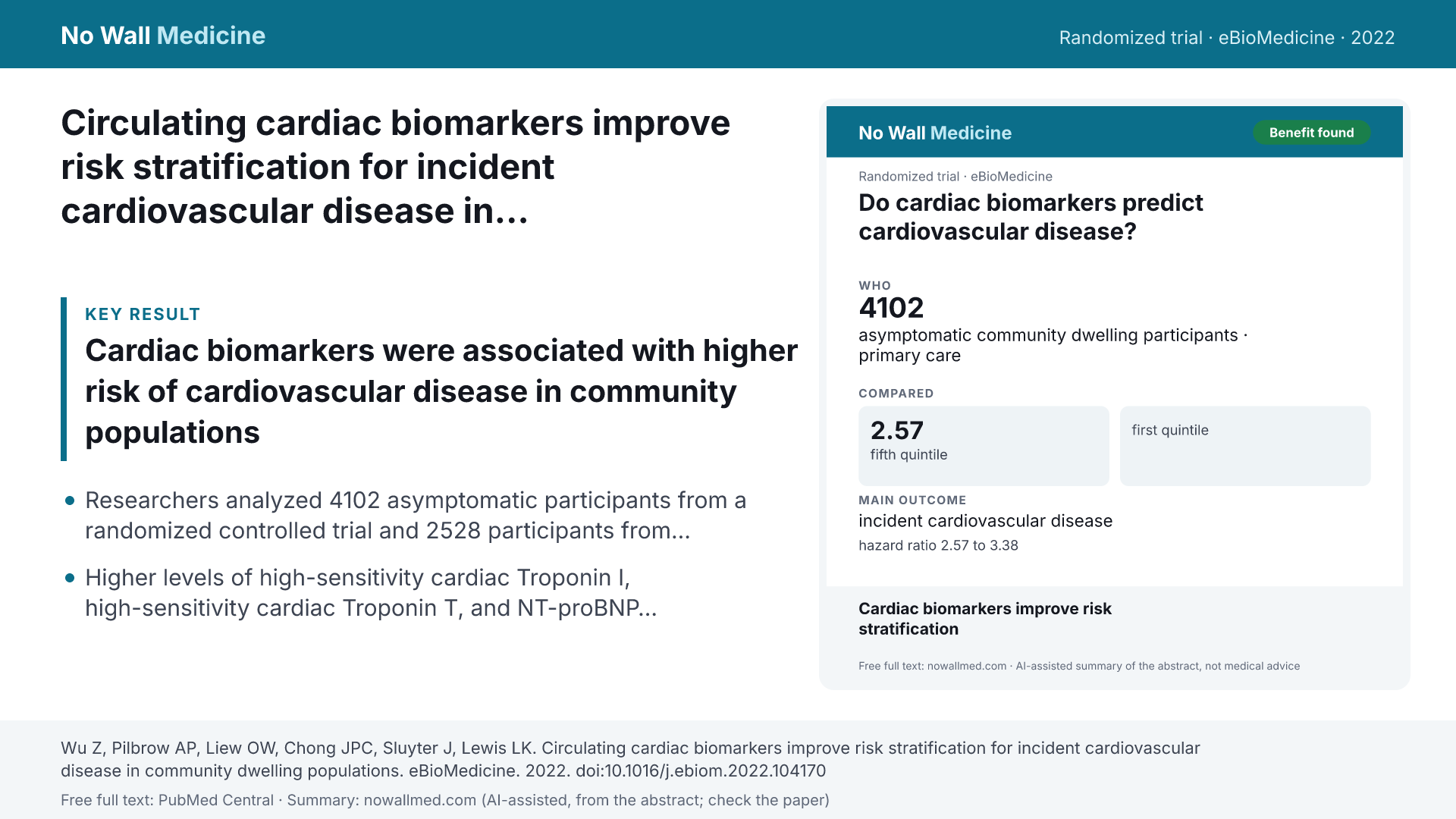
Circulating cardiac biomarkers improve risk stratification for incident cardiovascular disease in community dwelling populations
Key result: Cardiac biomarkers were associated with higher risk of cardiovascular disease in community populations
Randomized trialBenefit found
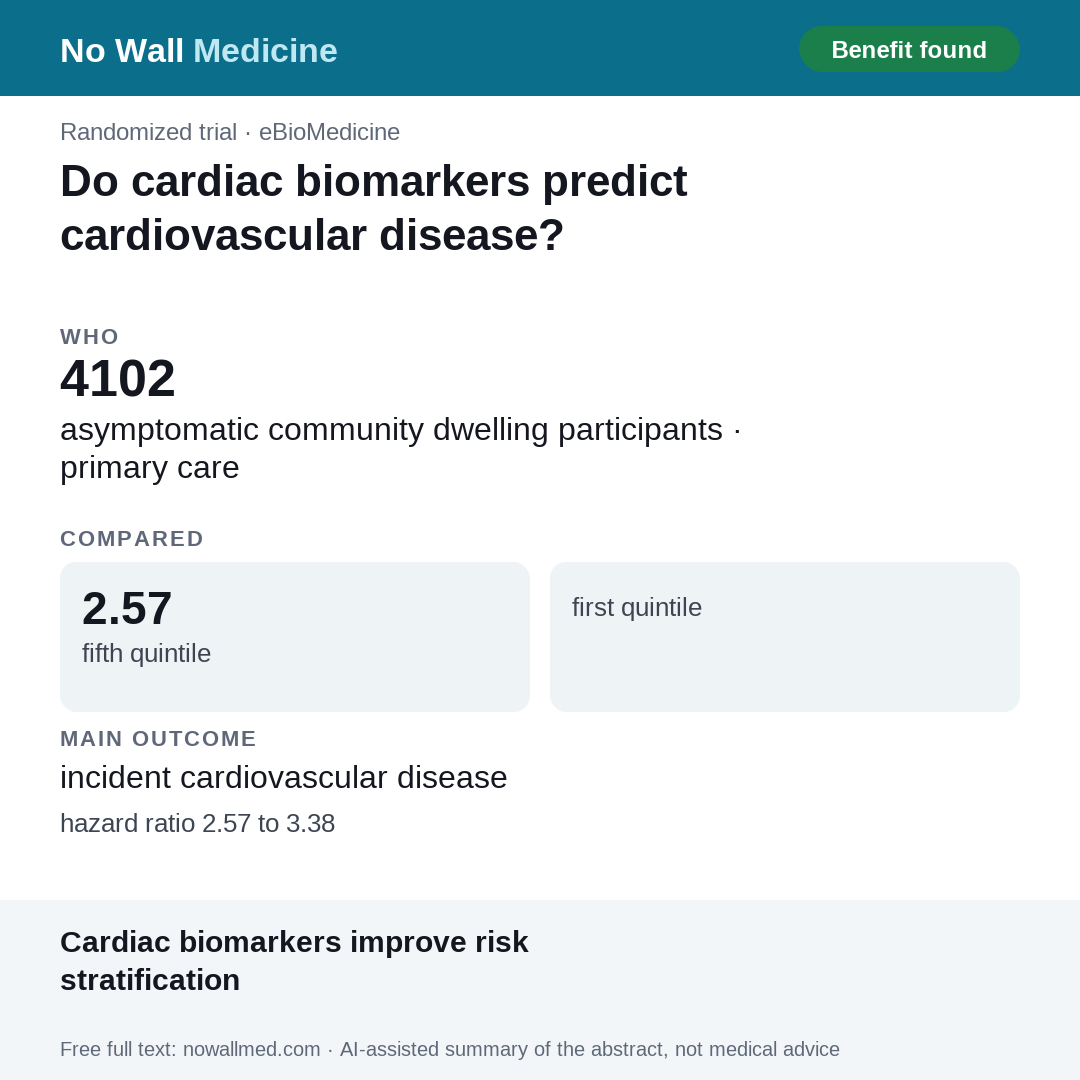
Do cardiac biomarkers predict cardiovascular disease?
Who
4102
asymptomatic community dwelling participants · primary care
Compared
2.57fifth quintile (95% CI 1.47-4.49)
first quintile
Main outcome
incident cardiovascular disease
Result: hazard ratio 2.57 to 3.38
Bottom line: Cardiac biomarkers improve risk stratification
Funded by: Health Research Council of New Zealand
eBioMedicine · 2022-07-15Download image
Key points
- Researchers analyzed 4102 asymptomatic participants from a randomized controlled trial and 2528 participants from an observational registry.
- Higher levels of high-sensitivity cardiac Troponin I, high-sensitivity cardiac Troponin T, and NT-proBNP were associated with hazard ratios of 2.57, 3.01, and 3.38 respectively.
- Adding these markers to existing risk scores increased the C statistic, a measure of predictive accuracy, from 0.755 to 0.771.
Why it matters: It was unknown if adding plasma cardiac markers to established risk scores could improve the prediction of cardiovascular disease in asymptomatic people.
Discussion prompts
- Would these patients look like yours? Who was left out?
- Is the main outcome one that matters to patients?
- Is the difference large enough to change what you do?
Cite: Wu Z, Pilbrow AP, Liew OW, Chong JPC, Sluyter J, Lewis LK. Circulating cardiac biomarkers improve risk stratification for incident cardiovascular disease in community dwelling populations. eBioMedicine. 2022. doi:10.1016/j.ebiom.2022.104170
Free full text: PubMed Central · Summary and visual abstract: nowallmed.com/a/circulating-cardiac-biomarkers-improve-risk-stratification-for-3cg606/ (AI-assisted from the abstract; check the paper before relying on it).