Nuclear magnetic resonance technology shows moderate to strong correlations with established fatty acid biomarkers
Circulating fatty acids from high-throughput metabolomics platforms as potential biomarkers of dietary fatty acids
Observational study across multiple cohortsMixed results
Do NMR and LC-MS platforms provide similar fatty acid information compared to gas chromatography?
Who
Pooled population-based cohort, patient cohort, and randomized controlled trial
Compared
NMR platform: r = 0.51-0.81
LC-MS platform: r = 0.44
Main outcome
Correlation of fatty acids between metabolomics platforms and gas chromatography
Bottom line: Nuclear magnetic resonance might be a better option than liquid chromatography mass-spectrometry for certain polyunsaturated fatty acid biomarkers.
Clin Nutr · 2022-10-13Download image
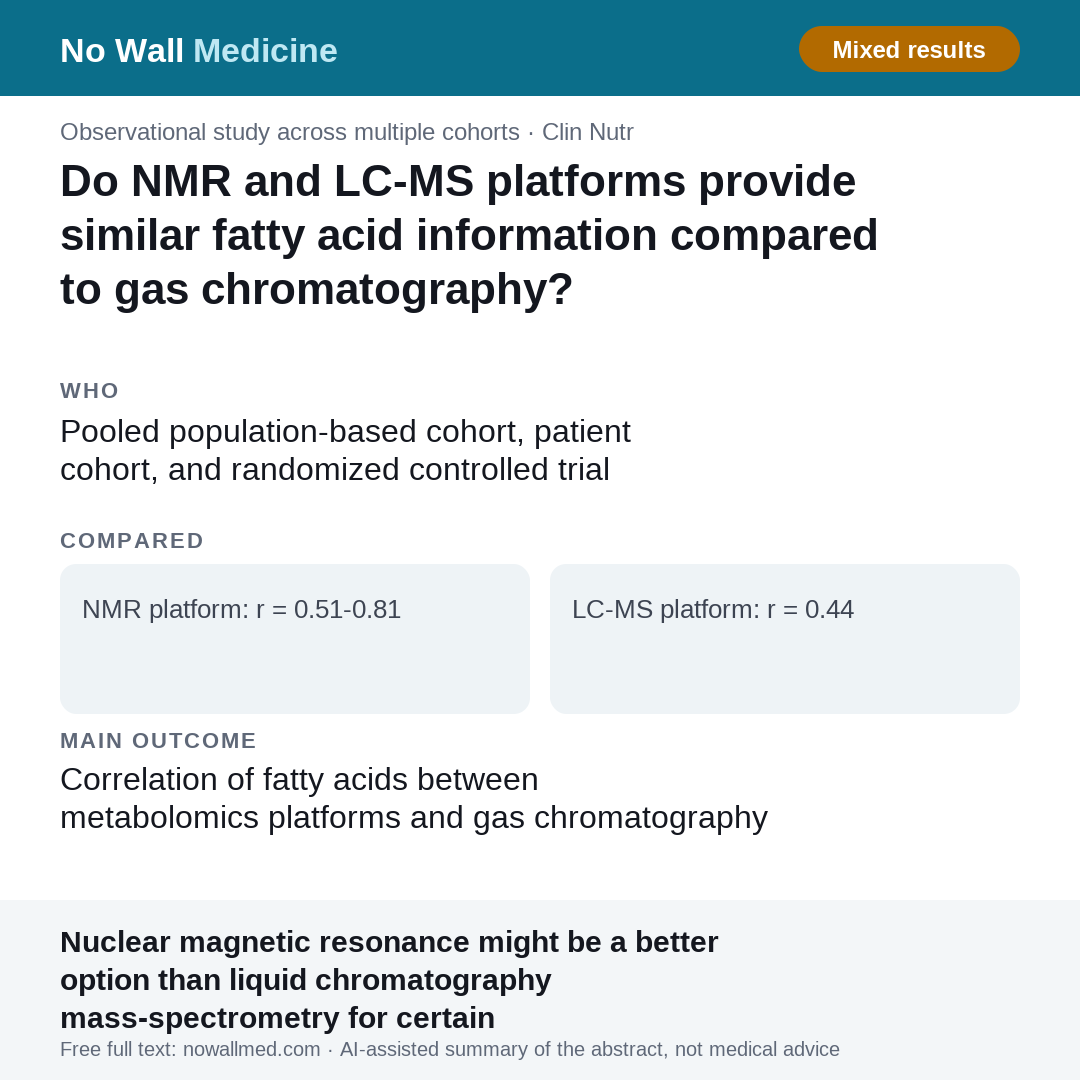
Clinical question: Do NMR and LC-MS platforms provide similar fatty acid information compared to gas chromatography?
Why it matters: The validity of using fast and inexpensive metabolomics platforms to reflect dietary fatty acid intake compared to established gas chromatography methods is unknown.
Key points
- Researchers compared fatty acid levels measured by nuclear magnetic resonance (NMR) and liquid chromatography mass-spectrometry (LC-MS) against gas chromatography (GC) in several groups, including a pooled cohort of approximately 1100 people.
- In the pooled cohort, linoleic acid and docosahexaenoic acid in cholesteryl esters showed strong correlations with NMR results (r = 0.67 and r = 0.68, respectively), while 49% were correctly classified into quartiles.
- Using the liquid chromatography mass-spectrometry platform, only docosahexaenoic acid showed moderate correlations with gas chromatography (r = 0.44).
Headline and key points written with AI from the paper’s abstract, with every number checked against it. Read the paper before relying on them.
Was this summary helpful?
Subject terms
Cite this article
Rosqvist F, Fridén M, Vessby J, Rorsman F, Lind L, Risérus U. Circulating fatty acids from high-throughput metabolomics platforms as potential biomarkers of dietary fatty acids. Clin Nutr. 2022. doi:10.1016/j.clnu.2022.10.005
Spotted a mistake? Suggest a correction
Top studies every Monday
The week’s key trials and guidelines in your specialties, plus any topics you follow. By email, free.
Get the weekly digest