Specific microRNA levels in blood were associated with declining beta cell function in youth with type 2 diabetes
Circulating MicroRNAs as Predictors of Beta Cell Function in Youth-onset Type 2 Diabetes: The TODAY Study
Observational phase of an intervention trialBenefit found
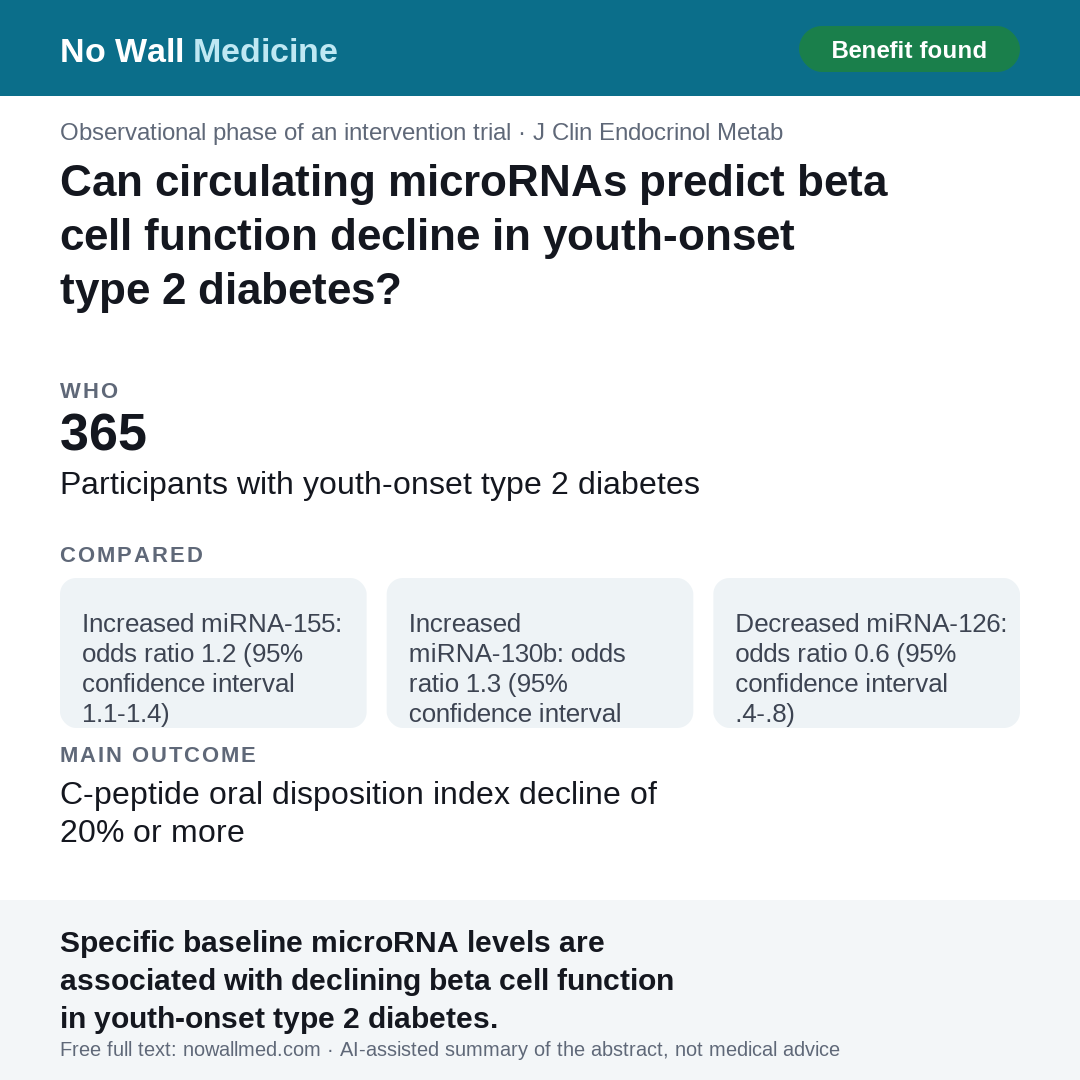
Can circulating microRNAs predict beta cell function decline in youth-onset type 2 diabetes?
Who
365
Participants with youth-onset type 2 diabetes
Compared
Increased miRNA-155: odds ratio 1.2 (95% confidence interval 1.1-1.4)
Increased miRNA-130b: odds ratio 1.3 (95% confidence interval 1.0-1.7)
Decreased miRNA-126: odds ratio 0.6 (95% confidence interval .4-.8)
Main outcome
C-peptide oral disposition index decline of 20% or more
Result: odds ratio 1.2 (95% CI 1.1-1.4) for miRNA-155
Bottom line: Specific baseline microRNA levels are associated with declining beta cell function in youth-onset type 2 diabetes.
J Clin Endocrinol Metab · 2024-05-30Download image
Clinical question: Can circulating microRNAs predict beta cell function decline in youth-onset type 2 diabetes?
Why it matters: It is unknown if specific circulating microRNA species can serve as markers for the decline of beta cell function in youth-onset type 2 diabetes.
Key points
- Researchers analyzed 365 participants from the TODAY study to see if circulating microRNA, small non-coding RNA molecules, could predict changes in beta cell function.
- Increased levels of miRNA-155 (OR: 1.2, 95% CI: 1.1-1.4) and miRNA-130b (OR: 1.3, 95% CI: 1.0-1.7) were associated with a decline in the C-peptide oral disposition index of 20% or more.
- Decreased levels of miRNA-126 (OR: 0.6, 95% CI: .4-.8) were also associated with the decline in the C-peptide oral disposition index.
Headline and key points written with AI from the paper’s abstract, with every number checked against it. Read the paper before relying on them.
Was this summary helpful?
Subject terms
Cite this article
Redling D, Bialak S, El Ghormli L, Chernausek SD, Jones K, Tryggestad JB. Circulating MicroRNAs as Predictors of Beta Cell Function in Youth-onset Type 2 Diabetes: The TODAY Study. J Clin Endocrinol Metab. 2024. doi:10.1210/clinem/dgae376
Spotted a mistake? Suggest a correction
Top studies every Monday
The week’s key trials and guidelines in your specialties, plus any topics you follow. By email, free.
Get the weekly digest