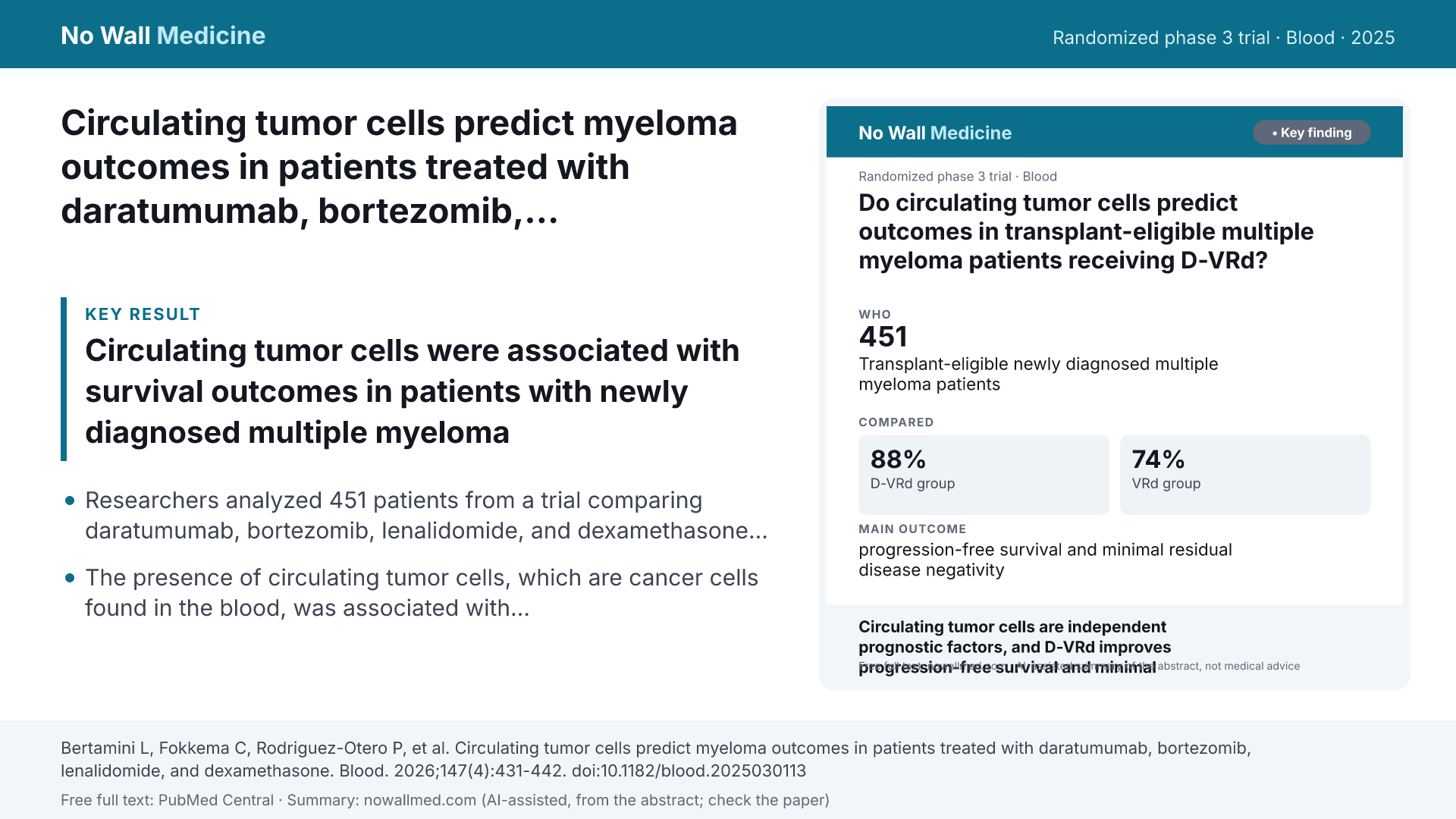
Circulating tumor cells were associated with survival outcomes in patients with newly diagnosed multiple myeloma
Circulating tumor cells predict myeloma outcomes in patients treated with daratumumab, bortezomib, lenalidomide, and dexamethasone
Randomized phase 3 trialKey finding
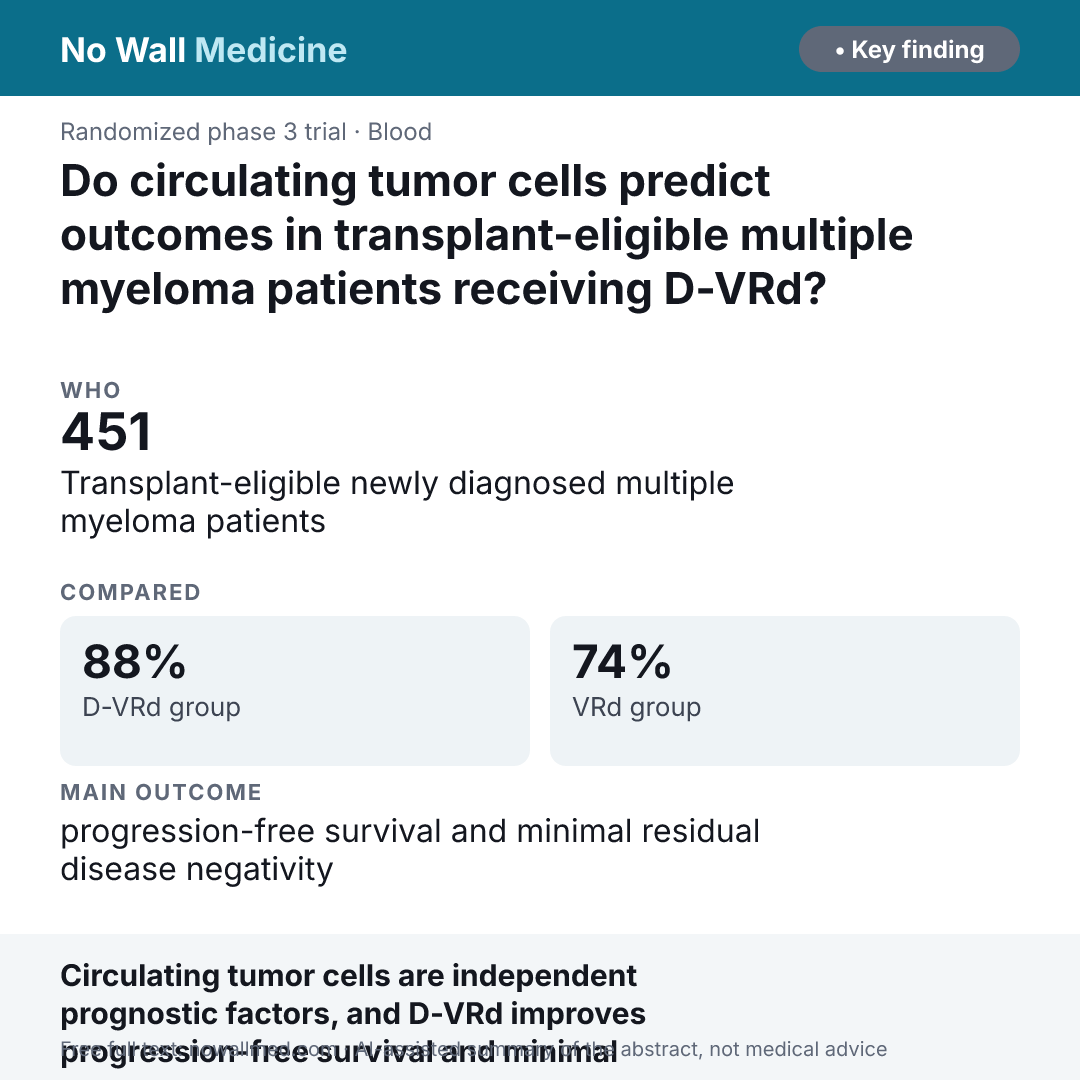
Do circulating tumor cells predict outcomes in transplant-eligible multiple myeloma patients receiving D-VRd?
Who
451
Transplant-eligible newly diagnosed multiple myeloma patients
Compared
88%D-VRd group (4-year PFS rate in CTC-low)
74%VRd group (4-year PFS rate in CTC-low)
Main outcome
progression-free survival and minimal residual disease negativity
Result: hazard ratio 1.36 (95% confidence interval 1.15-1.60)
Bottom line: Circulating tumor cells are independent prognostic factors, and D-VRd improves progression-free survival and minimal residual disease negativity.
Limitation: CTC analysis was performed on a subset of the total trial patients
Blood · 2025-10-08 · Save PNG
Same trial (NCT03710603)
Papers we list that report this registered trial, oldest first. Read a secondary analysis alongside the main results.
- Main results Benefit found
Adding subcutaneous daratumumab to standard therapy improved progression-free survival in multiple myeloma patients NEJM 2023-12 - Related analysis Key finding
This paper Blood 2025-10
Clinical question: Do circulating tumor cells predict outcomes in transplant-eligible multiple myeloma patients receiving D-VRd?
Key points
- Researchers analyzed 451 patients from a trial comparing daratumumab, bortezomib, lenalidomide, and dexamethasone to bortezomib, lenalidomide, and dexamethasone in transplant-eligible patients.
- The presence of circulating tumor cells, which are cancer cells found in the blood, was associated with progression-free survival with a hazard ratio of 1.36.
- Patients with high levels of circulating tumor cells had lower rates of minimal residual disease negativity, which is the absence of detectable cancer cells.
Headline and key points written with AI from the paper’s abstract, with every number checked against it. Read the paper before relying on them.
Was this summary helpful?
Abstract
Circulating tumor cells (CTC) represent a high-risk biomarker in newly diagnosed multiple myeloma (NDMM); however, their prognostic value among transplant-eligible (TE) patients receiving daratumumab/bortezomib/lenalidomide/dexamethasone (D-VRd) remains unknown. In this study, we analyzed CTC in the phase 3 PERSEUS/EMN017 trial. TE-NDMM patients were randomized (1:1) to D-VRd with daratumumab/lenalidomide maintenance (D-VRd group) or bortezomib/lenalidomide/dexamethasone (VRd) with lenalidomide maintenance (VRd group), both with transplant. A subset of 451 of 709 patients from PERSEUS (D-VRd, 231/355; VRd, 220/354) had screening blood samples collected for CTC analysis by flow cytometry. CTC were detected in 370 patients (82%; median limit of detection, 0.0004%). CTC were prognostic of progression-free survival (PFS), independent of other factors, as a continuous (hazard ratio [HR], 1.36 [95% confidence interval (CI), 1.15-1.60]; P< .001) and categorical variable (≥0.175% CTC-high, optimal threshold). D-VRd improved PFS vs VRd in CTC-low patients (4-year rates: 88% vs 74%; HR, 0.42 [95% CI, 0.25-0.70]; P = .0013). Regardless of study treatment, minimal residual disease (MRD)-negativity rates were lower in CTC-high vs CTC-low patients (10-5: 52.2% vs 66.2%; 10-6: 34.8% vs 52.4%). D-VRd significantly increased MRD-negativity rates vs VRd among CTC-high (10-5: 69.4% vs 33.3%; 10-6: 47.2% vs 21.2%; both P< .05) and CTC-low patients (10-5: 74.4% vs 57.8%; 10-6: 65.6% vs 38.5%; both P< .001), with similar observations for sustained MRD-negativity. CTC levels are an independent prognostic factor in TE-NDMM treated with standard-of-care frontline quadruplet. D-VRd improved and sustained MRD-negativity rates in CTC-high and CTC-low, and improved PFS for CTC-low with a positive trend in CTC-high patients. This trial was registered at www.clinicaltrials.gov as #NCT03710603.
Abstract reproduced under the article’s CC BY NC ND licence.
Subject terms
Headline, design, result, key points, caveat and citation as plain text.
Cite this article
Bertamini L, Fokkema C, Rodriguez-Otero P, et al. Circulating tumor cells predict myeloma outcomes in patients treated with daratumumab, bortezomib, lenalidomide, and dexamethasone. Blood. 2026;147(4):431-442. doi:10.1182/blood.2025030113
Spotted a mistake? Suggest a correction