Circulating tumor DNA detection was associated with worse survival in patients with operable breast cancer
Circulating tumor DNA for predicting recurrence in patients with operable breast cancer: a systematic review and meta-analysis
Systematic review and meta-analysisBenefit found
Does circulating tumor DNA predict recurrence in patients with operable breast cancer?
Who
5779
Patients with stage I-III operable breast cancer
Compared
ctDNA detected
ctDNA not detected
Main outcome
disease-free survival and overall survival
Result: hazard ratio 2.98 (95% CI 1.92-4.63) for baseline disease-free survival
Bottom line: Circulating tumor DNA detection is associated with worse disease-free survival and overall survival in operable breast cancer.
ESMO Open · 2024-03-10Download image
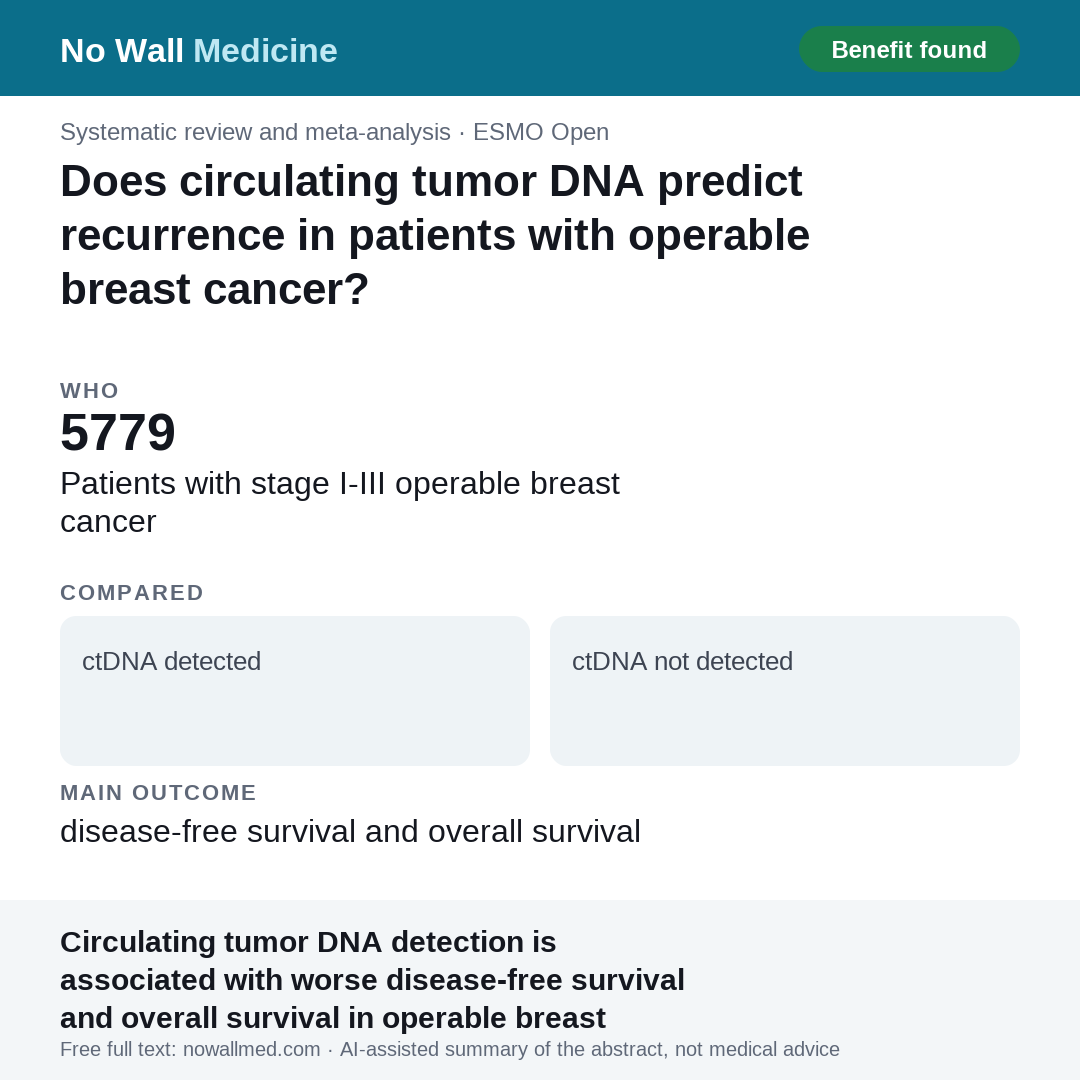
Clinical question: Does circulating tumor DNA predict recurrence in patients with operable breast cancer?
Why it matters: The prognostic value of circulating tumor DNA in patients with operable breast cancer has been unclear due to inconsistent results from different studies.
Key points
- Researchers analyzed 57 studies involving 5779 patients to assess how circulating tumor DNA, or small fragments of DNA from tumors in the blood, relates to survival.
- Detecting circulating tumor DNA was associated with a hazard ratio of 7.69 for disease-free survival after neoadjuvant therapy and a hazard ratio of 9.19 for overall survival during follow-up.
- The average lead time from detecting circulating tumor DNA to visible cancer recurrence was 10.81 months, with a range of 0-58.9 months.
Headline and key points written with AI from the paper’s abstract, with every number checked against it. Read the paper before relying on them.
Topics
Cite this article
Nader-Marta G, Monteforte M, Agostinetto E, Cinquini M, Martins-Branco D, Langouo M. Circulating tumor DNA for predicting recurrence in patients with operable breast cancer: a systematic review and meta-analysis. ESMO Open. 2024. doi:10.1016/j.esmoop.2024.102390
Spotted a mistake? Suggest a correction
Top studies every Monday
The week’s key trials and guidelines in your specialties, plus any topics you follow. By email, free.
Get the weekly digest