Specific gene mutations were associated with shorter progression-free survival after breast cancer treatment failure
Circulating tumor DNA mutational landscape and dynamics after progression on a CDK4/6 inhibitor in the PACE phase II trial for metastatic HR-positive/HER2-negative breast cancer
Randomized trialMixed results
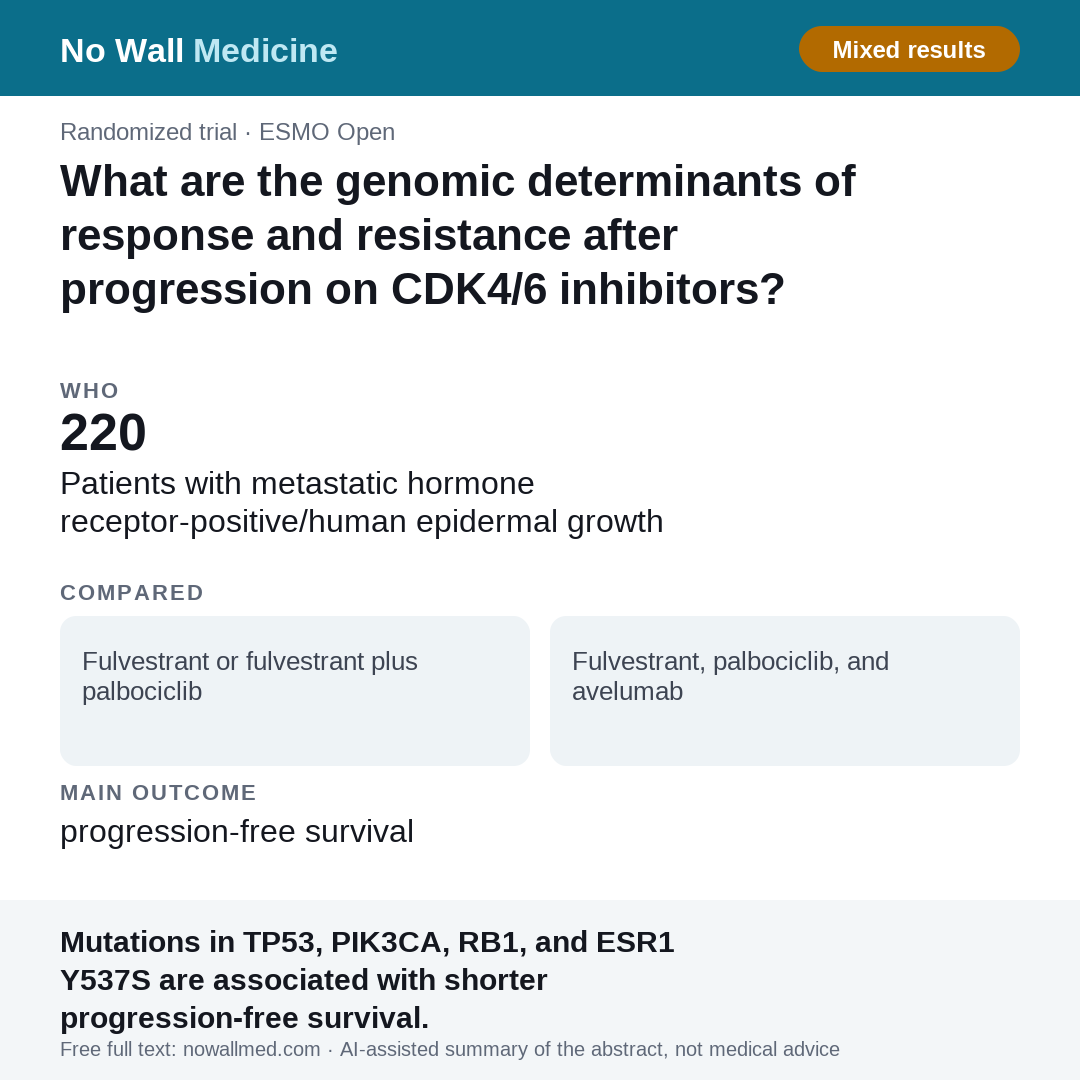
What are the genomic determinants of response and resistance after progression on CDK4/6 inhibitors?
Who
220
Patients with metastatic hormone receptor-positive/human epidermal growth factor receptor 2-negative breast cancer
Compared
Fulvestrant or fulvestrant plus palbociclib
Fulvestrant, palbociclib, and avelumab
Main outcome
progression-free survival
Bottom line: Mutations in TP53, PIK3CA, RB1, and ESR1 Y537S are associated with shorter progression-free survival.
ESMO Open · 2025-07-25Download image
Clinical question: What are the genomic determinants of response and resistance after progression on CDK4/6 inhibitors?
Why it matters: The genomic factors that influence how patients respond to therapy after their cancer progresses on hormone therapy and cyclin-dependent kinase 4/6 inhibitors are not well characterized.
Key points
- Researchers analyzed blood samples from 200 participants in the PACE trial who had metastatic hormone receptor-positive/human epidermal growth factor receptor 2-negative breast cancer.
- Baseline mutations in TP53, PIK3CA, RB1, and the Y537S ESR1 gene were associated with shorter progression-free survival, which is the time until the disease worsens.
- Increases in the amount of ESR1, PIK3CA, and TP53 mutations were observed in the blood at the time of disease progression.
Headline and key points written with AI from the paper’s abstract, with every number checked against it. Read the paper before relying on them.
Topics
Cite this article
Jeselsohn R, Fu J, Ren Y, Mahtani R, Ma C, DeMichele A. Circulating tumor DNA mutational landscape and dynamics after progression on a CDK4/6 inhibitor in the PACE phase II trial for metastatic HR-positive/HER2-negative breast cancer. ESMO Open. 2025. doi:10.1016/j.esmoop.2025.105506
Spotted a mistake? Suggest a correction