Circulating tumor DNA detection was associated with higher risks of cancer recurrence and death
Circulating tumour DNA-Based molecular residual disease detection in resectable cancers: a systematic review and meta-analysis
Systematic review and meta-analysisBenefit found
Does circulating tumour DNA detection predict recurrence and overall survival in resectable cancers?
Who
Patients with resectable cancers
Compared
circulating tumour DNA positive
circulating tumour DNA negative
Main outcome
Recurrence and overall survival
Result: hazard ratio 7.48 (95% CI 6.39-8.77) for recurrence; hazard ratio 5.58 (95% CI 4.17-7.48) for overall survival
Bottom line: Circulating tumour DNA testing is a significant prognostic factor for recurrence and overall survival in resectable cancers.
Limitation: The overall sensitivity of circulating tumour DNA molecular residual disease detection could be better.
Funded by: Qingyuan People's Hospital and GMU
eBioMedicine · 2024-04-13Download image
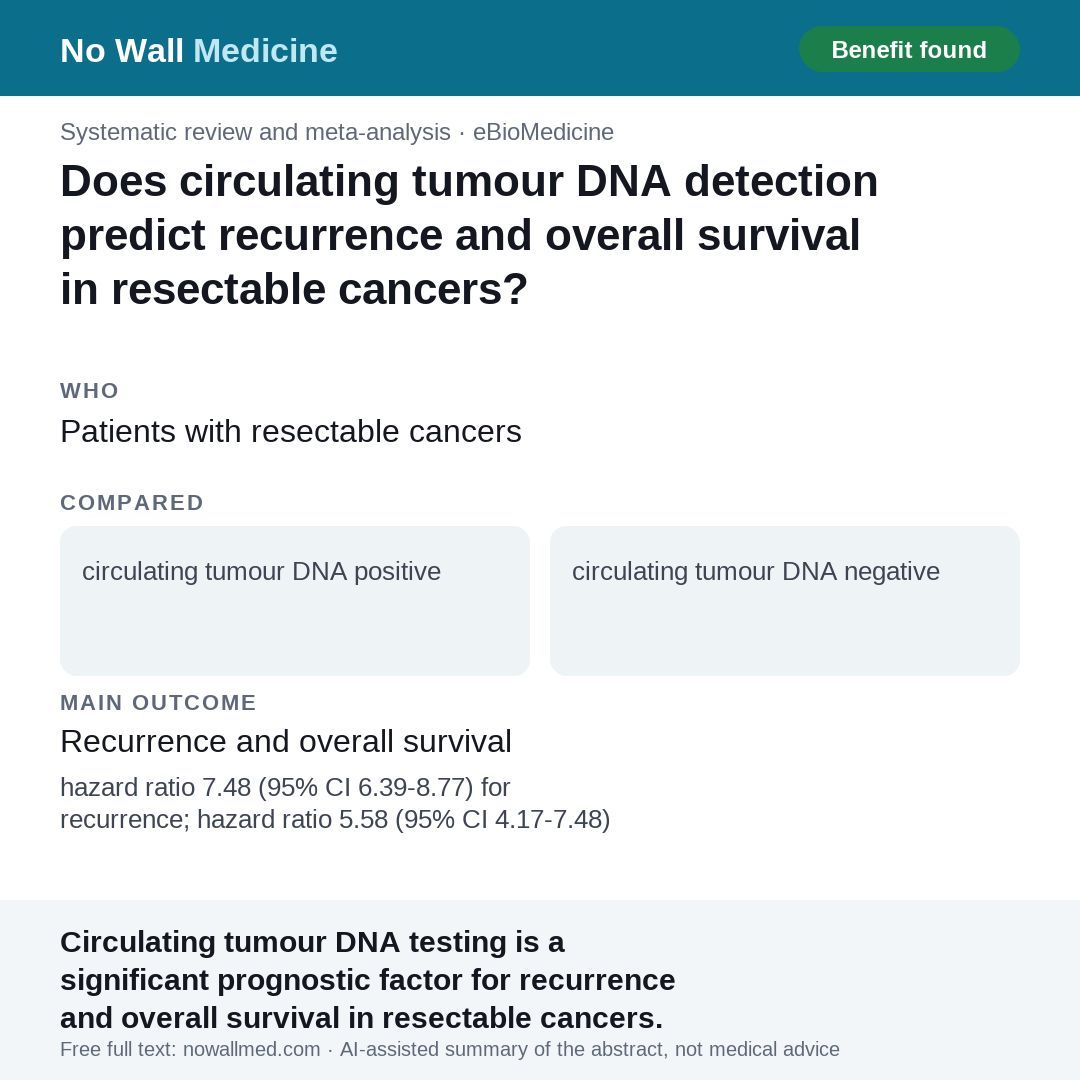
Clinical question: Does circulating tumour DNA detection predict recurrence and overall survival in resectable cancers?
Why it matters: There is no agreement on how well circulating tumor DNA can predict cancer recurrence, overall survival, or the accuracy of different testing methods.
Key points
- Researchers analyzed 80 prospective studies to compare patients with detectable circulating tumor DNA against those without it after cancer surgery.
- Positive tumor DNA was associated with a 7.48 hazard ratio for recurrence and a 5.58 hazard ratio for overall survival.
- Longitudinal testing, or repeated blood sampling over time, showed a higher sensitivity of 0.74 compared to 0.50 for single landmark tests.
Headline and key points written with AI from the paper’s abstract, with every number checked against it. Read the paper before relying on them.
Was this summary helpful?
Subject terms
Cite this article
Zheng J, Qin C, Wang Q, Tian D, Chen Z. Circulating tumour DNA-Based molecular residual disease detection in resectable cancers: a systematic review and meta-analysis. eBioMedicine. 2024. doi:10.1016/j.ebiom.2024.105109
Spotted a mistake? Suggest a correction
Top studies every Monday
The week’s key trials and guidelines in your specialties, plus any topics you follow. By email, free.
Get the weekly digest