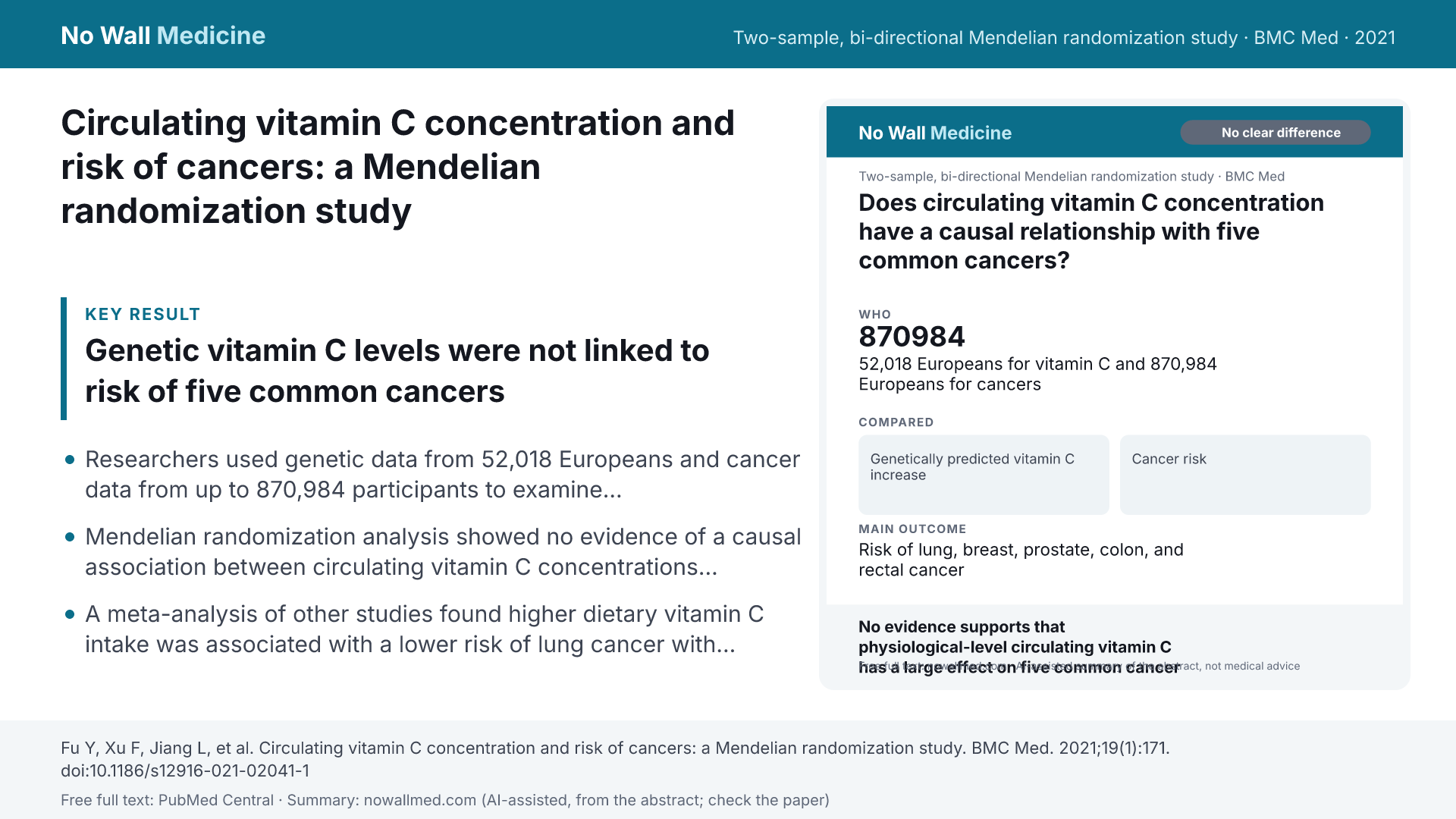
Genetic vitamin C levels were not linked to risk of five common cancers
Circulating vitamin C concentration and risk of cancers: a Mendelian randomization study
Two-sample, bi-directional Mendelian randomization studyNo clear difference
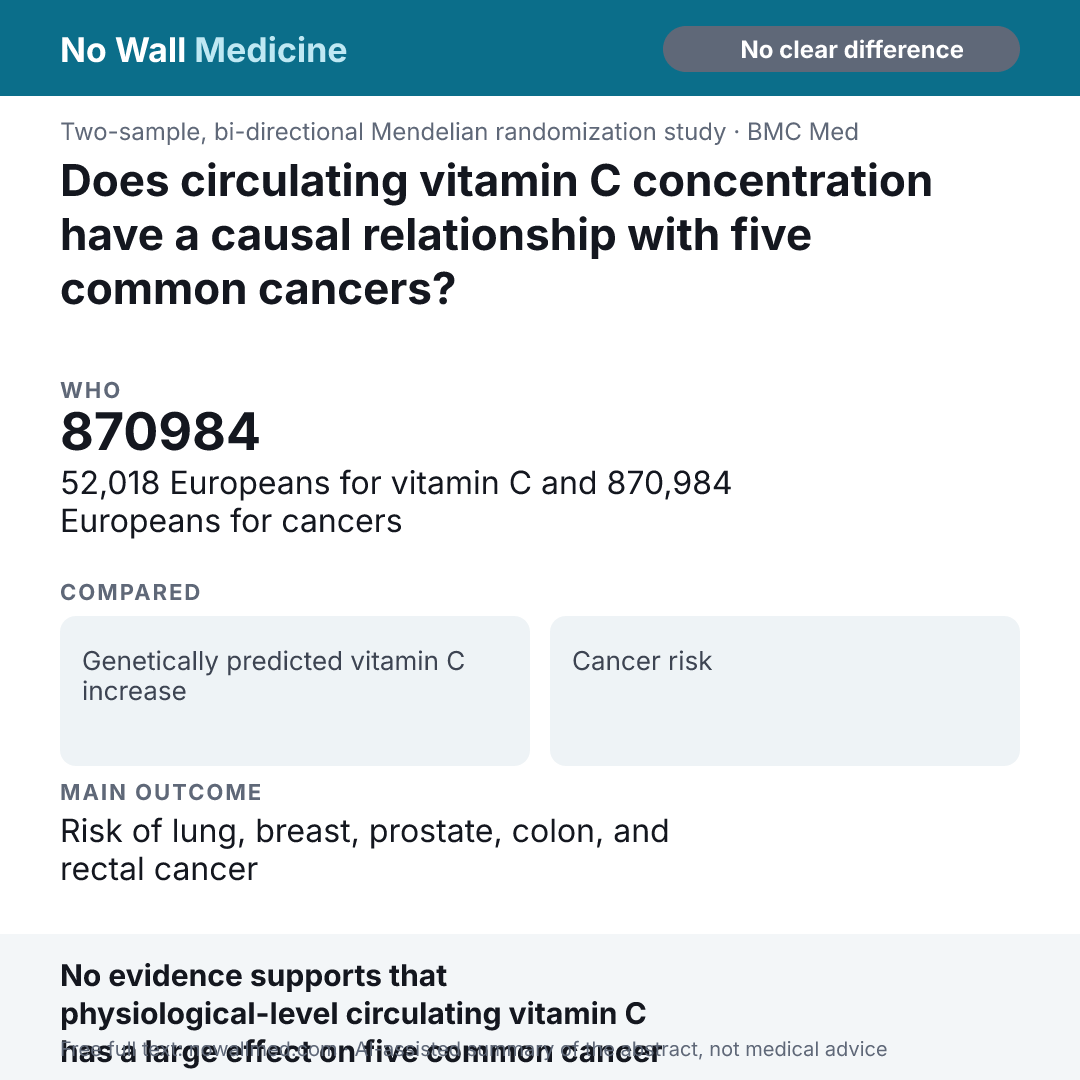
Does circulating vitamin C concentration have a causal relationship with five common cancers?
Who
870984
52,018 Europeans for vitamin C and 870,984 Europeans for cancers
Compared
Genetically predicted vitamin C increase
Cancer risk
Main outcome
Risk of lung, breast, prostate, colon, and rectal cancer
Bottom line: No evidence supports that physiological-level circulating vitamin C has a large effect on five common cancer risks.
Limitation: The study cannot rule out very small effect sizes.
BMC Med · 2021-07-30 · Save PNG
Clinical question: Does circulating vitamin C concentration have a causal relationship with five common cancers?
Key points
- Researchers used genetic data from 52,018 Europeans and cancer data from up to 870,984 participants to examine the relationship between vitamin C and cancer risk.
- Mendelian randomization analysis showed no evidence of a causal association between circulating vitamin C concentrations and lung, breast, prostate, colon, or rectal cancer.
- A meta-analysis of other studies found higher dietary vitamin C intake was associated with a lower risk of lung cancer with a risk ratio of 0.84 (95% confidence interval 0.71 to 0.99).
Limitation the authors note: The authors state they cannot rule out very small effect sizes.
Headline and key points written with AI from the paper’s abstract, with every number checked against it. Read the paper before relying on them.
Was this summary helpful?
Subject terms
Headline, design, result, key points, caveat and citation as plain text.
Cite this article
Fu Y, Xu F, Jiang L, et al. Circulating vitamin C concentration and risk of cancers: a Mendelian randomization study. BMC Med. 2021;19(1):171. doi:10.1186/s12916-021-02041-1
Spotted a mistake? Suggest a correction