Claustrum sign in brain imaging is linked to specific characteristics in new onset refractory status epilepticus
Claustrum Involvement in New Onset Refractory Status Epilepticus: A Systematic Review
Systematic reviewMixed results
How do clinical characteristics and outcomes differ in NORSE/FIRES with the claustrum sign?
Who
206
Patients with new onset refractory status epilepticus or febrile infection-related epilepsy syndrome
Compared
With claustrum sign: 9% in-hospital mortality
Without claustrum sign: 16% in-hospital mortality
Main outcome
Clinical characteristics, treatments, and outcomes
Bottom line: The claustrum sign is associated with febrile onset, convulsive status epilepticus, and lower rates of super-refractory status epilepticus.
Ann Clin Transl Neurol · 2026-08-04Download image
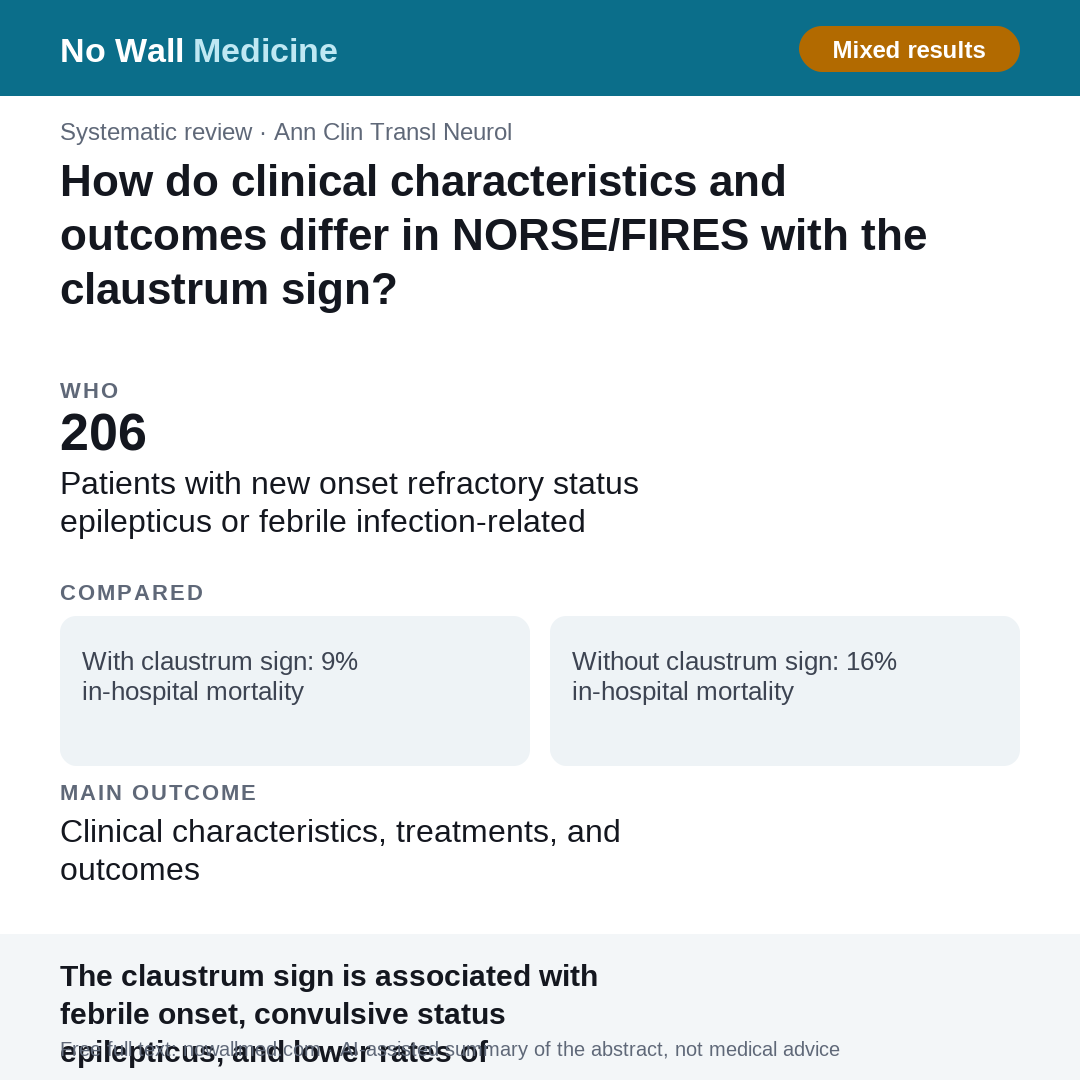
Clinical question: How do clinical characteristics and outcomes differ in NORSE/FIRES with the claustrum sign?
Why it matters: The claustrum sign is a distinctive neuroimaging finding that was first described in specific epilepsy syndromes, but its clinical characteristics and outcomes require systematic review.
Key points
- Researchers reviewed 65 studies involving 206 patients with new onset refractory status epilepticus, a condition of continuous seizures, to compare those with and without claustrum sign findings.
- Patients with the claustrum sign, which is brightness on an MRI scan, more often had a fever at onset (93% vs. 51%) and convulsive seizures (98% vs. 81.5%).
- Those with the sign had lower rates of super-refractory status epilepticus (51% vs. 96.5%) and intensive care unit admission (71% vs. 99%) compared to those without it.
Headline and key points written with AI from the paper’s abstract, with every number checked against it. Read the paper before relying on them.
Topics
Spotted a mistake? Suggest a correction