Environmental stressors from climate change are associated with increased cardiovascular risk and mortality
Climate Change and Cardiovascular Health: A Systematic Review
Systematic reviewHarm found
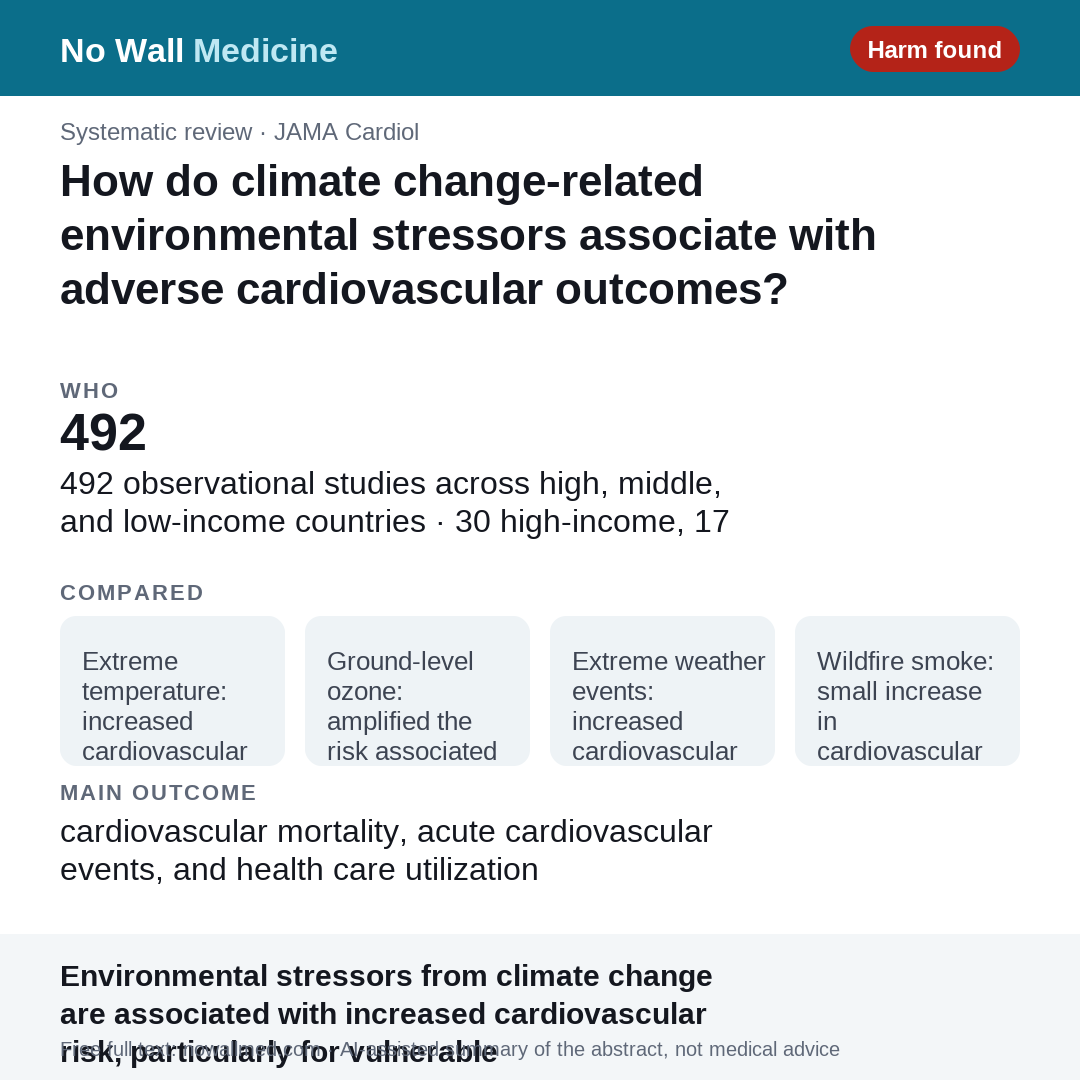
How do climate change-related environmental stressors associate with adverse cardiovascular outcomes?
Who
492
492 observational studies across high, middle, and low-income countries · 30 high-income, 17 middle-income, and 1 low-income countries
Compared
Extreme temperature: increased cardiovascular mortality and morbidity
Ground-level ozone: amplified the risk associated with higher temperatures
Extreme weather events: increased cardiovascular risk that persisted for many months
Wildfire smoke: small increase in cardiovascular mortality, out-of-hospital cardiac arrests, and hospitalizations
Main outcome
cardiovascular mortality, acute cardiovascular events, and health care utilization
Bottom line: Environmental stressors from climate change are associated with increased cardiovascular risk, particularly for vulnerable populations.
Limitation: data on outcomes in low-income countries are lacking
JAMA Cardiol · 2024-06-12Download image
Clinical question: How do climate change-related environmental stressors associate with adverse cardiovascular outcomes?
Why it matters: The association between numerous climate change-related environmental stressors and the incidence of adverse cardiovascular events has not been systematically reviewed.
Key points
- Researchers reviewed 492 observational studies involving 182 extreme temperature, 210 ground-level ozone, 45 wildfire smoke, and 63 extreme weather event studies.
- Extreme temperature was associated with increased cardiovascular mortality and morbidity, while ground-level ozone amplified the risk associated with higher temperatures.
- Extreme weather events like hurricanes were associated with increased cardiovascular risk that persisted for many months after the initial event.
Limitation the authors note: Data on outcomes in low-income countries are lacking.
Headline and key points written with AI from the paper’s abstract, with every number checked against it. Read the paper before relying on them.
Was this summary helpful?
Subject terms
Cite this article
Kazi DS, Katznelson E, Liu CL, Al-Roub NM, Chaudhary RS, Young DE. Climate Change and Cardiovascular Health: A Systematic Review. JAMA Cardiol. 2024. doi:10.1001/jamacardio.2024.1321
Spotted a mistake? Suggest a correction
Top studies every Monday
The week’s key trials and guidelines in your specialties, plus any topics you follow. By email, free.
Get the weekly digest