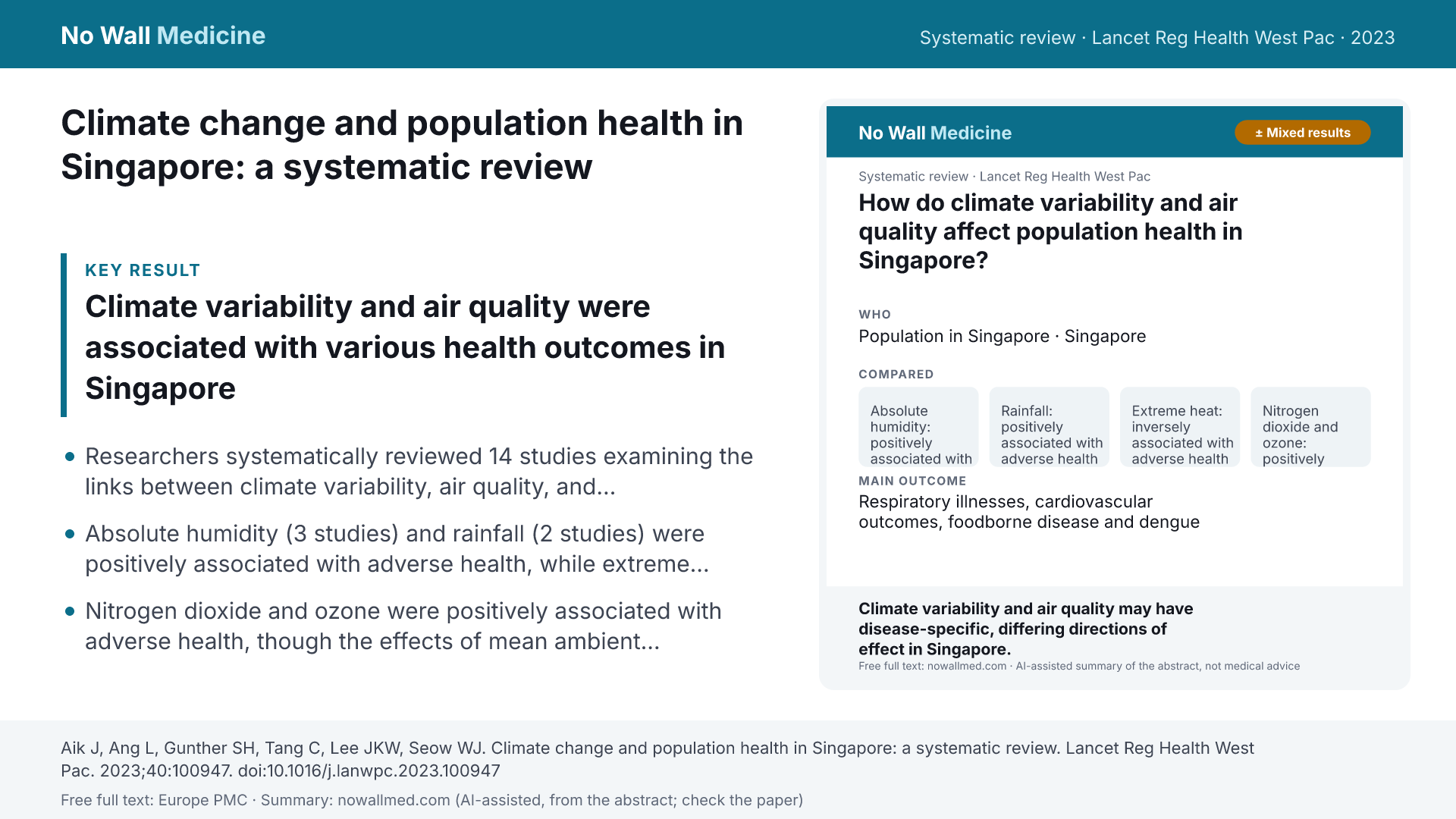
Climate variability and air quality were associated with various health outcomes in Singapore
Climate change and population health in Singapore: a systematic review
Systematic reviewMixed results
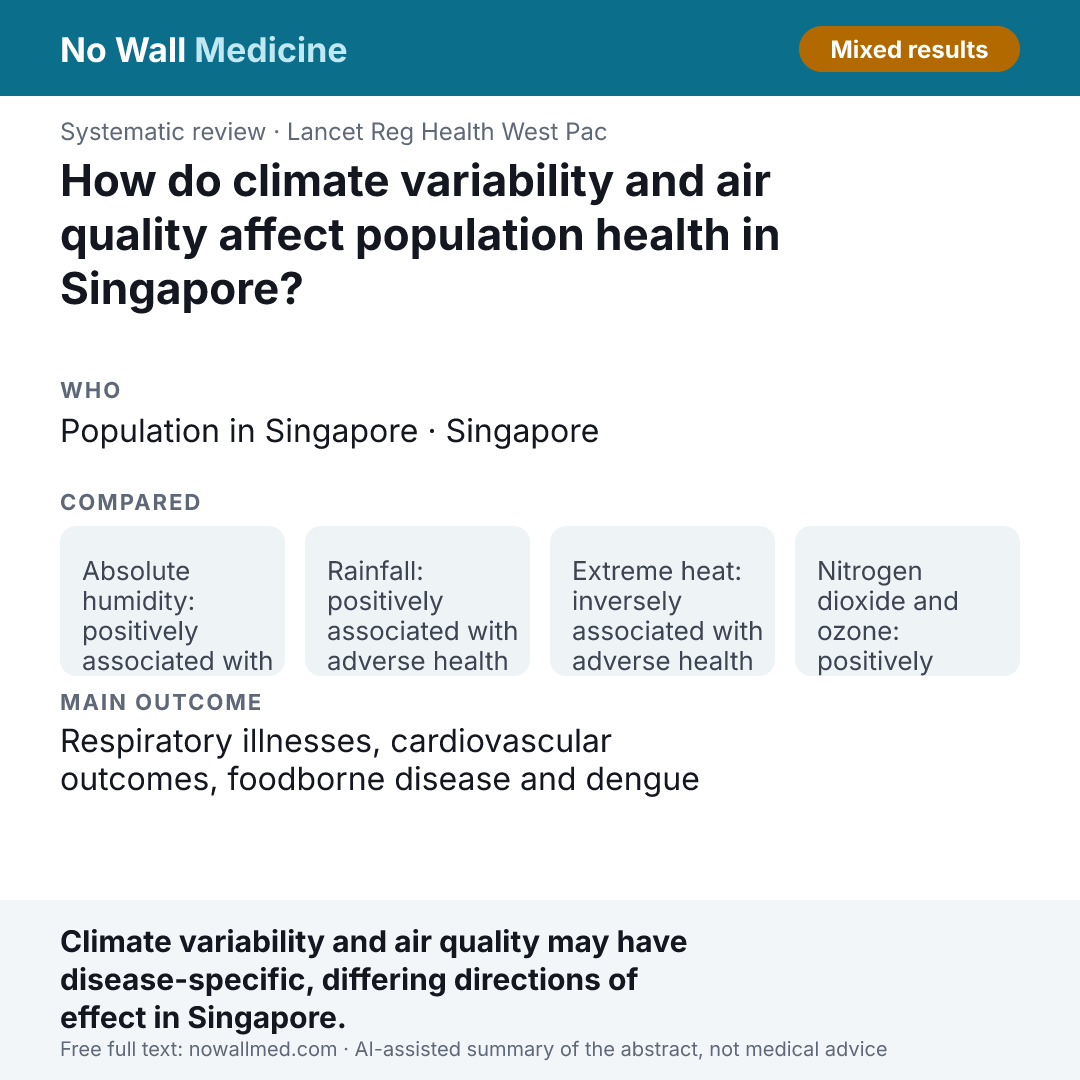
How do climate variability and air quality affect population health in Singapore?
Who
Population in Singapore · Singapore
Compared
Absolute humidity: positively associated with adverse health
Rainfall: positively associated with adverse health
Extreme heat: inversely associated with adverse health
Nitrogen dioxide and ozone: positively associated with adverse health
Main outcome
Respiratory illnesses, cardiovascular outcomes, foodborne disease and dengue
Bottom line: Climate variability and air quality may have disease-specific, differing directions of effect in Singapore.
Lancet Reg Health West Pac · 2023-11-15 · Save PNG
Clinical question: How do climate variability and air quality affect population health in Singapore?
Why it matters: The specific health impacts of climate variability and air quality in a tropical city-state like Singapore were not fully established for policymakers.
Key points
- Researchers systematically reviewed 14 studies examining the links between climate variability, air quality, and health outcomes like respiratory and cardiovascular illnesses in Singapore.
- Absolute humidity (3 studies) and rainfall (2 studies) were positively associated with adverse health, while extreme heat (2 studies) was inversely associated with adverse health.
- Nitrogen dioxide and ozone were positively associated with adverse health, though the effects of mean ambient temperature and relative humidity were inconsistent.
Headline and key points written with AI from the paper’s abstract, with every number checked against it. Read the paper before relying on them.
Was this summary helpful?
Abstract
Gaseous emissions have contributed to global warming, an increase in the frequency of extreme weather events and poorer air quality. The associated health impacts have been well reported in temperate regions. In Singapore, key climate change adaptation measures and activities include coastal and flood protection, and mitigating heat impacts. We systematically reviewed studies examining climate variability and air quality with population health in Singapore, a tropical city-state in South-East Asia (SEA), with the aim to identify evidence gaps for policymakers. We included 14 studies with respiratory illnesses, cardiovascular outcomes, foodborne disease and dengue. Absolute humidity (3 studies) and rainfall (2 studies) were positively associated with adverse health. Extreme heat (2 studies) was inversely associated with adverse health. The effects of mean ambient temperature and relative humidity on adverse health were inconsistent. Nitrogen dioxide and ozone were positively associated with adverse health. Climate variability and air quality may have disease-specific, differing directions of effect in Singapore. Additional high quality studies are required to strengthen the evidence for policymaking. Research on effective climate action advocacy and adaptation measures for community activities should be strengthened.Funding
There was no funding source for this study.
Abstract reproduced under the article’s CC BY-NC-ND licence.
Headline, design, result, key points, caveat and citation as plain text.
Cite this article
Aik J, Ang L, Gunther SH, Tang C, Lee JKW, Seow WJ. Climate change and population health in Singapore: a systematic review. Lancet Reg Health West Pac. 2023;40:100947. doi:10.1016/j.lanwpc.2023.100947
Spotted a mistake? Suggest a correction