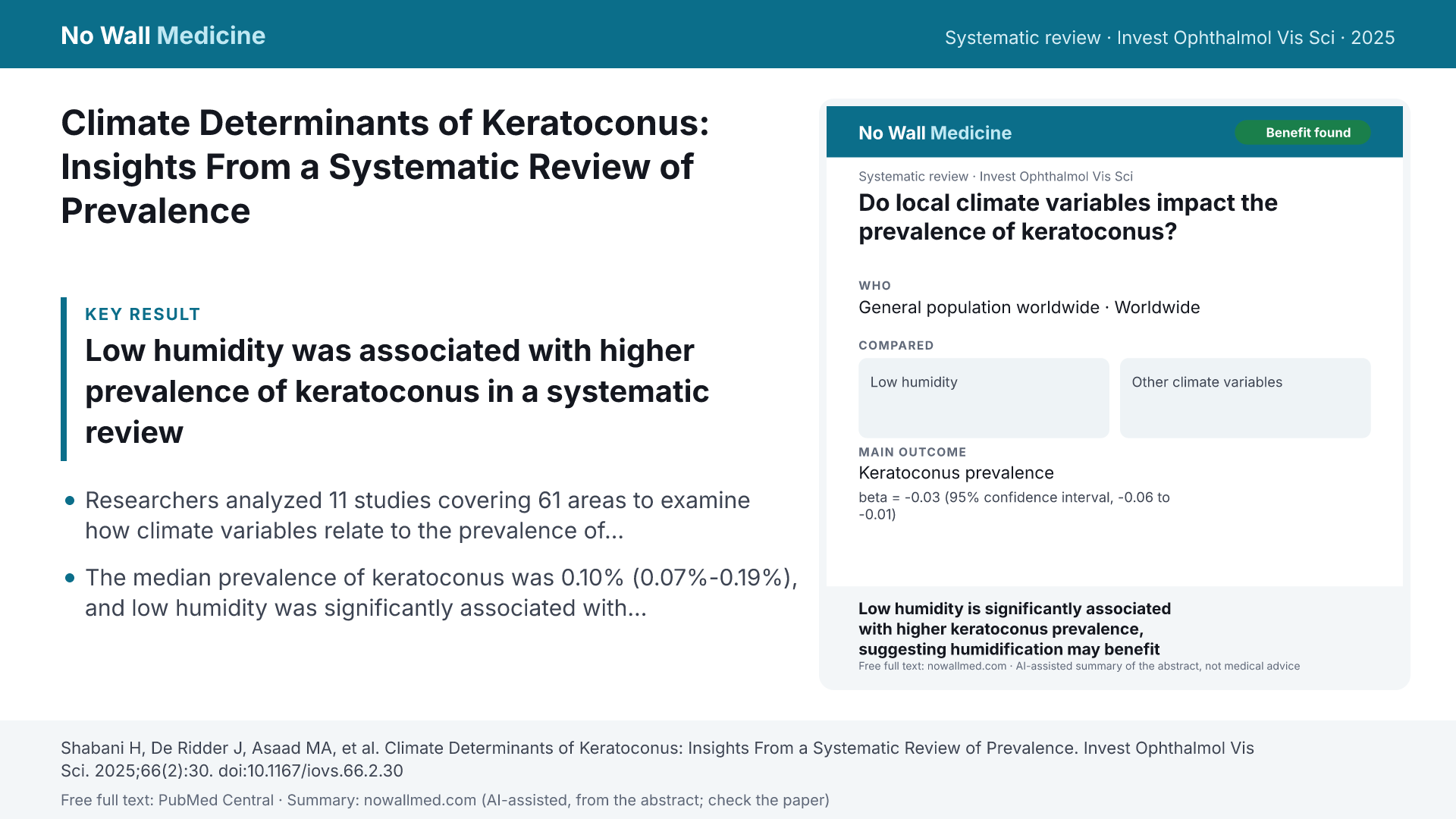
Low humidity was associated with higher prevalence of keratoconus in a systematic review
Climate Determinants of Keratoconus: Insights From a Systematic Review of Prevalence
Systematic reviewBenefit found
Do local climate variables impact the prevalence of keratoconus?
Who
General population worldwide · Worldwide
Compared
Low humidity
Other climate variables
Main outcome
Keratoconus prevalence
Result: beta = -0.03 (95% confidence interval, -0.06 to -0.01)
Bottom line: Low humidity is significantly associated with higher keratoconus prevalence, suggesting humidification may benefit at-risk groups.
Invest Ophthalmol Vis Sci · 2025-02-11 · Save PNG
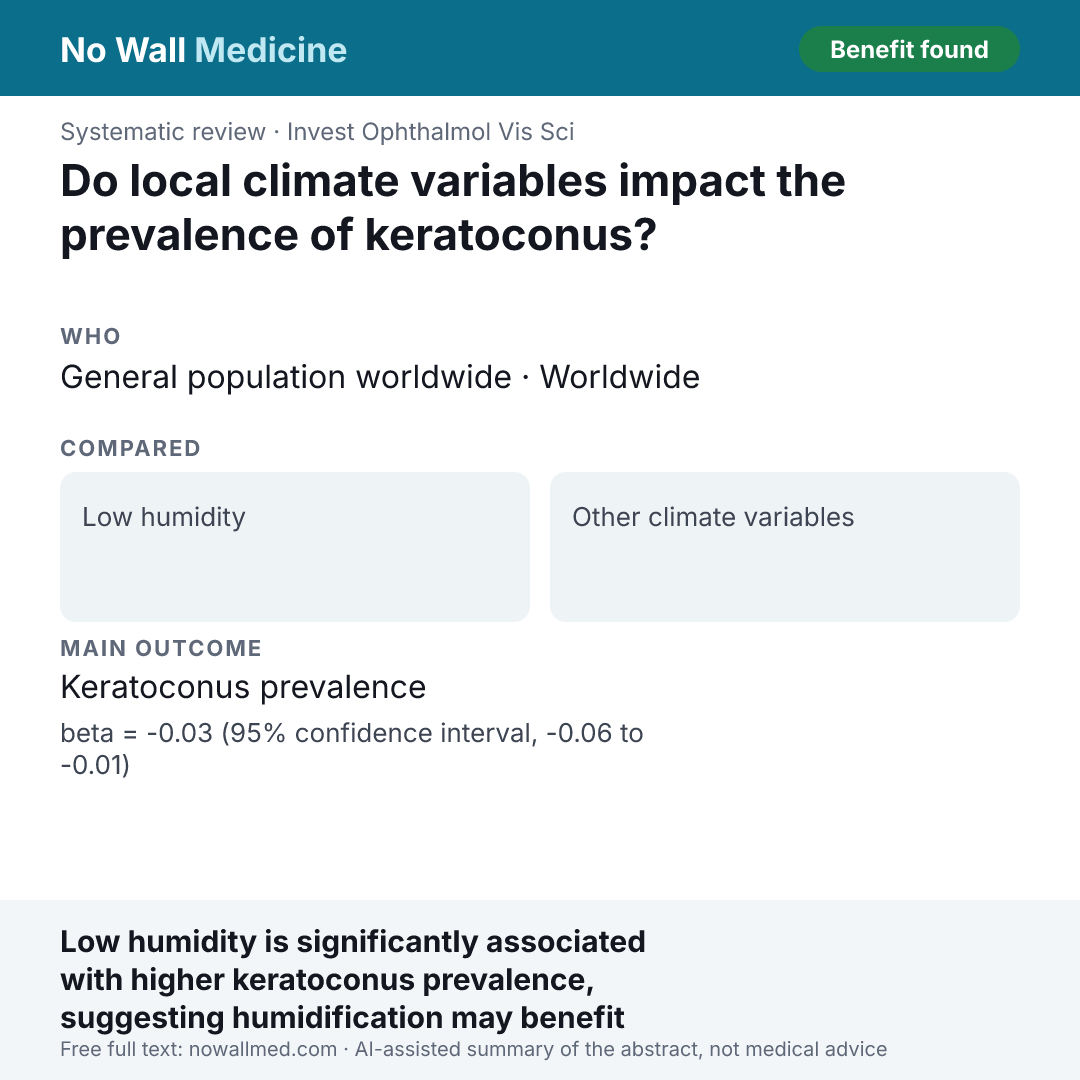
Clinical question: Do local climate variables impact the prevalence of keratoconus?
Key points
- Researchers analyzed 11 studies covering 61 areas to examine how climate variables relate to the prevalence of keratoconus, a condition where the cornea thins and bulges.
- The median prevalence of keratoconus was 0.10% (0.07%-0.19%), and low humidity was significantly associated with higher prevalence (β = -0.03; 95% confidence interval, -0.06 to -0.01; P = 0.004).
- Other climate variables, including daily maximum temperature, ultraviolet radiation, and wind speed, were not significantly associated with keratoconus prevalence.
Headline and key points written with AI from the paper’s abstract, with every number checked against it. Read the paper before relying on them.
Was this summary helpful?
Subject terms
Headline, design, result, key points, caveat and citation as plain text.
Cite this article
Shabani H, De Ridder J, Asaad MA, et al. Climate Determinants of Keratoconus: Insights From a Systematic Review of Prevalence. Invest Ophthalmol Vis Sci. 2025;66(2):30. doi:10.1167/iovs.66.2.30
Spotted a mistake? Suggest a correction