Systematic review identifies priority health indicators for monitoring climate change impacts in public health systems
Climate-related health impact indicators for public health surveillance in a changing climate: a systematic review and local suitability analysis
Systematic reviewMixed results
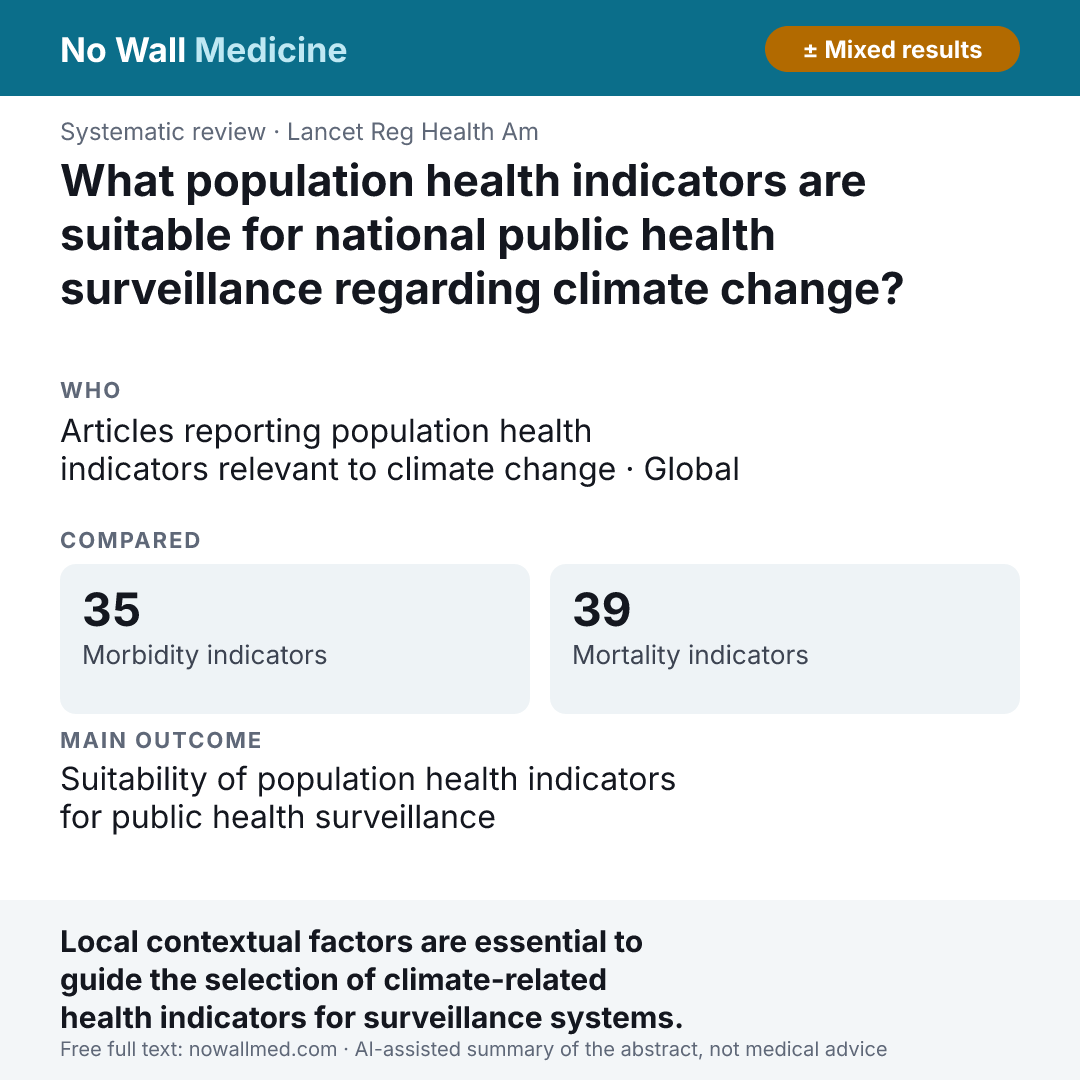
What population health indicators are suitable for national public health surveillance regarding climate change?
Who
Articles reporting population health indicators relevant to climate change · Global with a case study in Chile
Compared
35Morbidity indicators
39Mortality indicators
Main outcome
Suitability of population health indicators for public health surveillance
Bottom line: Local contextual factors are essential to guide the selection of climate-related health indicators for surveillance systems.
Funded by: ANID Chile and University College London
Lancet Reg Health Am · 2024-07-29 · Save PNG
Clinical question: What population health indicators are suitable for national public health surveillance regarding climate change?
Why it matters: The integration of existing global and country-specific health indicators into local public health surveillance systems is limited, which impacts decision-making.
Key points
- Researchers conducted a systematic review of 41 articles to examine population health indicators relevant to climate change and their suitability for national public health surveillance systems.
- The review found that 35 articles reported morbidity indicators, which measure the rate of disease in a population, and 39 articles reported mortality indicators, which measure death rates.
- In a case study of Chile, high-priority indicators included temperature-related health outcomes and diseases spread by vectors, food, or water due to their ease of integration.
Headline and key points written with AI from the paper’s abstract, with every number checked against it. Read the paper before relying on them.
Was this summary helpful?
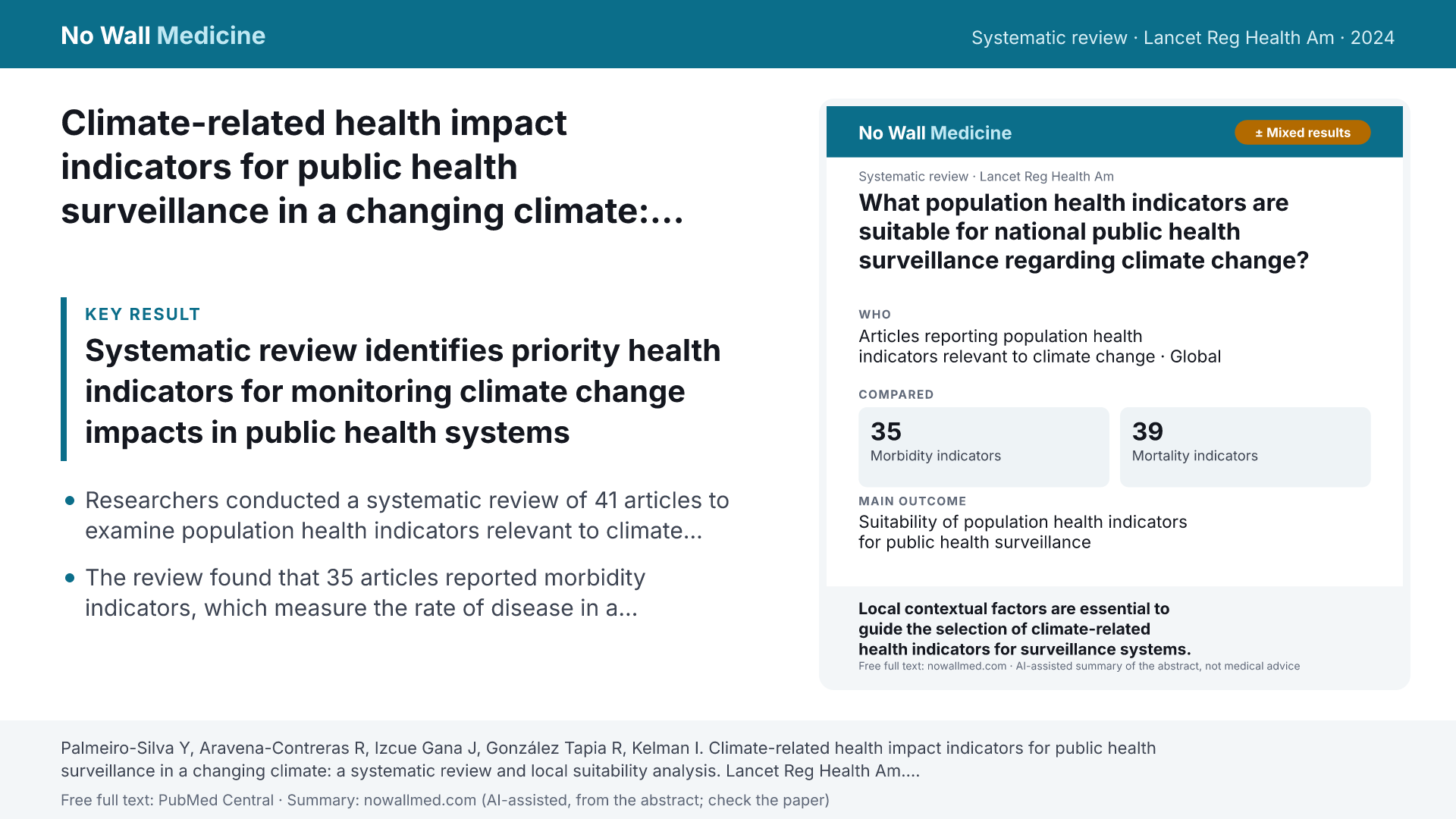
Headline, design, result, key points, caveat and citation as plain text.
Cite this article
Palmeiro-Silva Y, Aravena-Contreras R, Izcue Gana J, González Tapia R, Kelman I. Climate-related health impact indicators for public health surveillance in a changing climate: a systematic review and local suitability analysis. Lancet Reg Health Am. 2024;38:100854. doi:10.1016/j.lana.2024.100854
Spotted a mistake? Suggest a correction