Mixed granulocytic COPD is linked to higher exacerbation rates and increased lung tissue remodeling
Clinical and transcriptomic characterization of mixed granulocytic phenotype in chronic obstructive pulmonary disease
Post hoc analysis of a randomized controlled trialHarm found
How do clinical and transcriptomic features differ in mixed granulocytic COPD phenotypes?
Who
54
Patients with chronic obstructive pulmonary disease
Compared
mixed granulocytic COPD: highest annualized exacerbation rates
neutrophilic and pauci-granulocytic phenotypes
Main outcome
clinical outcomes and gene expression in bronchoalveolar lavage
Bottom line: Mixed granulocytic COPD is associated with more severe airflow limitation, emphysema, and higher exacerbation rates.
Limitation: This was a post hoc study of a randomized controlled trial
JACI · 2026-06-30Download image
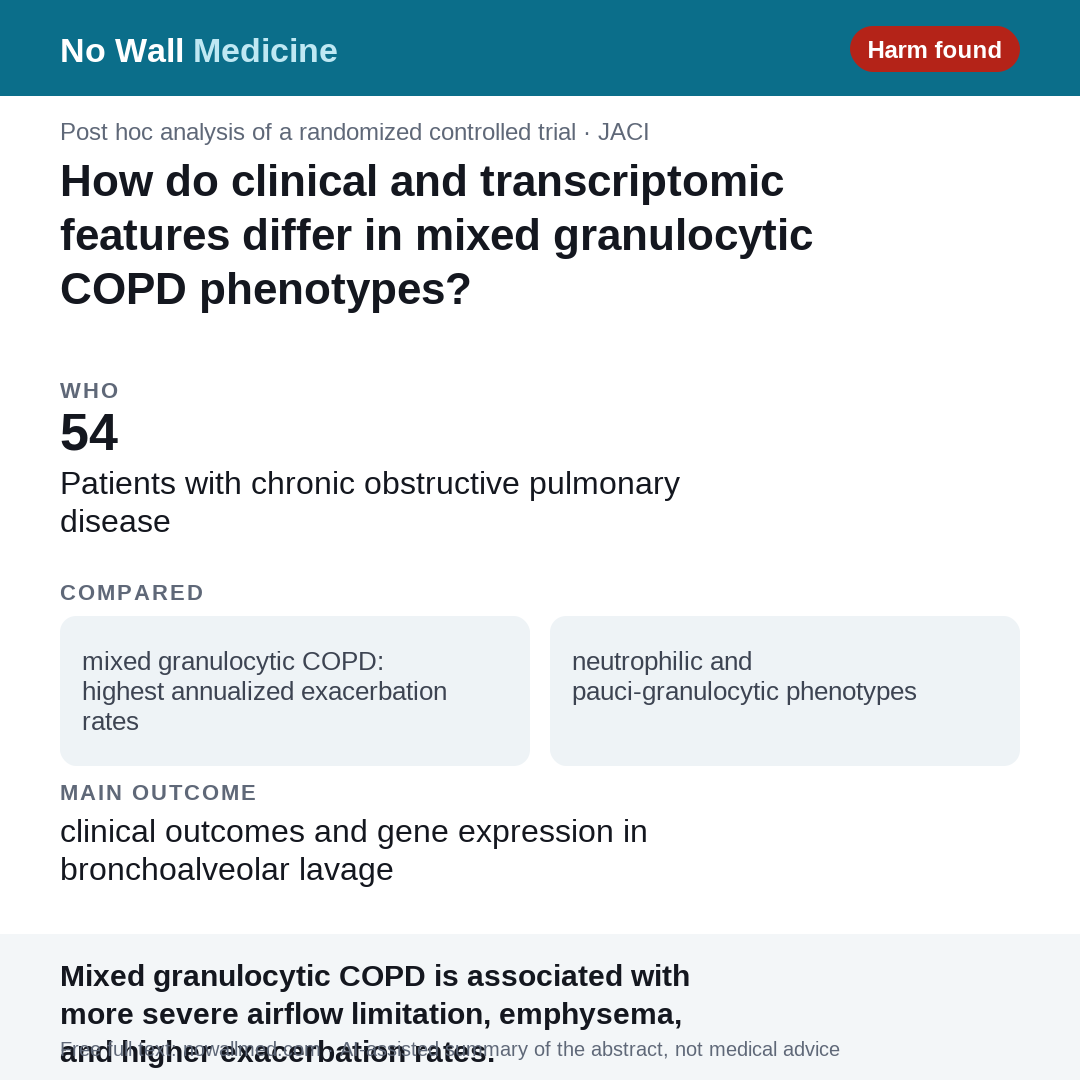
Clinical question: How do clinical and transcriptomic features differ in mixed granulocytic COPD phenotypes?
Why it matters: Patients with peripheral airways infiltrated by both eosinophils and neutrophils show worse outcomes than those without this mixed phenotype.
Key points
- Researchers studied 54 patients from the DISARM trial to compare mixed granulocytic, neutrophilic, and pauci-granulocytic phenotypes of chronic obstructive pulmonary disease.
- Patients with mixed granulocytic COPD had the lowest FEV1 (a measure of airflow), the most radiographic emphysema, and the highest annualized exacerbation rates.
- The mixed granulocytic phenotype showed increased expression of gene signatures for tissue remodeling processes that significantly associated with lower FEV1.
Headline and key points written with AI from the paper’s abstract, with every number checked against it. Read the paper before relying on them.
Topics
Spotted a mistake? Suggest a correction