Clinical applications and limitations of large language models in nephrology: a systematic review
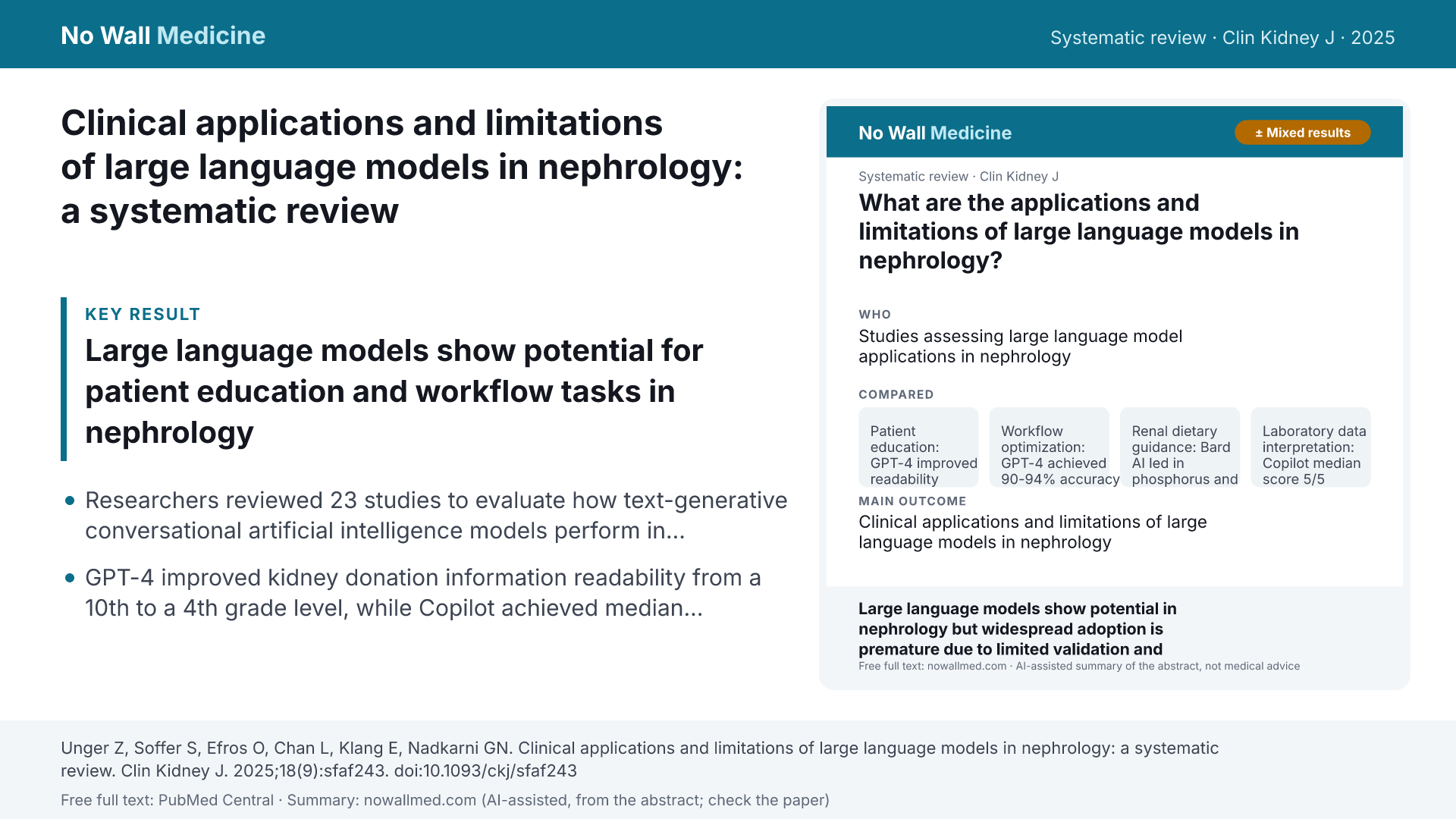
Key result: Large language models show potential for patient education and workflow tasks in nephrology
Systematic reviewMixed results
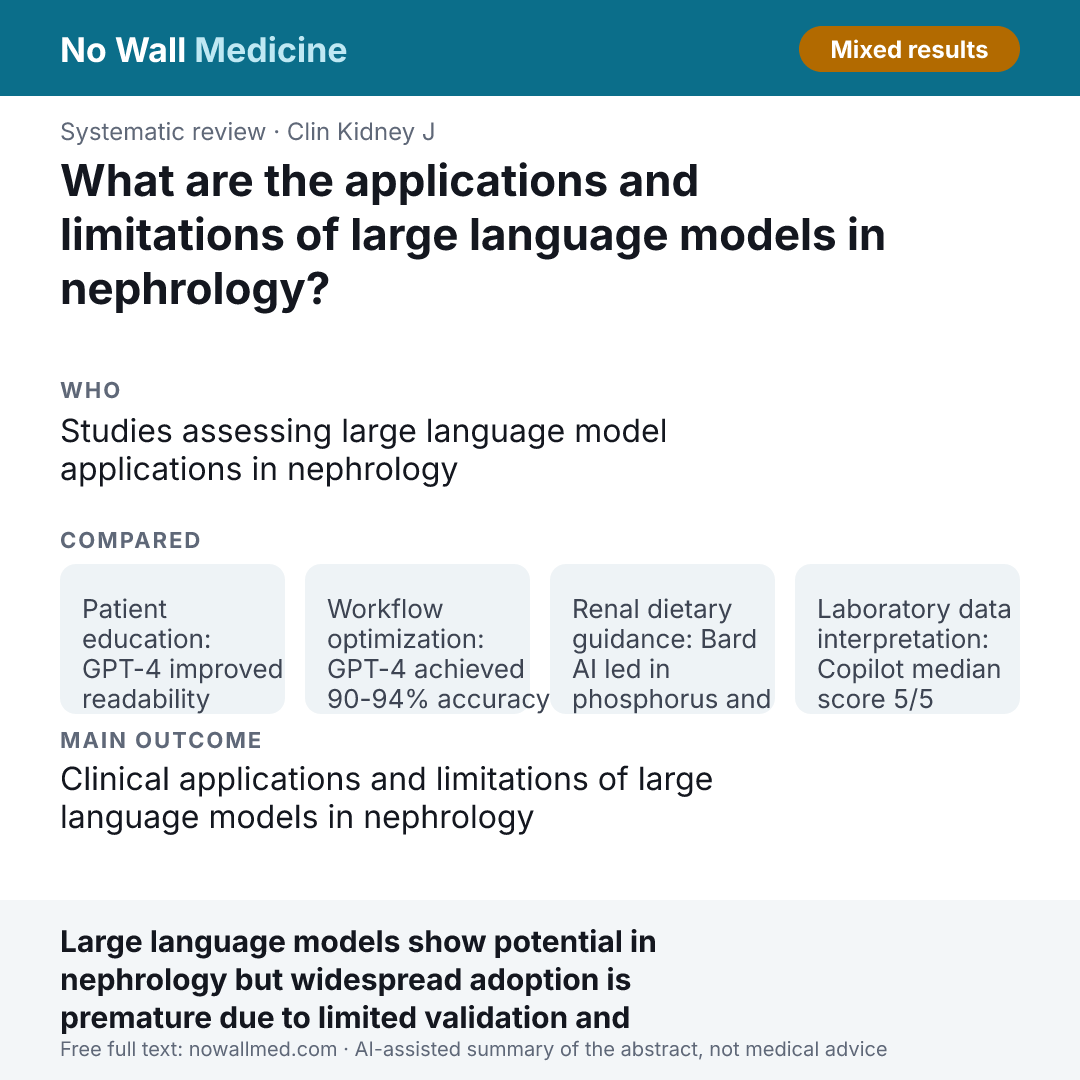
What are the applications and limitations of large language models in nephrology?
Who
Studies assessing large language model applications in nephrology
Compared
Patient education: GPT-4 improved readability from 10th to 4th grade level
Workflow optimization: GPT-4 achieved 90-94% accuracy in managing renal replacement therapy alarms
Renal dietary guidance: Bard AI led in phosphorus and oxalate classification
Laboratory data interpretation: Copilot median score 5/5
Main outcome
Clinical applications and limitations of large language models in nephrology
Bottom line: Large language models show potential in nephrology but widespread adoption is premature due to limited validation and input dependence.
Limitation: Input-quality dependence and limited external validation restrict generalizability.
Clin Kidney J · 2025-09-18 · Save PNG
Key points
- Researchers reviewed 23 studies to evaluate how text-generative conversational artificial intelligence models perform in kidney care applications.
- GPT-4 improved kidney donation information readability from a 10th to a 4th grade level, while Copilot achieved median scores of 5/5 in laboratory data interpretation.
- The review found that model performance was linked to input quality and noted frequent omissions in data handling and transparency.
Limitation the authors note: The authors state that input-quality dependence and limited external validation restrict the generalizability of the findings.
Discussion prompts
- Would these patients look like yours? Who was left out?
- Is the main outcome one that matters to patients?
- Is the difference large enough to change what you do?
Cite: Unger Z, Soffer S, Efros O, Chan L, Klang E, Nadkarni GN. Clinical applications and limitations of large language models in nephrology: a systematic review. Clin Kidney J. 2025;18(9):sfaf243. doi:10.1093/ckj/sfaf243
Free full text: PubMed Central · Summary and visual abstract: nowallmed.com/a/clinical-applications-and-limitations-of-large-language-models-in-1fv20xe/ (AI-assisted from the abstract; check the paper before relying on it).