SDHD gene mutation carriers show increasing tumor risk with age and high rates of multiple tumors
Clinical characteristics and prognosis of SDHD pathogenic variant carriers: a systematic review and meta-analysis
Systematic review and meta-analysisBenefit found
What are the penetrance, multifocality, metastatic risk, and mortality in SDHD pathogenic variant carriers?
Who
Carriers of succinate dehydrogenase subunit D pathogenic variants
Compared
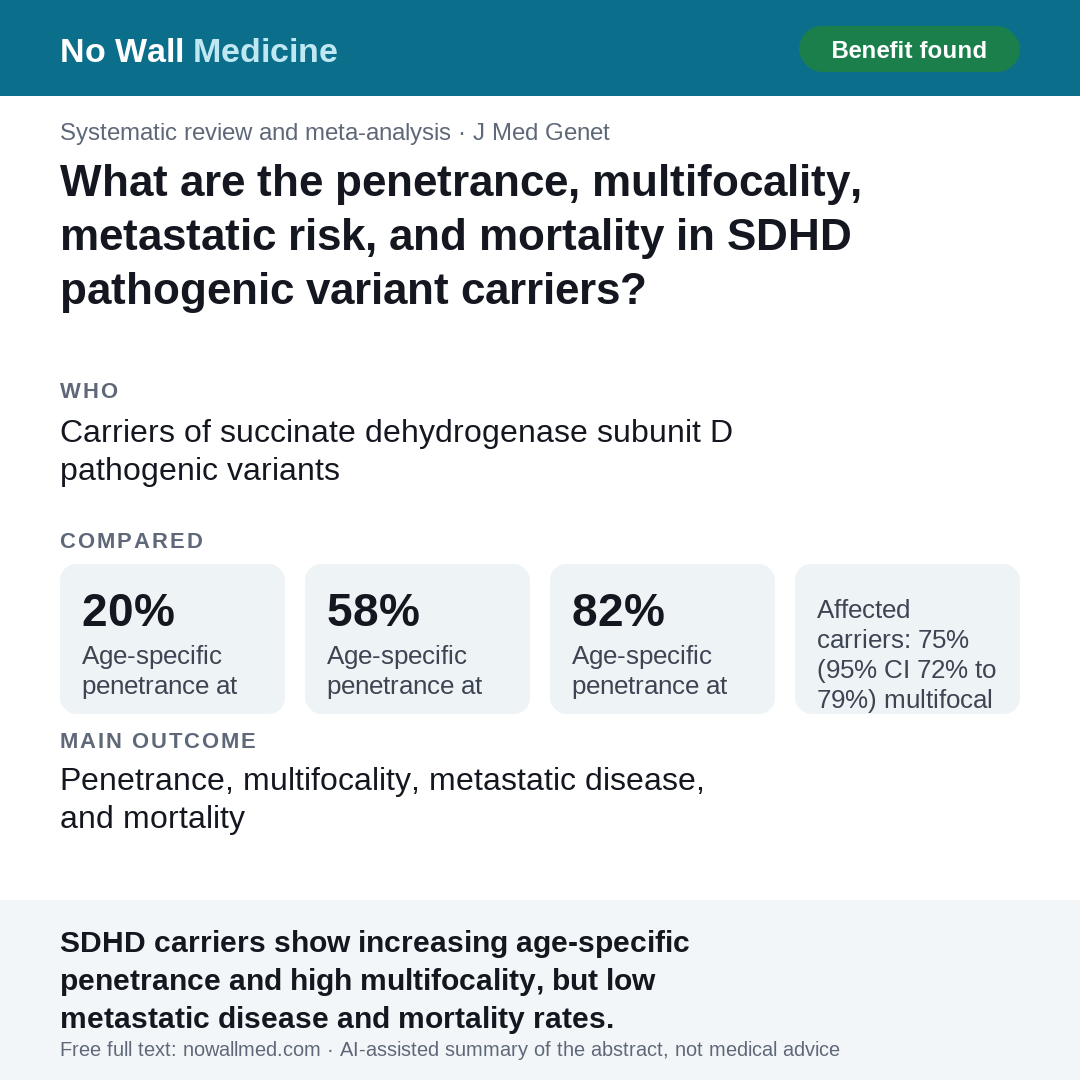
20%Age-specific penetrance at 20 years (95% CI 16% to 25%)
58%Age-specific penetrance at 40 years (95% CI 48% to 67%)
82%Age-specific penetrance at 60 years (95% CI 75% to 90%)
Affected carriers: 75% (95% CI 72% to 79%) multifocal tumours
Main outcome
Penetrance, multifocality, metastatic disease, and mortality
Bottom line: SDHD carriers show increasing age-specific penetrance and high multifocality, but low metastatic disease and mortality rates.
Limitation: Evidence linking specific variants to these phenotypes is limited.
J Med Genet · 2026-07-23Download image
Clinical question: What are the penetrance, multifocality, metastatic risk, and mortality in SDHD pathogenic variant carriers?
Why it matters: Existing studies have reported inconsistent findings regarding how often tumors occur, how many tumors develop, and the risk of spread in SDHD gene mutation carriers.
Key points
- Researchers performed a meta-analysis of observational studies to assess tumor risk and clinical characteristics in carriers of succinate dehydrogenase subunit D (SDHD) gene mutations.
- The risk of developing tumors increased from 20% at 20 years of age to 58% at 40 years and 82% at 60 years.
- Among those with tumors, 75% had multifocal tumors, while metastatic disease occurred in 3% and mortality was 1%.
Limitation the authors note: Evidence linking specific genetic variants to these clinical phenotypes is limited.
Headline and key points written with AI from the paper’s abstract, with every number checked against it. Read the paper before relying on them.
Abstract
Background
Germline pathogenic variants (PVs) of succinate dehydrogenase subunit D (SDHD) are major genetic causes of pheochromocytomas and paragangliomas. Existing studies have reported inconsistent findings and lack a comprehensive synthesis regarding penetrance, multifocality and metastatic risk in carriers of SDHD PVs. Objective
To systematically assess age-specific penetrance (in all carriers) and the proportions of multifocality, metastatic disease and mortality among affected carriers, and explore potential genotype-phenotype associations through a systematic review and meta-analysis. Methods
Eligible observational studies were selected from PubMed, MEDLINE and EMBASE that reported age-specific penetrance (in all carriers) and the proportions of multifocality, metastatic disease and mortality among affected carriers (those with tumours). Additionally, data on specific SDHD variants associated with tumour multifocality or metastatic behaviour were collected. Following independent data extraction and quality assessment by two reviewers, these proportions were meta-analysed using random-effects models or fixed-effect model to generate pooled estimates with 95% CIs and prediction intervals. Results
Age-specific penetrance increased from 20% at 20 years of age (95% CI 16% to 25%) to 58% at 40 years (95% CI 48% to 67%) and 82% at 60 years (95% CI 75% to 90%). Among the affected SDHD PV carriers, the pooled proportions were 75% (95% CI 72% to 79%) for multifocal tumours, 3% (95% CI 2% to 4%) for metastatic disease and 1% (95% CI 1% to 2%) for mortality. Conclusion
SDHD PV carriers exhibit increasing age-specific penetrance, with a high proportion of patients having multifocal tumours but low proportions of metastatic disease and mortality, providing partial evidence for the need for lifelong monitoring of SDHD PV carriers. However, evidence linking specific variants to these phenotypes is limited and requires further investigation. Prospero registration number
CRD420251060752.
Abstract reproduced under the article’s CC BY NC licence.
Topics
Cite this article
Lian X, Shen L, Song J, Pang M, Zhong Y, Zhang H. Clinical characteristics and prognosis of SDHD pathogenic variant carriers: a systematic review and meta-analysis. J Med Genet. 2026. doi:10.1136/jmg-2025-111235
Spotted a mistake? Suggest a correction