Electronic health record decision support reduced falls and fall-related injuries in older primary care patients
Clinical Decision Support for Fall Prevention in Primary Care: The eSTEPS Cluster Randomized Clinical Trial
Matched-pair cluster randomized clinical trialBenefit found
Does electronic health record-integrated clinical decision support reduce falls among older primary care patients?
Who
11945
Adults aged 65 years or older with positive fall-risk screen · 22 primary care practices within an integrated health system, US
Compared
eSTEPS intervention: 19.3 (95% CI, 18.6-20.1) per 100 patient-years
Control: 21.2 (95% CI, 20.2-22.1) per 100 patient-years
Main outcome
Rate of 1 or more ICD-10-coded falls per 100 patient-years
Result: rate ratio 0.91 (95% CI, 0.88-0.95)
Bottom line: Electronic health record-integrated decision support modestly reduced falls and fall-related injuries in older primary care patients.
JAMA Netw Open · 2026-10-01Download image
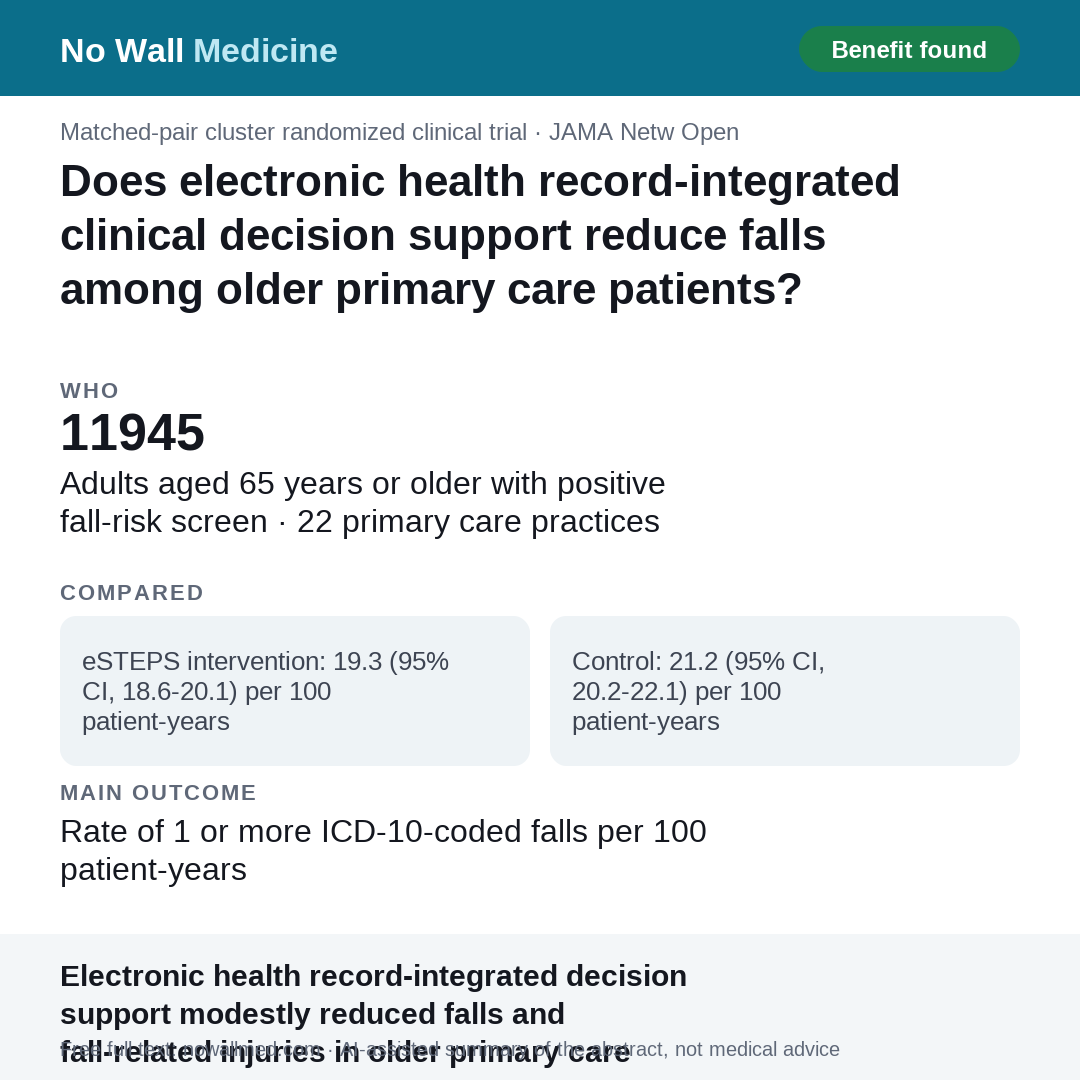
Clinical question: Does electronic health record-integrated clinical decision support reduce falls among older primary care patients?
Why it matters: Implementation of exercise programs to reduce fall risk remains limited in primary care settings.
Key points
- Researchers studied 11,945 adults aged 65 years or older at 22 primary care practices to compare an electronic decision support tool against standard care.
- The intervention group had 19.3 falls per 100 patient-years compared to 21.2 in the control group, and fall-related injuries were 15.7 versus 16.7 per 100 patient-years.
- While falls and injuries decreased, no differences were observed in mortality between the two groups.
Headline and key points written with AI from the paper’s abstract, with every number checked against it. Read the paper before relying on them.
Topics
Spotted a mistake? Suggest a correction