Brief cognitive behavioural therapy workshops for stress showed modest clinical effectiveness in adolescents
Clinical effectiveness and cost-effectiveness of a brief accessible cognitive behavioural therapy programme for stress in school-aged adolescents (BESST): a cluster randomised controlled trial in the UK
Multicentre, cluster randomised controlled trialBenefit found
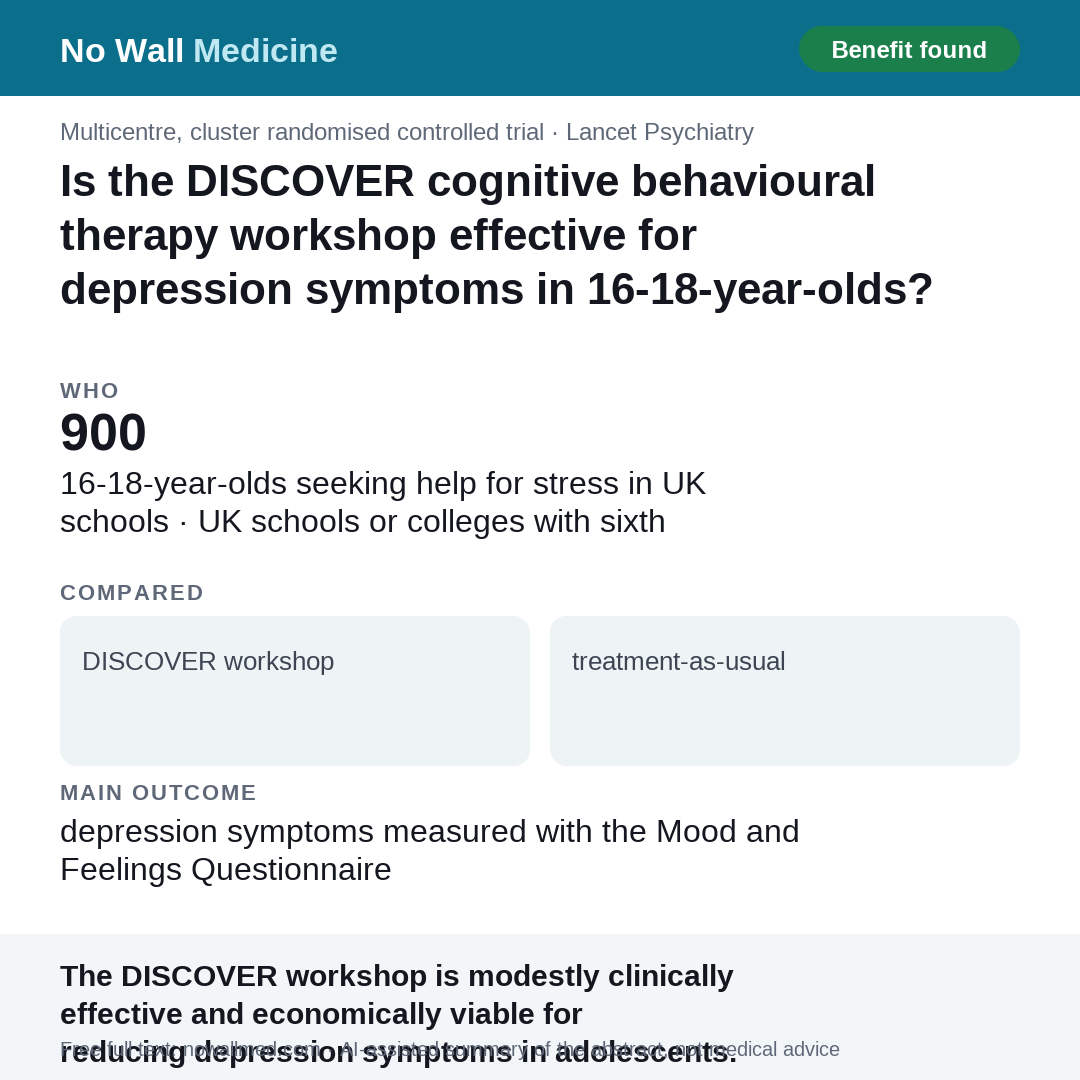
Is the DISCOVER cognitive behavioural therapy workshop effective for depression symptoms in 16-18-year-olds?
Who
900
16-18-year-olds seeking help for stress in UK schools · UK schools or colleges with sixth forms
Compared
DISCOVER workshop
treatment-as-usual
Main outcome
depression symptoms measured with the Mood and Feelings Questionnaire
Result: adjusted mean difference in MFQ -2·06 (95% CI -3·35 to -0·76)
Bottom line: The DISCOVER workshop is modestly clinically effective and economically viable for reducing depression symptoms in adolescents.
Funded by: National Institute for Health and Care Research Health Technology Assessment Programme
Lancet Psychiatry · 2024-05-14Download image
Clinical question: Is the DISCOVER cognitive behavioural therapy workshop effective for depression symptoms in 16-18-year-olds?
Why it matters: It is unknown if a brief, accessible cognitive behavioural therapy workshop can effectively address depression symptoms in school-aged adolescents.
Key points
- The study compared a brief cognitive behavioural therapy workshop called DISCOVER to treatment-as-usual among 900 adolescents aged 16-18 in UK schools.
- At the 6-month follow-up, the DISCOVER group had an adjusted mean difference in depression symptoms of -2.06 on the Mood and Feelings Questionnaire.
- The probability that the workshop was cost-effective compared to usual care ranged from 61% to 78% at a £20,000 to £30,000 threshold.
Headline and key points written with AI from the paper’s abstract, with every number checked against it. Read the paper before relying on them.
Abstract
Background
Depression and anxiety are increasingly prevalent in adolescents. The Brief Educational Workshops in Secondary Schools Trial investigated the effectiveness of a brief accessible stress workshop programme for 16-18-year-olds. We aimed to investigate the clinical effectiveness and cost-effectiveness of the DISCOVER cognitive behavioural therapy (CBT) workshop on symptoms of depression in 16-18-year-olds at 6 months compared with treatment-as-usual. Methods
We conducted a multicentre, cluster randomised controlled trial in UK schools or colleges with sixth forms to evaluate clinical effectiveness and cost-effectiveness of a brief CBT workshop (DISCOVER) compared with treatment-as-usual. We planned to enrol 60 schools and 900 adolescents, using a self-referral system to recruit participants. Schools were randomised in a 1:1 ratio for participants to receive either the DISCOVER workshop or treatment-as-usual, stratified by site and balanced on school size and index of multiple deprivation. Participants were included if they were 16-18 years old, attending for the full school year, seeking help for stress, and fluent in English and able to provide written informed consent. The outcome assessors, senior health economist, senior statistician, and chief investigator were masked. People with lived experience were involved in the study. The primary outcome was depression symptoms measured with the Mood and Feelings Questionnaire (MFQ) at 6-month follow-up, in the intention-to-treat population of all participants with full covariate data. The trial was registered with the ISRCTN registry (ISRCTN90912799). Findings
111 schools were invited to participate in the study, seven were deemed ineligible, and 47 did not provide consent. Between Oct 4, 2021, and Nov 10, 2022, 933 students at 57 schools were screened for eligibility, seven were not eligible for inclusion, and 26 did not attend the baseline meeting and assessment, resulting in 900 adolescents participating in the study. The DISCOVER group included 443 participants (295 [67%] female and 136 [31%] male) and the treatment-as-usual group included 457 participants (346 [76%] female and 92 [20%] male). 468 (52%) of the 900 participants were White, and the overall age of the participants was 17·2 years (SD 0·6). 873 (97%) adolescents were followed up in the intention-to-treat population. The primary intention-to-treat analysis (n=854) found an adjusted mean difference in MFQ of -2·06 (95% CI -3·35 to -0·76; Cohen's d=-0·17; p=0·0019) at the 6-month follow-up, indicating a clinical improvement in the DISCOVER group. The probability that DISCOVER is cost- effective compared with treatment-as-usual ranged from 61% to 78% at a £20 000 to £30 000 per quality-adjusted life-year threshold. Nine adverse events (two of which were classified as serious) were reported in the DISCOVER group and 14 (two of which were classified as serious) were reported in the treatment-as-usual group. Interpretation
Our findings indicate that the DISCOVER intervention is modestly clinically effective and economically viable and could be a promising early intervention in schools. Given the importance of addressing mental health needs early in this adolescent population, additional research is warranted to explore this intervention. Funding
National Institute for Health and Care Research Health Technology Assessment Programme.
Abstract reproduced under the article’s CC BY licence.
Topics
Cite this article
Brown J, James K, Lisk S, Shearer J, Byford S, Stallard P. Clinical effectiveness and cost-effectiveness of a brief accessible cognitive behavioural therapy programme for stress in school-aged adolescents (BESST): a cluster randomised controlled trial in the UK. Lancet Psychiatry. 2024. doi:10.1016/S2215-0366(24)00101-9
Spotted a mistake? Suggest a correction
Top studies every Monday
The week’s key trials and guidelines in your specialties, plus any topics you follow. By email, free.
Get the weekly digest