Time-lapse imaging systems for embryo culture and selection did not increase live birth rates
Clinical effectiveness and safety of time-lapse imaging systems for embryo incubation and selection in in-vitro fertilisation treatment (TILT): a multicentre, three-parallel-group, double-blind, randomised controlled trial
Multicentre, three-parallel-group, double-blind, randomised controlled trialNo clear difference
Do time-lapse imaging systems improve live birth rates in IVF or ICSI treatment?
Who
1575
Women aged 18-42 and men 18 or older undergoing IVF or ICSI · Seven IVF centres in the United Kingdom and Hong Kong
Compared
33·7%Time-lapse imaging group (175/520)
36·6%Undisturbed culture group (189/516)
33·0%Standard care group (172/522)
Main outcome
Live birth
Result: adjusted odds ratio 1·04 (97·5% CI 0·73 to 1·47)
Bottom line: Time-lapse imaging systems for embryo culture and selection do not significantly increase live birth rates compared to standard care.
Lancet · 2024-07-21Download image
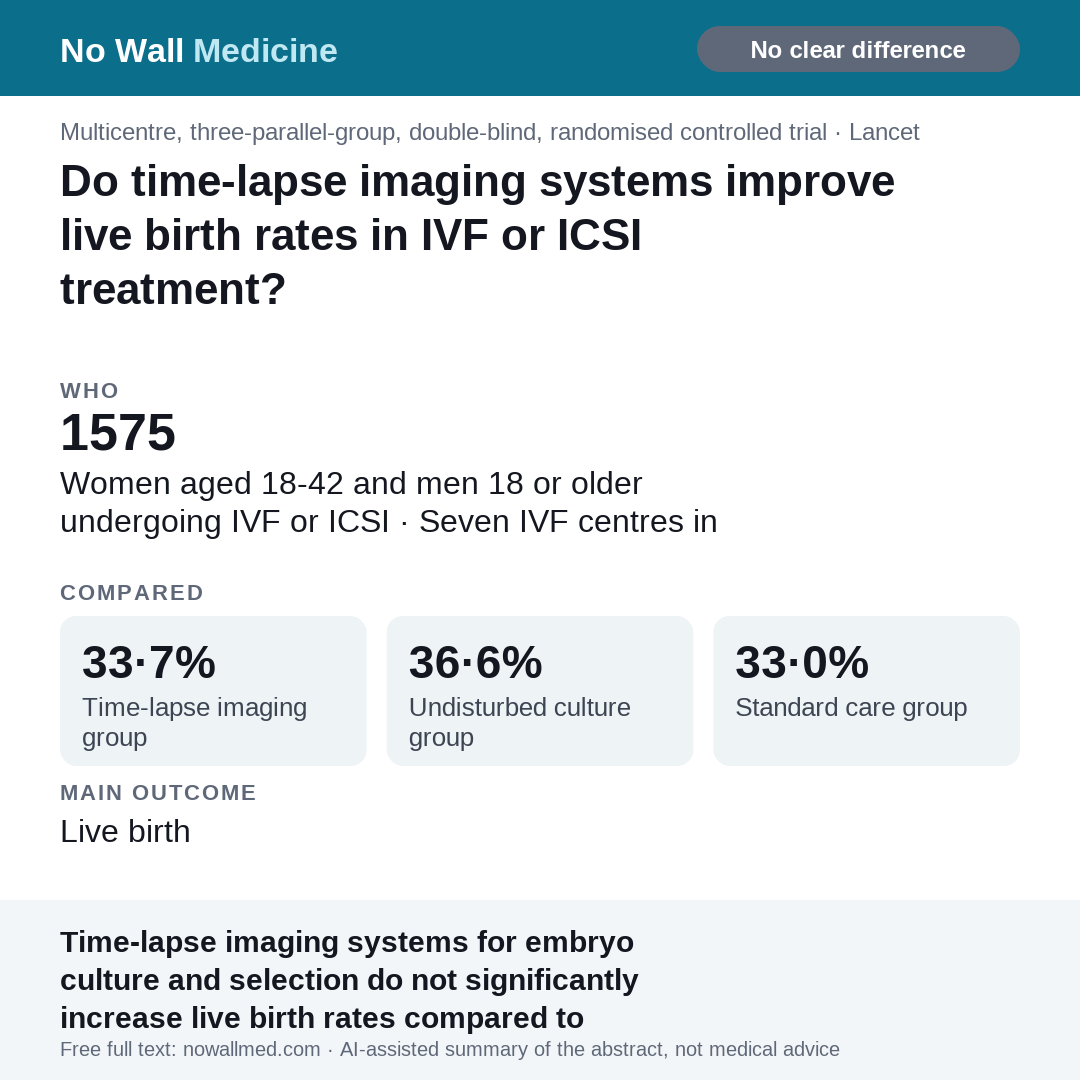
Clinical question: Do time-lapse imaging systems improve live birth rates in IVF or ICSI treatment?
Why it matters: The benefit of using time-lapse imaging systems for undisturbed embryo culture and selection compared to standard care remains uncertain.
Key points
- Researchers conducted a randomized controlled trial with 1575 participants undergoing in-vitro fertilisation or intracytoplasmic sperm injection across seven centres.
- Live birth rates were 33.7% in the time-lapse imaging group, 36.6% in the undisturbed culture group, and 33.0% in the standard care group.
- The adjusted odds ratio for the time-lapse imaging group versus control was 1.04 (97.5% CI 0.73 to 1.47), showing no significant difference.
Headline and key points written with AI from the paper’s abstract, with every number checked against it. Read the paper before relying on them.
Abstract
Background
Time-lapse imaging systems for embryo incubation and selection might improve outcomes of in-vitro fertilisation (IVF) and intracytoplasmic sperm injection (ICSI) treatment due to undisturbed embryo culture conditions, improved embryo selection, or both. However, the benefit remains uncertain. We aimed to evaluate the effectiveness of time-lapse imaging systems providing undisturbed culture and embryo selection, and time-lapse imaging systems providing only undisturbed culture, and compared each with standard care without time-lapse imaging. Methods
We conducted a multicentre, three-parallel-group, double-blind, randomised controlled trial in participants undergoing IVF or ICSI at seven IVF centres in the UK and Hong Kong. Embryologists randomly assigned participants using a web-based system, stratified by clinic in a 1:1:1 ratio to the time-lapse imaging system for undisturbed culture and embryo selection (time-lapse imaging group), time-lapse imaging system for undisturbed culture alone (undisturbed culture group), and standard care without time-lapse imaging (control group). Women were required to be aged 18-42 years and men (ie, their partners) 18 years or older. Couples had to be receiving their first, second, or third IVF or ICSI treatment and could not participate if using donor gametes. Participants and trial staff were masked to group assignment, embryologists were not. The primary outcome was live birth. We performed analyses using the intention-to-treat principle and reported the main analysis in participants with primary outcome data available (full analysis set). The trial is registered on the International Trials Registry (ISRCTN17792989) and is now closed. Findings
1575 participants were randomly assigned to treatment groups (525 participants per group) between June 21, 2018, and Sept 30, 2022. The live birth rates were 33·7% (175/520) in the time-lapse imaging group, 36·6% (189/516) in the undisturbed culture group, and 33·0% (172/522) in the standard care group. The adjusted odds ratio was 1·04 (97·5% CI 0·73 to 1·47) for time-lapse imaging arm versus control and 1·20 (0·85 to 1·70) for undisturbed culture versus control. The risk reduction for the absolute difference was 0·7 percentage points (97·5% CI -5·85 to 7·25) between the time-lapse imaging and standard care groups and 3·6 percentage points (-3·02 to 10·22) between the undisturbed culture and standard care groups. 79 serious adverse events unrelated to the trial were reported (n=28 in time-lapse imaging, n=27 in undisturbed culture, and n=24 in standard care). Interpretation
In women undergoing IVF or ICSI treatment, the use of time-lapse imaging systems for embryo culture and selection does not significantly increase the odds of live birth compared with standard care without time-lapse imaging. Funding
Barts Charity, Pharmasure Pharmaceuticals, Hong Kong OG Trust Fund, Hong Kong Health and Medical Research Fund, Hong Kong Matching Fund.
Abstract reproduced under the article’s CC BY licence.
Topics
Cite this article
Bhide P, Chan DYL, Lanz D, Alqawasmeh O, Barry E, Baxter D. Clinical effectiveness and safety of time-lapse imaging systems for embryo incubation and selection in in-vitro fertilisation treatment (TILT): a multicentre, three-parallel-group, double-blind, randomised controlled trial. Lancet. 2024. doi:10.1016/S0140-6736(24)00816-X
Spotted a mistake? Suggest a correction