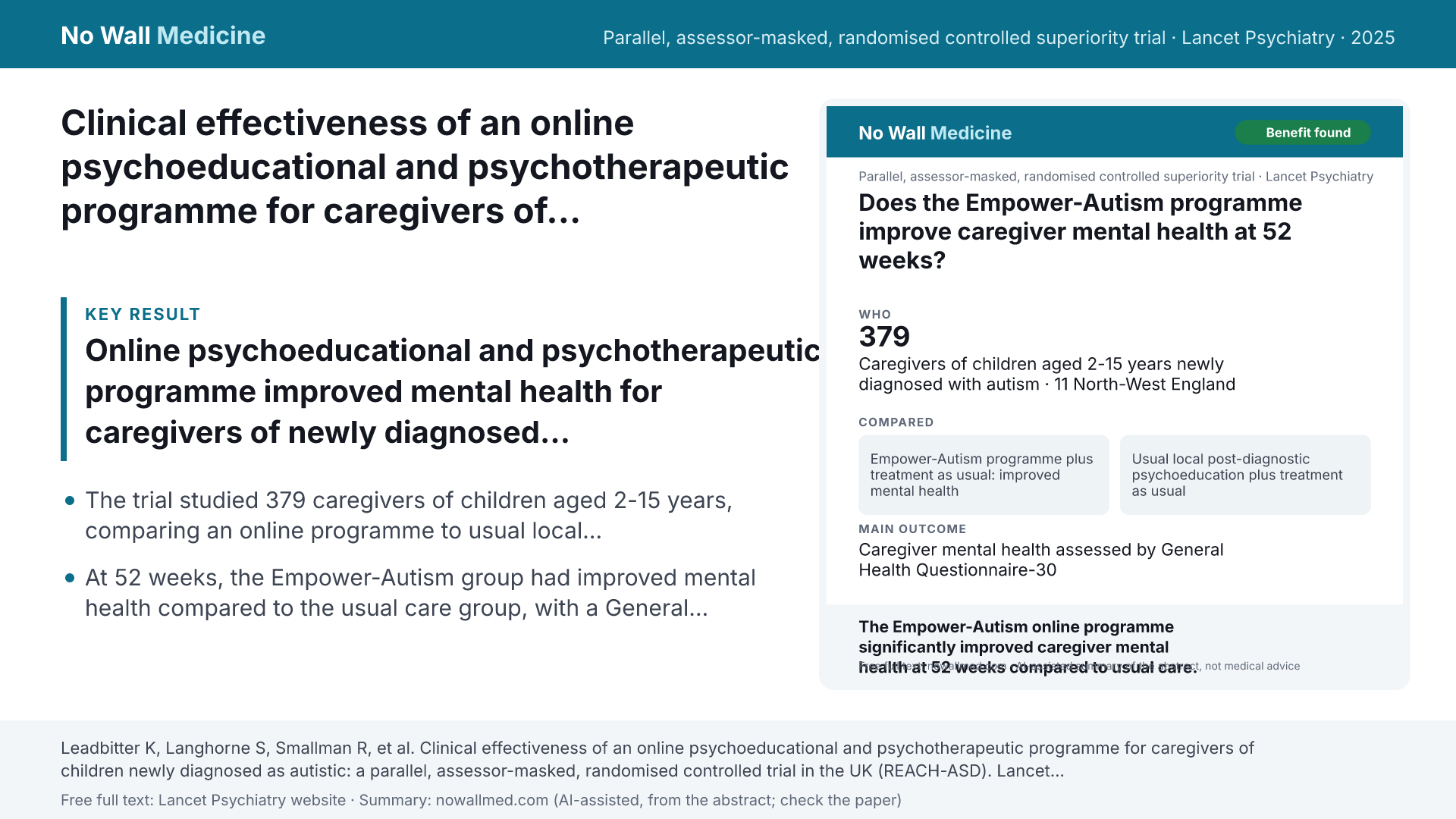
Clinical effectiveness of an online psychoeducational and psychotherapeutic programme for caregivers of children newly diagnosed as autistic: a parallel, assessor-masked, randomised controlled trial in the UK (REACH-ASD)
Key result: Online psychoeducational and psychotherapeutic programme improved mental health for caregivers of newly diagnosed autistic children
Key points
- The trial studied 379 caregivers of children aged 2-15 years, comparing an online programme to usual local post-diagnostic support.
- At 52 weeks, the Empower-Autism group had improved mental health compared to the usual care group, with a General Health Questionnaire-30 mean difference of -4.95.
- There were 181 adverse events reported, including 15 serious adverse events, though none were deemed related to the study intervention.
Why it matters: Post-diagnostic family support is often inconsistently implemented and may not directly address the mental health of caregivers.
Discussion prompts
- Would these patients look like yours? Who was left out?
- Is the main outcome one that matters to patients?
- Is the difference large enough to change what you do?
Cite: Leadbitter K, Langhorne S, Smallman R, et al. Clinical effectiveness of an online psychoeducational and psychotherapeutic programme for caregivers of children newly diagnosed as autistic: a parallel, assessor-masked, randomised controlled trial in the UK (REACH-ASD). Lancet Psychiatry. 2025;12(4):289-302. doi:10.1016/S2215-0366(25)00036-7
Free full text: Lancet Psychiatry website · Summary and visual abstract: nowallmed.com/a/clinical-effectiveness-of-an-online-psychoeducational-and-npzi6z/ (AI-assisted from the abstract; check the paper before relying on it).