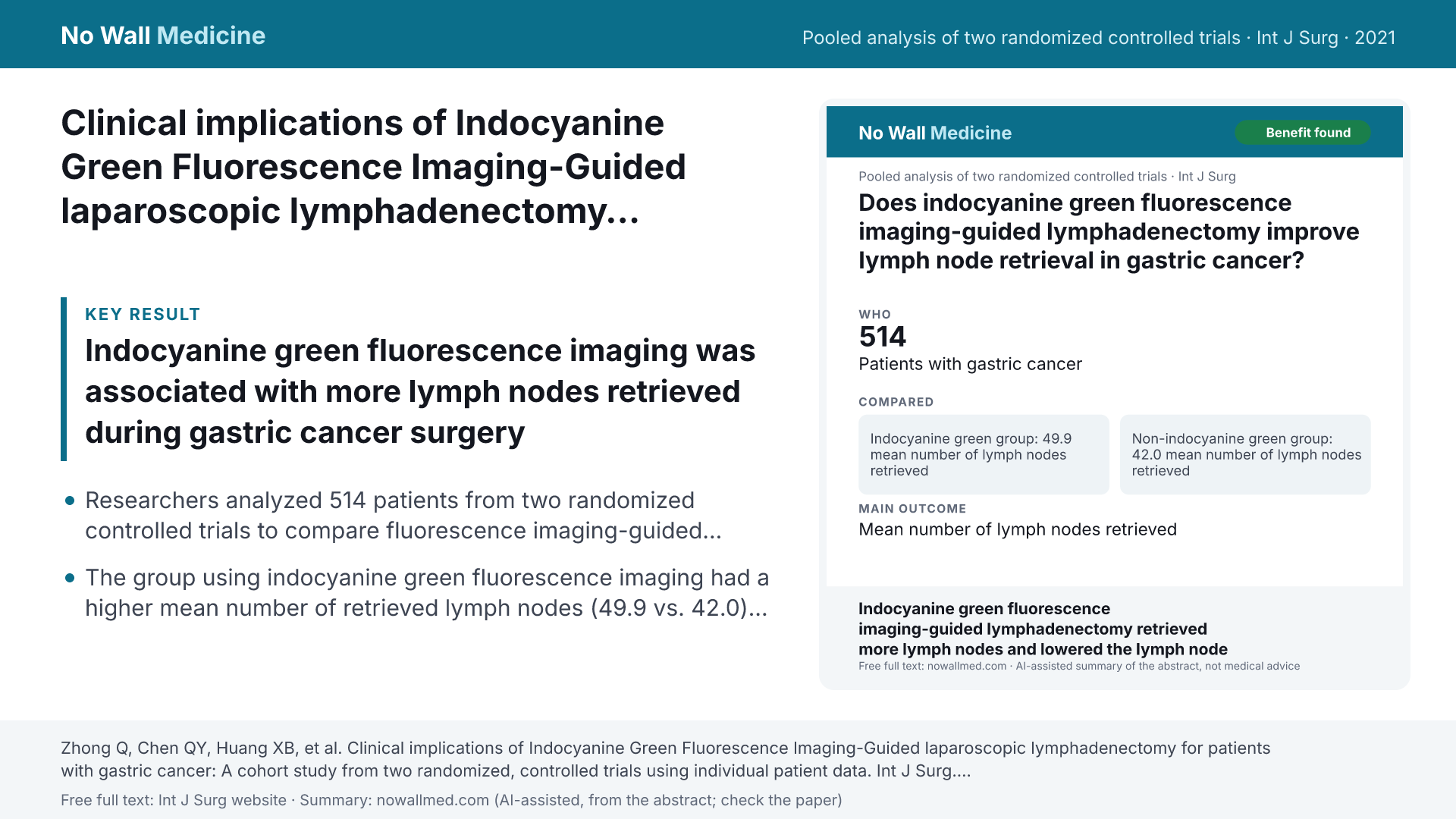
Indocyanine green fluorescence imaging was associated with more lymph nodes retrieved during gastric cancer surgery
Clinical implications of Indocyanine Green Fluorescence Imaging-Guided laparoscopic lymphadenectomy for patients with gastric cancer: A cohort study from two randomized, controlled trials using individual patient data
Pooled analysis of two randomized controlled trialsBenefit found
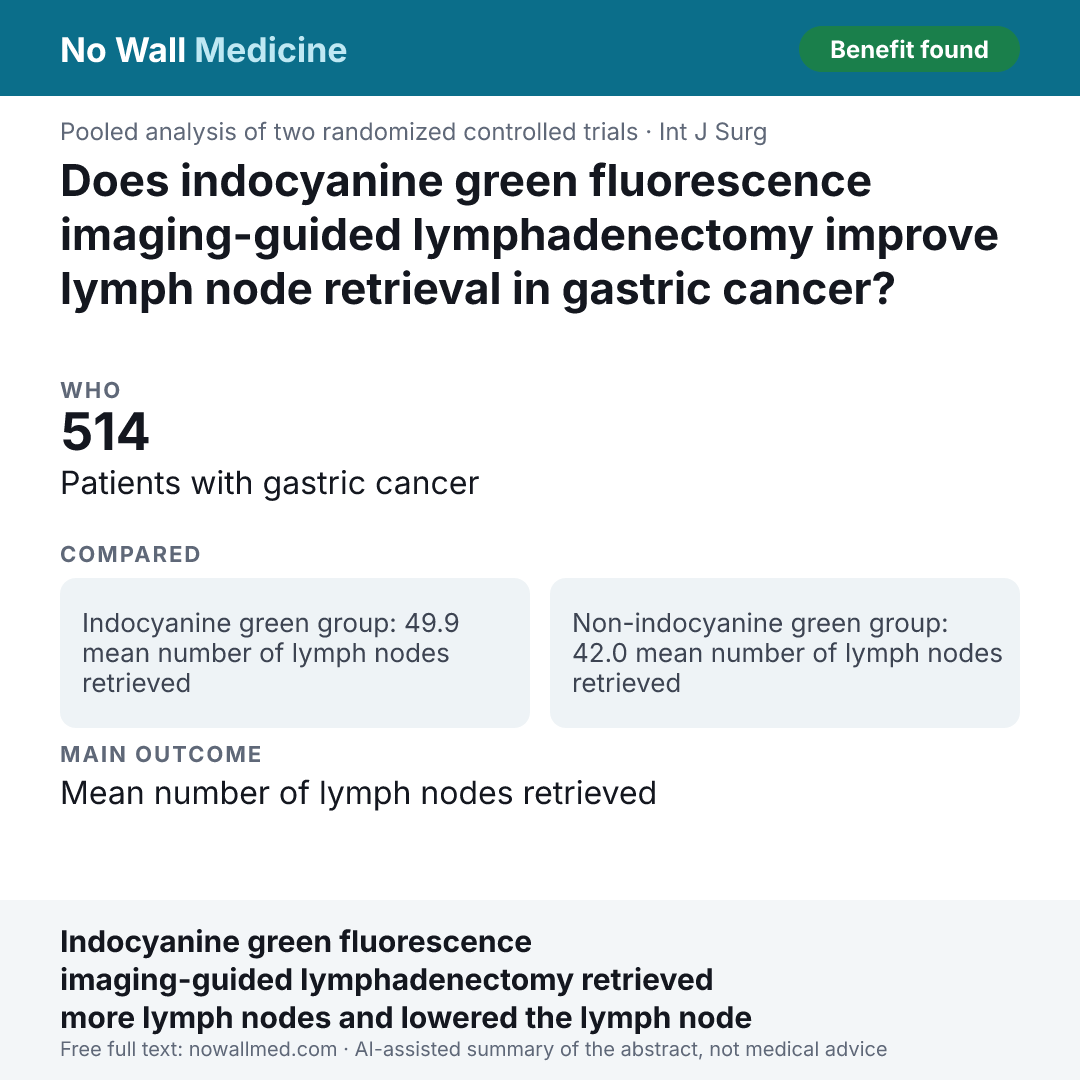
Does indocyanine green fluorescence imaging-guided lymphadenectomy improve lymph node retrieval in gastric cancer?
Who
514
Patients with gastric cancer
Compared
Indocyanine green group: 49.9 mean number of lymph nodes retrieved
Non-indocyanine green group: 42.0 mean number of lymph nodes retrieved
Main outcome
Mean number of lymph nodes retrieved
Bottom line: Indocyanine green fluorescence imaging-guided lymphadenectomy retrieved more lymph nodes and lowered the lymph node noncompliance rate.
Int J Surg · 2021-09-20 · Save PNG
Clinical question: Does indocyanine green fluorescence imaging-guided lymphadenectomy improve lymph node retrieval in gastric cancer?
Why it matters: The value of using indocyanine green fluorescence imaging to trace metastatic lymph nodes in gastric cancer has rarely been reported.
Key points
- Researchers analyzed 514 patients from two randomized controlled trials to compare fluorescence imaging-guided lymph node removal with conventional methods.
- The group using indocyanine green fluorescence imaging had a higher mean number of retrieved lymph nodes (49.9 vs. 42.0) and a lower noncompliance rate (31.9% vs. 57.4%).
- Fluorescence imaging showed an 86.8% sensitivity for detecting all metastatic lymph node stations and a 92.2% negative predictive value for nonfluorescent stations.
Headline and key points written with AI from the paper’s abstract, with every number checked against it. Read the paper before relying on them.
Was this summary helpful?
Subject terms
Headline, design, result, key points, caveat and citation as plain text.
Cite this article
Zhong Q, Chen QY, Huang XB, et al. Clinical implications of Indocyanine Green Fluorescence Imaging-Guided laparoscopic lymphadenectomy for patients with gastric cancer: A cohort study from two randomized, controlled trials using individual patient data. Int J Surg. 2021;94:106120. doi:10.1016/j.ijsu.2021.106120
Spotted a mistake? Suggest a correction