Body weight support levels varied widely across neurological diagnoses
Clinical indications and protocol considerations for selecting initial body weight support levels in gait rehabilitation: a systematic review
Systematic reviewUnclear result
What are the initial body weight support levels used in gait rehabilitation?
Who
Individuals with neurological disorders
Compared
Multiple sclerosis: median: 75%, IQR: 6%
Spinal cord injury: median: 40%, IQR: 35%
Stroke: median: 30%, IQR: 4.75%
Traumatic brain injury: median: 15%, IQR: 0%
Main outcome
Initial body weight support levels used during gait training
Bottom line: Initial body weight support levels vary considerably without a clear relationship to diagnosis, training goals, or rationale.
Limitation: Variation in study designs and populations prevents conclusions on the effectiveness of body weight support levels.
J Neuroeng Rehabil · 2024-06-07Download image
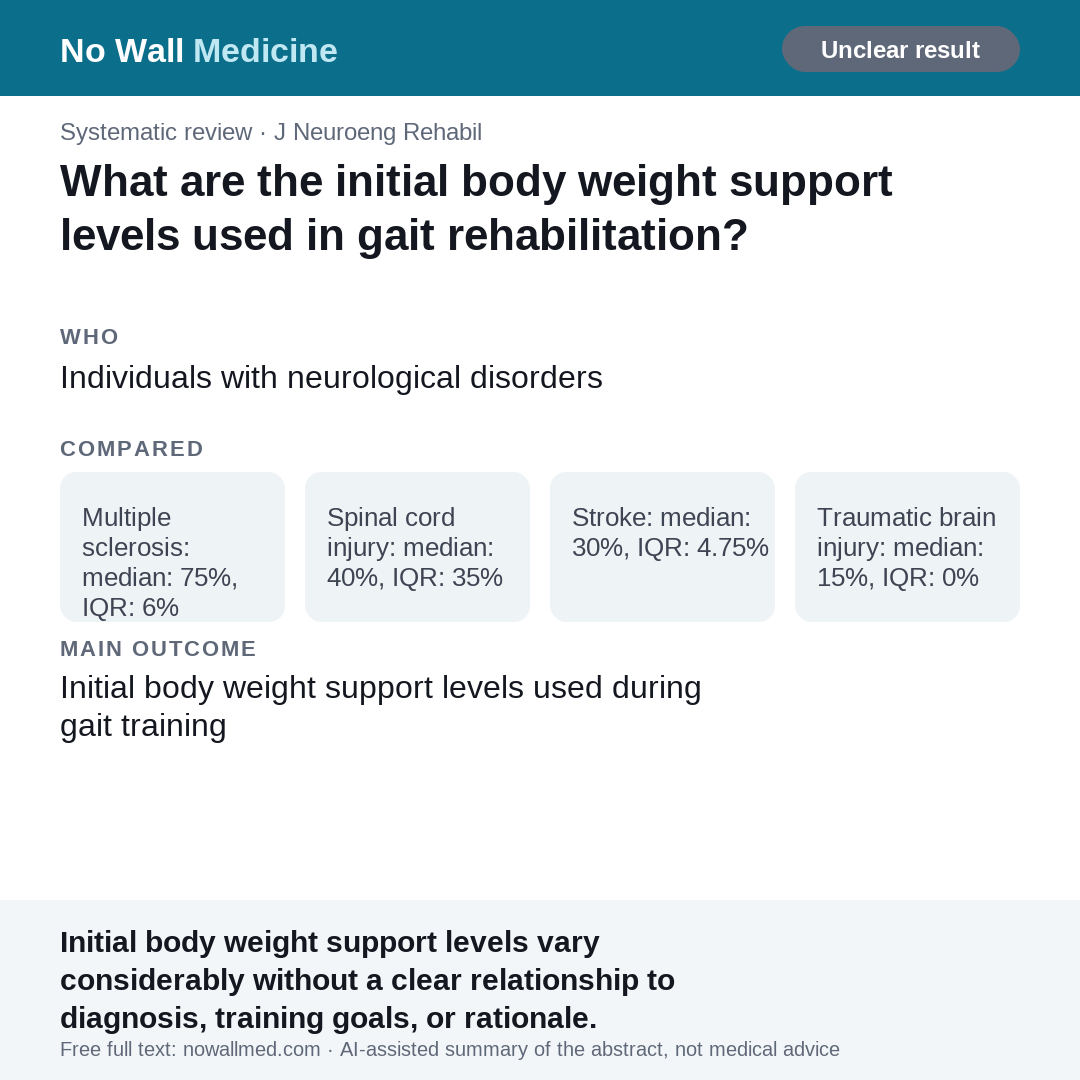
Clinical question: What are the initial body weight support levels used in gait rehabilitation?
Why it matters: Guidance on selecting appropriate body weight support levels is limited
Key points
- Thirty-three articles described body weight support training for 4 diagnoses.
- Median body weight support levels ranged from 15% to 75% across diagnoses.
- Training goals were achieved in all included studies, but with unclear rationale for support levels.
Limitation the authors note: Variation in study designs and populations limited ability to draw conclusions on effectiveness
Headline and key points written with AI from the paper’s abstract, with every number checked against it. Read the paper before relying on them.
Was this summary helpful?
Subject terms
Cite this article
Ettema S, Pennink GH, Buurke TJW, David S, van Bennekom CAM, Houdijk H. Clinical indications and protocol considerations for selecting initial body weight support levels in gait rehabilitation: a systematic review. J Neuroeng Rehabil. 2024. doi:10.1186/s12984-024-01389-8
Spotted a mistake? Suggest a correction
Top studies every Monday
The week’s key trials and guidelines in your specialties, plus any topics you follow. By email, free.
Get the weekly digest