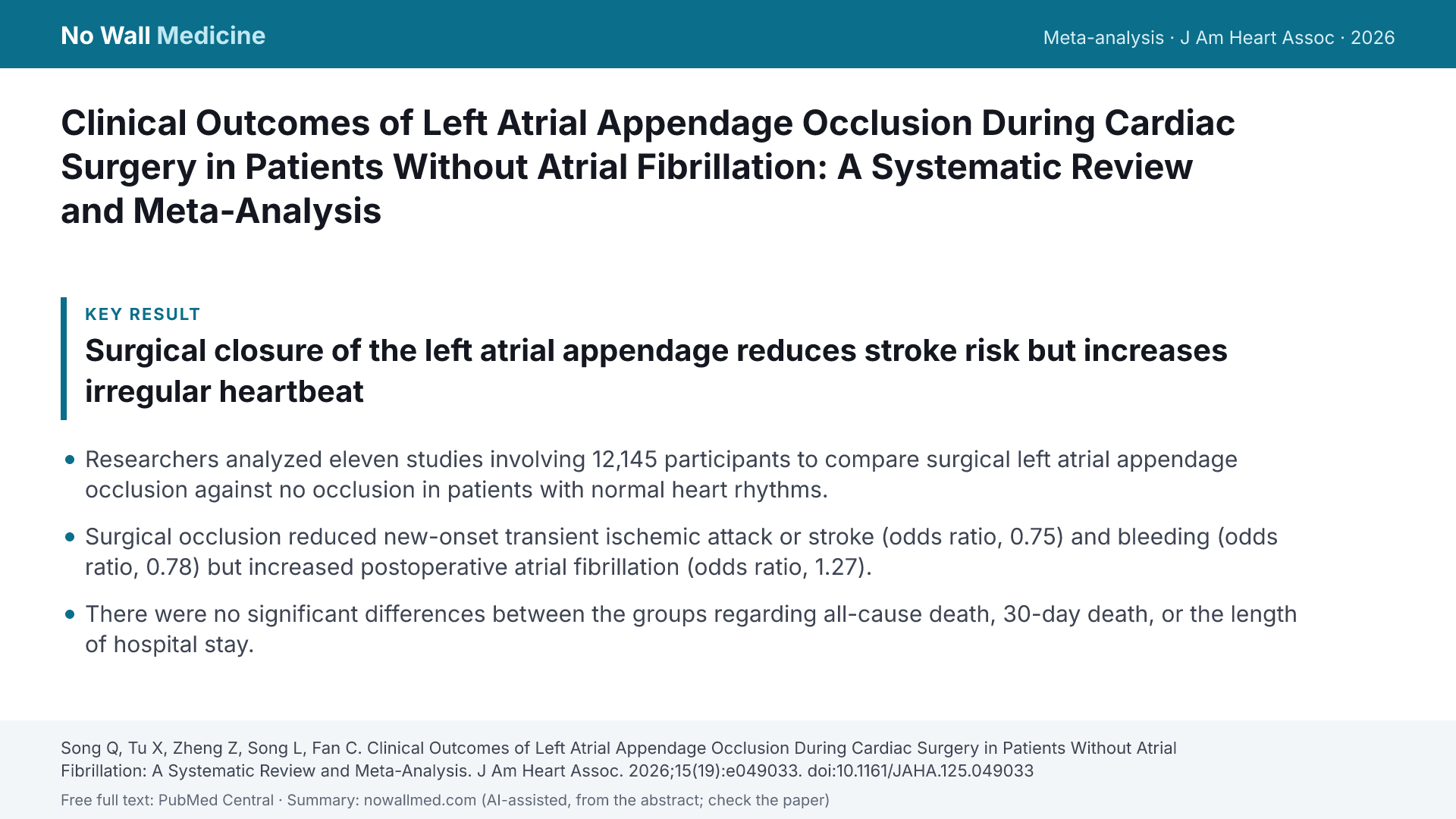
Surgical closure of the left atrial appendage reduces stroke risk but increases irregular heartbeat
Clinical Outcomes of Left Atrial Appendage Occlusion During Cardiac Surgery in Patients Without Atrial Fibrillation: A Systematic Review and Meta-Analysis
Why it matters: The benefit of excluding the left atrial appendage, a primary source of blood clots, remains uncertain in patients without preoperative atrial fibrillation.
Key points
- Researchers analyzed eleven studies involving 12,145 participants to compare surgical left atrial appendage occlusion against no occlusion in patients with normal heart rhythms.
- Surgical occlusion reduced new-onset transient ischemic attack or stroke (odds ratio, 0.75) and bleeding (odds ratio, 0.78) but increased postoperative atrial fibrillation (odds ratio, 1.27).
- There were no significant differences between the groups regarding all-cause death, 30-day death, or the length of hospital stay.
Limitation the authors note: The authors state that the findings should be interpreted cautiously due to low to moderate certainty of evidence.
Headline and key points written with AI from the paper’s abstract, with every number checked against it. Read the paper before relying on them.
Was this summary helpful?
Subject terms
Cite this article
Song Q, Tu X, Zheng Z, Song L, Fan C. Clinical Outcomes of Left Atrial Appendage Occlusion During Cardiac Surgery in Patients Without Atrial Fibrillation: A Systematic Review and Meta-Analysis. J Am Heart Assoc. 2026;15(19):e049033. doi:10.1161/JAHA.125.049033
Spotted a mistake? Suggest a correction