Systemic, local, and biologic therapies are associated with slower progression in autoimmune retinopathy
Clinical Outcomes of Therapeutic Interventions for Autoimmune Retinopathy: A Meta-analysis and Systematic Review
Meta-analysis of 12 studiesBenefit found
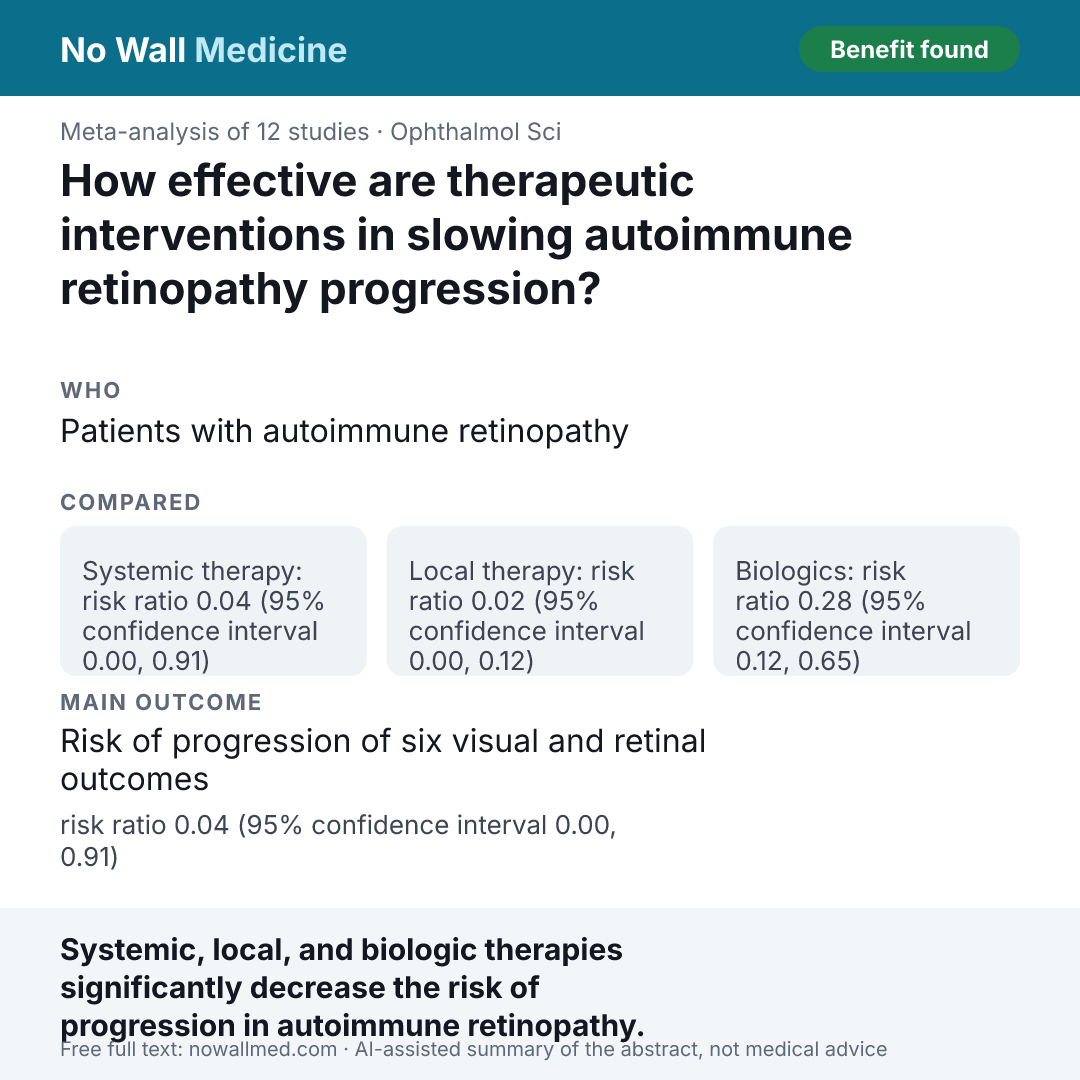
How effective are therapeutic interventions in slowing autoimmune retinopathy progression?
Who
Patients with autoimmune retinopathy
Compared
Systemic therapy: risk ratio 0.04 (95% confidence interval 0.00, 0.91)
Local therapy: risk ratio 0.02 (95% confidence interval 0.00, 0.12)
Biologics: risk ratio 0.28 (95% confidence interval 0.12, 0.65)
Main outcome
Risk of progression of six visual and retinal outcomes
Result: risk ratio 0.04 (95% confidence interval 0.00, 0.91)
Bottom line: Systemic, local, and biologic therapies significantly decrease the risk of progression in autoimmune retinopathy.
Limitation: Additional research is needed to assess long-term outcomes.
Ophthalmol Sci · 2024-09-12 · Save PNG
Clinical question: How effective are therapeutic interventions in slowing autoimmune retinopathy progression?
Why it matters: An evidence-based treatment consensus for autoimmune retinopathy remains poorly understood despite the use of systemic steroids and steroid-sparing agents.
Key points
- A meta-analysis of 12 studies and 40 case reports examined how different treatments affect vision and retinal structure in patients with autoimmune retinopathy.
- Systemic therapy was associated with a lower risk of loss in visual acuity (RR = 0.04), visual field (RR = 0.01), and cystoid macular edema (RR = 0.02).
- Local therapy was associated with lower risks for visual acuity (RR = 0.02), cystoid macular edema (RR = 0.06), central retinal thickness (RR = 0.02), and ellipsoid zone loss (RR = 0.31).
Headline and key points written with AI from the paper’s abstract, with every number checked against it. Read the paper before relying on them.
Was this summary helpful?
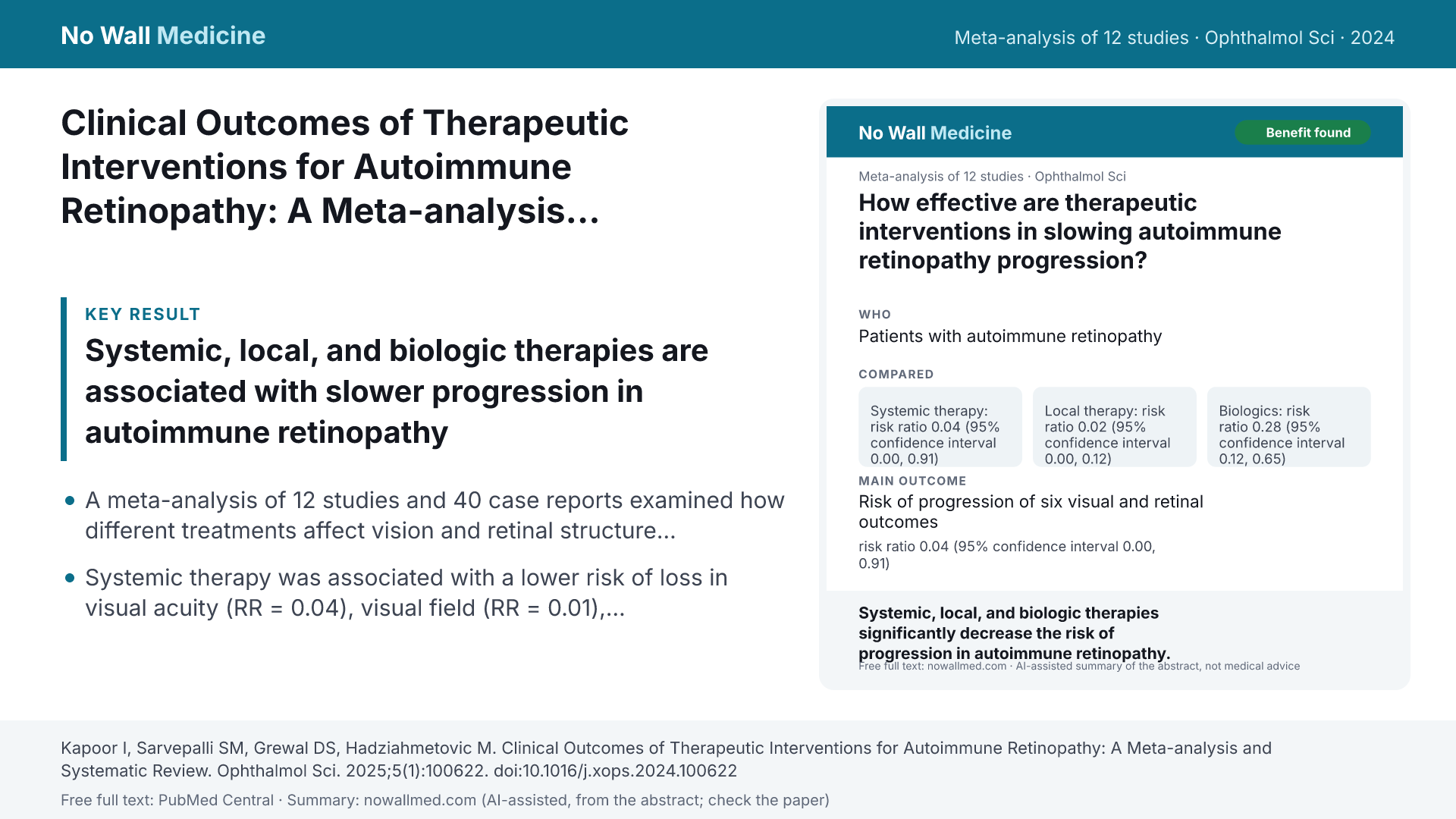
Headline, design, result, key points, caveat and citation as plain text.
Cite this article
Kapoor I, Sarvepalli SM, Grewal DS, Hadziahmetovic M. Clinical Outcomes of Therapeutic Interventions for Autoimmune Retinopathy: A Meta-analysis and Systematic Review. Ophthalmol Sci. 2025;5(1):100622. doi:10.1016/j.xops.2024.100622
Spotted a mistake? Suggest a correction